



HMGB1/HMG-1 Protein, Human (HEK293, C-His)
Based on 1 Customer Validation
The multifunctional and redox-sensitive HMGB1/HMG-1 protein plays multiple roles in cellular compartments. In the nucleus, it serves as a major chromatin-associated non-histone protein involved in key processes such as replication, transcription, chromatin remodeling, V(D)J recombination, DNA repair, and genome stability. HMGB1/HMG-1 Protein, Human (HEK293, His) is the recombinant human-derived HMGB1/HMG-1 protein, expressed by HEK293 , with C-6*His labeled tag.
- Species: Human
- Source: HEK293
-
Storage:Stored at -20°C for 2 years from date of receipt. After reconstitution, it is stable at 4°C for 1 week or -20°C for longer (with carrier protein). It is recommended to freeze aliquots at -20°C or -80°C for extended storage.


To place orders, for customer services and technical support, please contact: MedChemExpress USA
Tel: 609-228-6898 E-mail: [email protected] [email protected]


-
 Biological Activity
-
Technical Parameters
-
Product Properties
- Documentation
- Help & FAQs




Biological Activity
Description
The multifunctional and redox-sensitive HMGB1/HMG-1 protein plays multiple roles in cellular compartments. In the nucleus, it serves as a major chromatin-associated non-histone protein involved in key processes such as replication, transcription, chromatin remodeling, V(D)J recombination, DNA repair, and genome stability. HMGB1/HMG-1 Protein, Human (HEK293, His) is the recombinant human-derived HMGB1/HMG-1 protein, expressed by HEK293 , with C-6*His labeled tag.
Background
HMGB1/HMG-1, a multifunctional redox-sensitive protein, exhibits diverse roles across different cellular compartments. Within the nucleus, it stands as a major chromatin-associated non-histone protein, functioning as a DNA chaperone involved in crucial processes such as replication, transcription, chromatin remodeling, V(D)J recombination, DNA repair, and genome stability. Proposed as a universal biosensor for nucleic acids, HMGB1/HMG-1 plays a pivotal role in promoting the host inflammatory response to both sterile and infectious signals, coordinating innate and adaptive immune responses. In the cytoplasm, it serves as a sensor and/or chaperone for immunogenic nucleic acids, activating TLR9-mediated immune responses and mediating autophagy. Released to the extracellular environment, HMGB1/HMG-1 engages with various molecules such as DNA, nucleosomes, IL-1 beta, CXCL12, AGER isoform 2/sRAGE, lipopolysaccharide (LPS), and lipoteichoic acid (LTA), activating cells through multiple surface receptors. The extracellular HMGB1 exists in different redox states, with fully reduced HMGB1 acting as a chemokine, disulfide HMGB1 as a cytokine, and sulfonyl HMGB1 promoting immunological tolerance. Beyond its immunomodulatory roles, HMGB1/HMG-1 is implicated in proangiogenic activity, platelet activation, neuronal outgrowth signaling via RAGE, and potential involvement in the accumulation of expanded polyglutamine proteins. Its nuclear functions, attributed to fully reduced HMGB1, include association with chromatin, DNA bending, and enhancement of DNA flexibility through looping, facilitating various gene promoter activities. Additionally, HMGB1/HMG-1 may play roles in nucleotide excision repair, mismatch repair, base excision repair, double-strand break repair, V(D)J recombination, displacement of histone H1, restructuring nucleosomes, enhancing transcription factor binding, and modulating the telomerase complex. The intricate functions of HMGB1/HMG-1 highlight its significance in diverse cellular processes.
Verified Bioactivity
Measured by its binding ability in a functional ELISA.Immobilized Recombinant Human HMGB1/HMG-1 at 2 μg/mL (100 μL/well) can bind Biotinylated Recombinant Human AGER/RAGE Protein. The ED50 for this effect is 77.15 ng/mL.
MCE Validation Data
-
Purity - SDS-PAGE
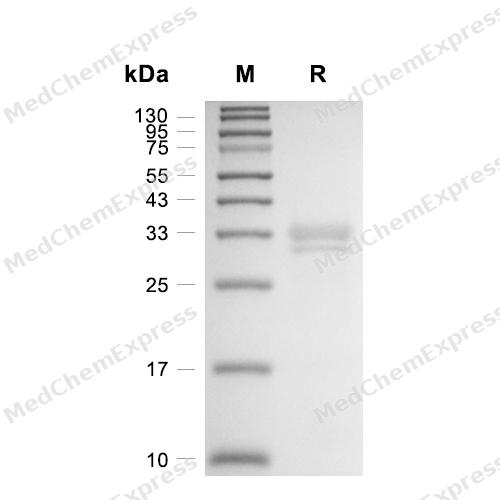
Purity - SDS-PAGE
-
Bioactivity - ELISA
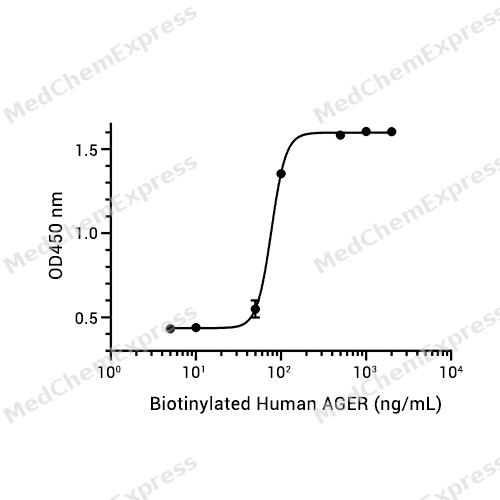
Bioactivity - ELISA


Technical Parameters
-
Species Human
-
Source HEK293
-
Tag C-6*His
-
Accession
P09429 (G2-E215)
-
Gene ID3146
-
Molecular Construction
-
N-term
-
HMGB1 (G2-E215)
Accession # P09429 -
6*His
-
C-term
-
-
Protein Length
Full Length
-
Synonyms
HMGB1; Sulfoglucuronyl Carbohydrate Binding Protein; Prev. HMG1; Amphoterin; High Mobility Group Protein B1; HMG-1; High Mobility Group Protein 1; Nuclear Dot-Associated Sp100 Protein; SBP-1; Nuclear Autoantigen Sp-100; HMG3; High-Mobility Group Box 1; Hi
-
AA Sequence
GKGDPKKPRGKMSSYAFFVQTCREEHKKKHPDASVNFSEFSKKCSERWKTMSAKEKGKFEDMAKADKARYEREMKTYIPPKGETKKKFKDPNAPKRPPSAFFLFCSEYRPKIKGEHPGLSIGDVAKKLGEMWNNTAADDKQPYEKKAAKLKEKYEKDIAAYRAKGKPDAAKKGVVKAEKSKKKKEEEEDEEDEEDEEEEEDEEDEDEEEDDDDE
-
Predicted Molecular Mass
24.8 kDa
-
Molecular Weight
Approximately 29-33 kDa, based on SDS-PAGE under reducing conditions, due to the glycosylation.
-
Purity
≥ 95%, as determined by reducing SDS-PAGE.


Product Properties
Lyophilized powder.
Lyophilized from a 0.22 μm filtered solution of PBS, pH 7.4, 8% trehalose.
<1 EU/μg, determined by LAL method.
It is not recommended to reconstitute to a concentration less than 100 μg/mL in ddH2O.
Stored at -20°C for 2 years from date of receipt. After reconstitution, it is stable at 4°C for 1 week or -20°C for longer (with carrier protein). It is recommended to freeze aliquots at -20°C or -80°C for extended storage.
Room temperature in continental US; may vary elsewhere.


Documentation
-
Data Sheet (238 KB)
-
SDS (252 KB)
- English - EN (252 KB)
- Français - FR (252 KB)
- Deutsch - DE (252 KB)
- Norwegian - NO (252 KB)
- Español - ES (252 KB)
- Swedish - SV (252 KB)
- Italian - IT (252 KB)
- Korean - KR (252 KB)
- Portuguese - PT (252 KB)
-
Handling Instructions (2659 KB)

Calculators
Concentration (start) × Volume (start) = Concentration (final) × Volume (final)


 Powered by Bioz

