



IGSF11 Protein, Mouse (HEK293, His)

Based on 1 Customer Validation
IGSF11 (Immunoglobulin superfamily member 11) operates as a cell adhesion molecule by engaging in homophilic interactions, thereby facilitating cell-to-cell adhesion. Additionally, IGSF11 is implicated in the stimulation of cell growth, suggesting a role in cellular proliferation and potentially contributing to regulatory pathways involved in cellular development and maintenance. IGSF11 Protein, Mouse (HEK293, His) is the recombinant mouse-derived IGSF11 protein, expressed by HEK293 , with C-His labeled tag.
- Species: Mouse
- Source: HEK293
-
Storage:Stored at -20°C for 2 years from date of receipt. After reconstitution, it is stable at 4°C for 1 week or -20°C for longer (with carrier protein). It is recommended to freeze aliquots at -20°C or -80°C for extended storage.


To place orders, for customer services and technical support, please contact: MedChemExpress USA
Tel: 609-228-6898 E-mail: [email protected] [email protected]


-
 Biological Activity
-
Technical Parameters
-
Product Properties
- Documentation
- Help & FAQs




Biological Activity
Description
IGSF11 (Immunoglobulin superfamily member 11) operates as a cell adhesion molecule by engaging in homophilic interactions, thereby facilitating cell-to-cell adhesion. Additionally, IGSF11 is implicated in the stimulation of cell growth, suggesting a role in cellular proliferation and potentially contributing to regulatory pathways involved in cellular development and maintenance. IGSF11 Protein, Mouse (HEK293, His) is the recombinant mouse-derived IGSF11 protein, expressed by HEK293 , with C-His labeled tag.
Background
IGSF11 (Immunoglobulin Superfamily Member 11), also known as SynCAM3 (Synaptic Cell Adhesion Molecule 3), is a cell adhesion molecule that plays a key role in mediating cell-cell interactions through homophilic binding, where it interacts with identical molecules on adjacent cells. This homophilic interaction suggests its involvement in processes related to cell adhesion, which are critical for various physiological functions such as tissue development and maintenance. Additionally, there is evidence to suggest that IGSF11 stimulates cell growth, as indicated by similarity to other proteins with known growth-promoting functions. The dual role of IGSF11 in cell adhesion and growth regulation underscores its significance in cellular processes and highlights its potential impact on tissue development and homeostasis. Ongoing research may further uncover additional details about the precise mechanisms and functions of IGSF11.
Verified Bioactivity
VISTA immobilized on CM5 Chip can bind IGSF11 with an affinity constant of 160.8 μM as determined in SPR assay.
MCE Validation Data
-
Purity - SDS-PAGE
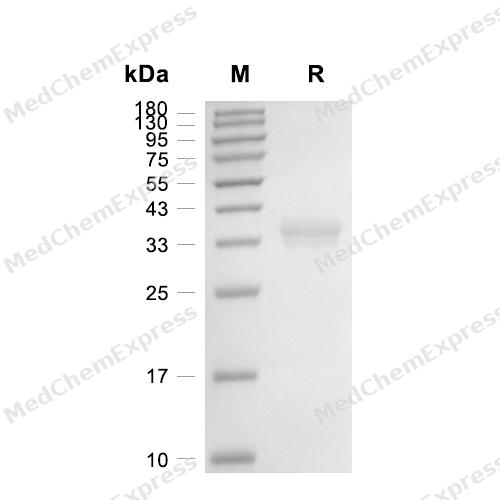
Purity - SDS-PAGE
-
Bioactivity - SPR
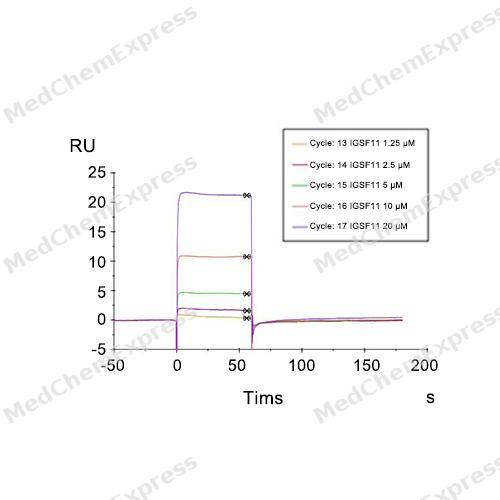
Bioactivity - SPR


Technical Parameters
-
Species Mouse
-
Source HEK293
-
Tag C-His
-
Accession
P0C673 (L23-V240)
-
Molecular Construction
-
N-term
-
IGSF11 (L23-V240)
Accession # P0C673 -
His
-
C-term
-
-
Protein Length
Extracellular Domain
-
Synonyms
IGSF11; CXADRL1; Immunoglobulin Superfamily Member 11; BTIGSF; VSIG3; Brain And Testis-Specific Immunoglobin Superfamily Protein; BT-IgSF; V-Set And Immunoglobulin Domain Containing 3; Igsf13; Immunoglobulin Superfamily, Member 11; CT119; Alternative Prot
-
AA Sequence
LEVSESPGSVQVARGQTAVLPCAFSTSAALLNLNVIWMVIPLSNANQPEQVILYQGGQMFDGALRFHGRVGFTGTMPATNVSIFINNTQLSDTGTYQCLVNNLPDRGGRNIGVTGLTVLVPPSAPQCQIQGSQDLGSDVILLCSSEEGIPRPTYLWEKLDNTLKLPPTATQDQVQGTVTIRNISALSSGLYQCVASNAIGTSTCLLDLQVISPQPRSV
-
Molecular Weight
Approximately 38-42 kDa, based on SDS-PAGE under reducing conditions, due to the glycosylation.
-
Glycosylation
Yes
-
Purity
≥ 95%, as determined by reducing SDS-PAGE.


Product Properties
Lyophilized powder
Lyophilized from a 0.22 μm filtered solution of PBS, pH 7.4. Normally 8% trehalose is added as protectant before lyophilization.
<1 EU/μg, determined by LAL method.
It is not recommended to reconstitute to a concentration less than 100 μg/mL in ddH2O.
Stored at -20°C for 2 years from date of receipt. After reconstitution, it is stable at 4°C for 1 week or -20°C for longer (with carrier protein). It is recommended to freeze aliquots at -20°C or -80°C for extended storage.
Room temperature in continental US; may vary elsewhere.


Documentation
-
Data Sheet (236 KB)
-
SDS (252 KB)
- English - EN (252 KB)
- Français - FR (252 KB)
- Deutsch - DE (252 KB)
- Norwegian - NO (252 KB)
- Español - ES (252 KB)
- Swedish - SV (252 KB)
- Italian - IT (252 KB)
- Korean - KR (252 KB)
- Portuguese - PT (252 KB)
-
Handling Instructions (2659 KB)

Calculators
Concentration (start) × Volume (start) = Concentration (final) × Volume (final)


 Powered by Bioz

