



IL-1 beta Protein, Cavia porcellus (His)

Based on 1 Customer Validation
IL-1 beta is a potent proinflammatory cytokine expressed by monocytes, macrophages, and dendritic cells. IL-1 beta plays a key role in inflammation and immunologic reactions. IL-1 beta Protein, Cavia porcellus (His) is produced in E. coli with six C-Terminal His-tags. It consists of 152 amino acids (T115-S266).
- Species: Others
- Source: E. coli
-
Storage:Stored at -20°C for 2 years from date of receipt. After reconstitution, it is stable at 4°C for 1 week or -20°C for longer (with carrier protein). It is recommended to freeze aliquots at -20°C or -80°C for extended storage.


To place orders, for customer services and technical support, please contact: MedChemExpress USA
Tel: 609-228-6898 E-mail: [email protected] [email protected]


-
 Biological Activity
-
Technical Parameters
-
Product Properties
- Documentation
- References
- Help & FAQs




Biological Activity
Description
IL-1 beta is a potent proinflammatory cytokine expressed by monocytes, macrophages, and dendritic cells. IL-1 beta plays a key role in inflammation and immunologic reactions[1][2]. IL-1 beta Protein, Cavia porcellus (His) is produced in E. coli with six C-Terminal His-tags. It consists of 152 amino acids (T115-S266).
Background
Interleukin-1β (IL-1β) is one of the pro-inflammatory cytokines and is produced and secreted by a variety of cell types although the vast majority of studies have focussed on its production within cells of the innate immune system, such as monocytes and macrophages[1][2].
IL-1β is produced as inactive pro-IL-1β (encoded by pro-Il-1b) in response to inflammatory stimuli, including both microbial products and endogenous danger-associated molecules. IL-1β gene expression and synthesis of pro-IL-1β occurs after activation of pattern recognition receptors (PRRs). Inflammatory stimuli also drive activation of cytosolic CARD and PYHIN domain-containing PRRs that recruit ASC and caspase-1 (Casp-1) to assemble into the multiprotein complex inflammasome. Pro-Casp-1 (encoded by pro-Casp-1), activated by the inflammasome, cleaves pro-IL-1β into the bioactive IL-1β. IL-1β acts in an autocrine/paracrine manner via the type I IL-1 receptor (IL-1R1)[1][2][3].
IL-1β could regulate the inflammatory response, and is involved in a variety of cellular activities, including cell proliferation, differentiation, and apoptosis. IL-1β also plays a significant regulator of reproduction in females[1][2][3].
In Vitro
IL-1β (1-15625 pg/mL; 12 hours) dose-dependently increases production of the NF-κB-dependent inflammatory cytokine TNF-α, and a significant effect of IL-1β is observed at concentrations as low as 5 pg/mL in immortalized murine RAW264.7 macrophages[1].
IL-1β (1, 10 and 100 ng/mL; 24 hours) results in a dose-dependent increase of cell proliferation in pig heart cells. IL-1β increases the gene expression of caspase-3, and increases the enzymatic activities of MMP-2 and MMP-9[2].
In Vivo
IL-1β (8 ng; i.p.; daily; for 3 days) rescues Casp1−/− mice, restores survival and reduces lung bacterial load (i.e. days 0, 1, and 2 post-infection) in Chlamydia pneumoniae infected Casp1−/− mice. Yet, mice treated later (days 2, 3 and 4 post-infection) shows significantly increased bacterial counts relative to early-treated mice[3].
MCE Validation Data
-
Purity - SDS-PAGE
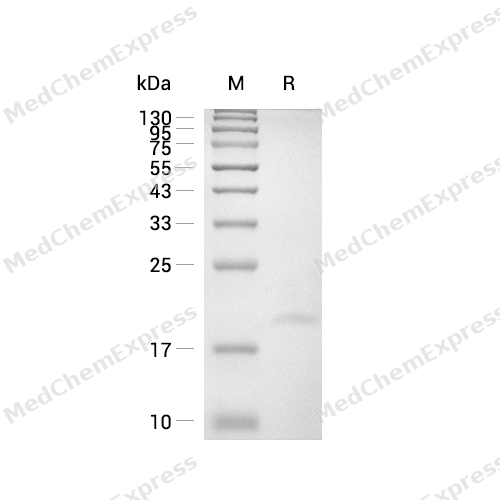
Purity - SDS-PAGE


Technical Parameters
-
Species Others
-
Source E. coli
-
Tag C-6*His
-
Accession
Q9WVG1 (T115-S266)
-
Gene ID100135556 [NCBI]
-
Molecular Construction
-
N-term
-
IL-1β (T115-S266)
Accession # Q9WVG1 -
6*His
-
C-term
-
-
Protein Length
Full Length of Mature Protein
-
Synonyms
IL1B; IL-1B; Interleukin 1 Beta; Multifunctional Fusion Protein; IL1F2; Pro-Interleukin-1-Beta; Interleukin-1 Beta; Preinterleukin 1 Beta; IL1-BETA; Interleukin 1beta; IL-1 Beta; IL1beta; Catabolin; IL-1
-
AA Sequence
TPVPSRNCTLHDIQHKRLVLSDPCELKALHLNGDNLNRQVVFSMSFVQGERSDNKMPVALGLKGKNLYLSCVMKDGKPVLQLESVDGKQYPKKKMEKRFVFNKITSKSTVEFESAQFPNWYISTSQAEHKPVFLGNNNGQDIIDFKLELVSS
-
Predicted Molecular Mass
18.2 kDa
-
Molecular Weight
Approximately 16-19 kDa, based on SDS-PAGE under reducing conditions.
-
Purity
≥ 95%, as determined by reducing SDS-PAGE.


Product Properties
Lyophilized powder.
Lyophilized from a 0.22 μm filtered solution of 20 mM PB, 150 mM NaCl, pH 7.4.
<1 EU/μg, determined by LAL method.
It is not recommended to reconstitute to a concentration less than 100 μg/mL in ddH2O. For long term storage it is recommended to add a carrier protein (0.1% BSA, 5% HSA, 10% FBS or 5% Trehalose).
Stored at -20°C for 2 years from date of receipt. After reconstitution, it is stable at 4°C for 1 week or -20°C for longer (with carrier protein). It is recommended to freeze aliquots at -20°C or -80°C for extended storage.
Room temperature in continental US; may vary elsewhere.


Documentation
-
Data Sheet (263 KB)
-
SDS (252 KB)
- English - EN (252 KB)
- Français - FR (252 KB)
- Deutsch - DE (252 KB)
- Norwegian - NO (252 KB)
- Español - ES (252 KB)
- Swedish - SV (252 KB)
- Italian - IT (252 KB)
- Korean - KR (252 KB)
- Portuguese - PT (252 KB)
-
Handling Instructions (2659 KB)


References
[1]. Jan Petrasek, et al. IL-1 receptor antagonist ameliorates inflammasome-dependent alcoholic steatohepatitis in mice. J Clin Invest. 2012 Oct;122(10):3476-89. [Content Brief]
[2]. Karina Zitta, et al. Interleukin-1beta regulates cell proliferation and activity of extracellular matrix remodelling enzymes in cultured primary pig heart cells. Biochem Biophys Res Commun. 2010 Sep 3;399(4):542-7. [Content Brief]
[3]. Kenichi Shimada, et al. Caspase-1 dependent IL-1β secretion is critical for host defense in a mouse model of Chlamydia pneumoniae lung infection. PLoS One. 2011;6(6):e21477. [Content Brief]

Calculators
Concentration (start) × Volume (start) = Concentration (final) × Volume (final)


 Powered by Bioz

