



IL-6 Protein, Cynomolgus (HEK293, His)
Based on 1 Customer Validation
IL-6 is a cytokine with multiple functions in immunity, tissue regeneration, and metabolism, coordinating complex signaling. Binding to IL6R initiates the IL6 signaling pathway through a complex with the signaling subunit IL6ST/gp130. IL-6 Protein, Cynomolgus (HEK293, His) is the recombinant cynomolgus-derived IL-6 protein, expressed by HEK293 , with C-His labeled tag.
- Species: Cynomolgus
- Source: HEK293
-
Storage:Stored at -20°C for 2 years from date of receipt. After reconstitution, it is stable at 4°C for 1 week or -20°C for longer (with carrier protein). It is recommended to freeze aliquots at -20°C or -80°C for extended storage.


To place orders, for customer services and technical support, please contact: MedChemExpress USA
Tel: 609-228-6898 E-mail: [email protected] [email protected]


-
 Biological Activity
-
Technical Parameters
-
Product Properties
- Documentation
- Help & FAQs




Biological Activity
Description
IL-6 is a cytokine with multiple functions in immunity, tissue regeneration, and metabolism, coordinating complex signaling. Binding to IL6R initiates the IL6 signaling pathway through a complex with the signaling subunit IL6ST/gp130. IL-6 Protein, Cynomolgus (HEK293, His) is the recombinant cynomolgus-derived IL-6 protein, expressed by HEK293 , with C-His labeled tag.
Background
IL-6, a cytokine boasting a diverse array of biological functions spanning immunity, tissue regeneration, and metabolism, engages in a sophisticated signaling orchestration. Upon binding to IL6R, the resulting complex orchestrates the intracellular IL6-signaling pathway through its association with the signaling subunit IL6ST/gp130. Interactions with membrane-bound IL6R and IL6ST prompt 'classic signaling,' whereas binding of IL6 to soluble IL6R and IL6ST elicits 'trans-signaling.' Furthermore, 'cluster signaling' unfolds as membrane-bound IL6:IL6R complexes on transmitter cells activate IL6ST receptors on adjacent receiver cells. IL-6 serves as a potent inducer of the acute phase response, rapidly contributing to host defense during infection and tissue injury, yet its overproduction is implicated in disease pathology. In the innate immune response, IL-6 synthesis by myeloid cells, including macrophages and dendritic cells, is triggered upon pathogen recognition through toll-like receptors (TLRs) at the infection or injury site. Crucially, in the adaptive immune response, IL-6 is indispensable for the differentiation of B cells into immunoglobulin-secreting cells, a pivotal player in the differentiation of CD4(+) T cell subsets, and a key factor in the development of T follicular helper (Tfh) cells crucial for germinal-center induction. Additionally, IL-6 is required to drive naive CD4(+) T cells toward the Th17 lineage and plays a crucial role in the proliferation of myeloma cells and the survival of plasmablast cells.
Verified Bioactivity
1.Immobilized Cynomolgus IL-6, His Tag at 2μg/ml (100μl/well) on the plate. Dose response curve for Human IL-6 R alpha, hFc Tag with the EC50 of less than 14.0ng/ml determined by ELISA.
2. Measured in a cell proliferation assay using TF-1 cells. The ED50 for this effect is 0.5279 ng/mL,corresponding to a specific activity is 1.894×10⁶ units/mg.
MCE Validation Data
-
Purity - SDS-PAGE
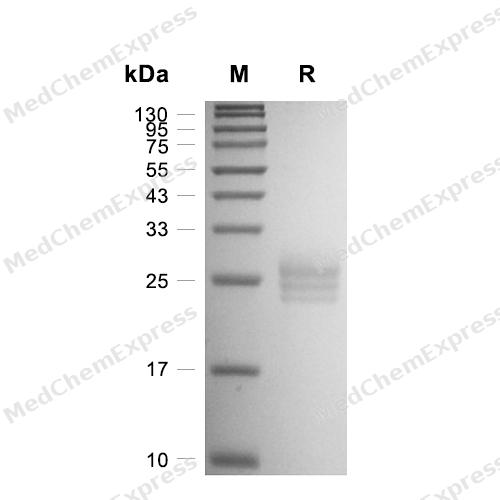
Purity - SDS-PAGE
-
Bioactivity - Cell-Based Assay
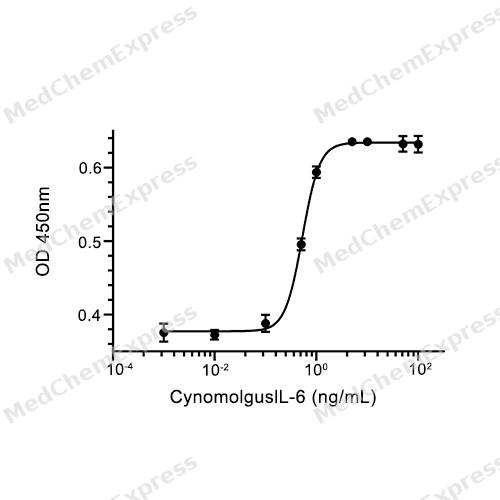
Bioactivity - Cell-Based Assay


Technical Parameters
-
Species Cynomolgus
-
Source HEK293
-
Tag C-6*His
-
Accession
P79341 (A28-M212)
-
Molecular Construction
-
N-term
-
IL-6 (A28-M212)
Accession # P79341 -
6*His
-
C-term
-
-
Protein Length
Full Length of Mature Protein
-
Synonyms
IL6; Hybridoma Growth Factor; Prev. IFNB2; IFN-Beta-2; IL-6; BSF-2; Interleukin-6; CDF; BSF2; Interleukin 6 (Interferon, Beta 2); HGF; B-Cell Differentiation Factor; HSF; Truncated Interleukin 6; B-Cell Stimulatory Factor 2; Interferon, Beta 2; CTL Differ
-
AA Sequence
APVLPGEDSKDVAAPHSQPLTSSERIDKHIRYILDGISALRKETCNRSNMCESSKEALAENNLNLPKMAEKDGCFQSGFNEDTCLVKIITGLLEFEVYLEYLQNRFESSEEQARAVQMSTKVLIQFLQKKAKNLDAITTPEPTTNASLLTKLQAQNQWLQDMTTHLILRSFKEFLQSSLRALRQM
-
Predicted Molecular Mass
22.1 kDa
-
Molecular Weight
Approximately 25-30 kDa, based on SDS-PAGE under reducing conditions, due to the glycosylation.
-
Glycosylation
Yes
-
Purity
≥ 95%, as determined by reducing SDS-PAGE.


Product Properties
Lyophilized powder
Lyophilized from a 0.22 μm filtered solution of PBS, pH 7.4. Normally 8% trehalose is added as protectant before lyophilization.
<1 EU/μg, determined by LAL method.
It is not recommended to reconstitute to a concentration less than 100 μg/mL in ddH2O.
Stored at -20°C for 2 years from date of receipt. After reconstitution, it is stable at 4°C for 1 week or -20°C for longer (with carrier protein). It is recommended to freeze aliquots at -20°C or -80°C for extended storage.
Room temperature in continental US; may vary elsewhere.


Documentation
-
Data Sheet (237 KB)
-
SDS (252 KB)
- English - EN (252 KB)
- Français - FR (252 KB)
- Deutsch - DE (252 KB)
- Norwegian - NO (252 KB)
- Español - ES (252 KB)
- Swedish - SV (252 KB)
- Italian - IT (252 KB)
- Korean - KR (252 KB)
- Portuguese - PT (252 KB)
-
Handling Instructions (2659 KB)

Calculators
Concentration (start) × Volume (start) = Concentration (final) × Volume (final)


 Powered by Bioz

