



IL-6 Protein, Equine

Based on 1 Customer Validation
IL-6 protein is a crucial cytokine in immunity, tissue regeneration and metabolism. It binds to IL6R and forms a complex that binds to IL6ST/gp130, triggering intracellular IL6 signaling. Membrane-bound IL6:IL6R complexes induce "cluster signaling" that activates IL6ST receptors on neighboring cells. IL-6 Protein, Equine is the recombinant equine-derived IL-6 protein, expressed by E. coli , with tag free.
- Species: Equine
- Source: E. coli
-
보관:Stored at -20°C for 2 years from date of receipt. After reconstitution, it is stable at 4°C for 1 week or -20°C for longer (with carrier protein). It is recommended to freeze aliquots at -20°C or -80°C for extended storage.


To place orders, for customer services and technical support, please contact: MedChemExpress USA
Tel: 609-228-6898 E-mail: [email protected] [email protected]


-
 Biological Activity
-
Technical Parameters
-
Product Properties
- 각종 서류
- Help & FAQs




Biological Activity
제품 설명
IL-6 protein is a crucial cytokine in immunity, tissue regeneration and metabolism. It binds to IL6R and forms a complex that binds to IL6ST/gp130, triggering intracellular IL6 signaling. Membrane-bound IL6:IL6R complexes induce "cluster signaling" that activates IL6ST receptors on neighboring cells. IL-6 Protein, Equine is the recombinant equine-derived IL-6 protein, expressed by E. coli , with tag free.
Background
IL-6, a multifunctional cytokine, exerts diverse biological effects in immunity, tissue regeneration, and metabolism. Upon binding to its receptor, IL6R, the complex associates with the signaling subunit IL6ST/gp130, initiating the intracellular IL6-signaling pathway. This interaction can elicit 'classic signaling' when IL6 binds to membrane-bound IL6R, or 'trans-signaling' when IL6 and soluble IL6R engage IL6ST. Additionally, 'cluster signaling' occurs when IL6:IL6R complexes on transmitter cells activate IL6ST receptors on neighboring receiver cells. IL-6 is a crucial inducer of the acute phase response, rapidly produced during infection and tissue injury for host defense. However, excessive IL-6 synthesis is implicated in various disease pathologies. In the innate immune response, myeloid cells, including macrophages and dendritic cells, synthesize IL-6 upon recognizing pathogens through toll-like receptors (TLRs) at infection sites or tissue injuries. In the adaptive immune response, IL-6 is essential for B cell differentiation into immunoglobulin-secreting cells, T follicular helper (Tfh) cell development, and driving naive CD4(+) T cells toward the Th17 lineage. Furthermore, IL-6 plays a significant role in myeloma cell proliferation and the survival of plasmablast cells.
Verified Bioactivity
Measured in a cell proliferation assay using TF-1 cells. The ED50 for this effect is 0.6786 ng/mL, corresponding to a specific activity is 1.474×10⁶ units/mg.
MCE Validation Data
-
Purity - SDS-PAGE
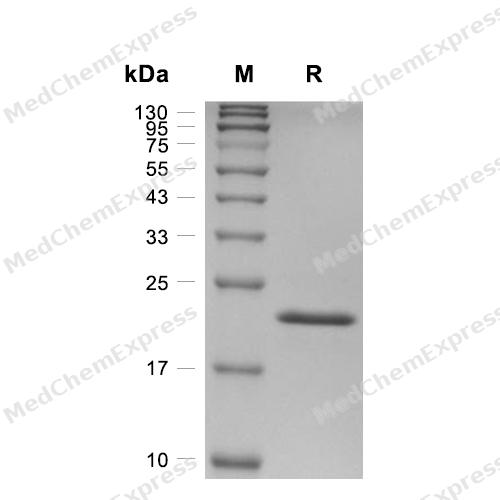
Purity - SDS-PAGE
-
Bioactivity - Cell-Based Assay
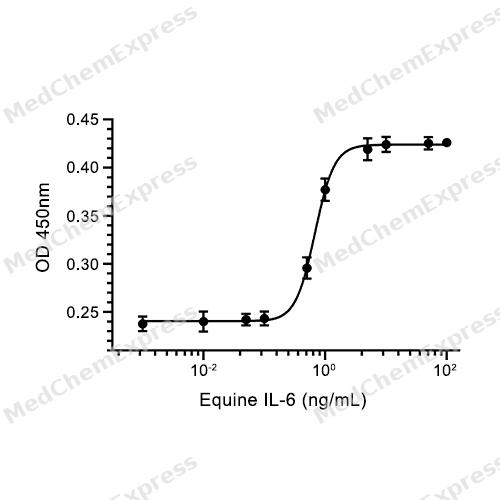
Bioactivity - Cell-Based Assay


Technical Parameters
-
Species Equine
-
Source E. coli
-
Tag Tag Free
-
Accession
Q95181 (F26-M208)
-
Gene ID100034196 [NCBI]
-
Molecular Construction
-
N-term
-
IL-6 (F26-M208)
Accession # Q95181 -
C-term
-
-
Protein Length
Full Length of Interleukin-6 Chain
-
Synonyms
IL6; Hybridoma Growth Factor; Prev. IFNB2; IFN-Beta-2; IL-6; BSF-2; Interleukin-6; CDF; BSF2; Interleukin 6 (Interferon, Beta 2); HGF; B-Cell Differentiation Factor; HSF; Truncated Interleukin 6; B-Cell Stimulatory Factor 2; Interferon, Beta 2; CTL Differ
-
AA Sequence
FPTPLPLGEDETTSNGPLLTTADKTKQHIKYILGKISALKNEMCNNFSKCENSKEVLAENNLNLPKMAEKDGCFQSGFNQETCLMKITTGLSEFQIYLEYLQNEFKGEKENIKTMQISTKVLVQILMQKMKNPEVTTPDPTAKSSLLAKLHSQNEWLKNTTTHLILRSLEDFLQFSLRAVRIM
-
Predicted Molecular Mass
20.8 kDa
-
분자량
Approximately 21 kDa, based on SDS-PAGE under reducing conditions.
-
Purity
≥ 95%, as determined by reducing SDS-PAGE.


Product Properties
Lyophilized powder.
Lyophilized from a 0.22 μm filtered solution of PBS, pH 6.5, 8% trehalose.
<1 EU/μg, determined by LAL method.
It is not recommended to reconstitute to a concentration less than 100 μg/mL in ddH2O.
Stored at -20°C for 2 years from date of receipt. After reconstitution, it is stable at 4°C for 1 week or -20°C for longer (with carrier protein). It is recommended to freeze aliquots at -20°C or -80°C for extended storage.
Room temperature in continental US; may vary elsewhere.


각종 서류
-
Data Sheet (236 KB)
-
SDS (251 KB)
- English - EN (251 KB)
- Français - FR (251 KB)
- Deutsch - DE (251 KB)
- Norwegian - NO (251 KB)
- Español - ES (251 KB)
- Swedish - SV (251 KB)
- Italian - IT (251 KB)
- Korean - KR (251 KB)
- Portuguese - PT (251 KB)
-
Handling Instructions (2659 KB)

Calculators
Concentration (start) × Volume (start) = Concentration (final) × Volume (final)


 Powered by Bioz

