



Intelectin-1/ITLN1 Protein, Human (N-His, C-Myc)
Based on 1 publication(s) in Google Scholar
Intelectin-1/ITLN1 is a lectin with specific affinity for microbial carbohydrate chains and recognizes β-linked D-galactofuranosose, D-glycerolphosphate modified glycans, D-glycerol-D-talo-oct- 2-ulosonic acid (KO) and 3-deoxy-D-manno-oct-2-keto acid (KDO). It binds to bacterial glycans and helps defend against microorganisms. Intelectin-1/ITLN1 Protein, Human (N-His, C-myc) is the recombinant human-derived Intelectin-1/ITLN1 protein, expressed by E. coli , with N-10*His, C-Myc labeled tag.
- Species: Human
- Source: E. coli
-
Storage:Stored at -20°C for 2 years from date of receipt. After reconstitution, it is stable at 4°C for 1 week or -20°C for longer (with carrier protein). It is recommended to freeze aliquots at -20°C or -80°C for extended storage.


To place orders, for customer services and technical support, please contact: MedChemExpress USA
Tel: 609-228-6898 E-mail: [email protected] [email protected]


-
 Biological Activity
-
Technical Parameters
-
Product Properties
- Documentation
- Help & FAQs




Biological Activity
Description
Intelectin-1/ITLN1 is a lectin with specific affinity for microbial carbohydrate chains and recognizes β-linked D-galactofuranosose, D-glycerolphosphate modified glycans, D-glycerol-D-talo-oct- 2-ulosonic acid (KO) and 3-deoxy-D-manno-oct-2-keto acid (KDO). It binds to bacterial glycans and helps defend against microorganisms. Intelectin-1/ITLN1 Protein, Human (N-His, C-myc) is the recombinant human-derived Intelectin-1/ITLN1 protein, expressed by E. coli , with N-10*His, C-Myc labeled tag.
Background
The Intelectin-1/ITLN1 protein operates as a lectin with a specific affinity for microbial carbohydrate chains in a calcium-dependent manner. It recognizes microbial glycans containing a terminal acyclic 1,2-diol moiety, such as beta-linked D-galactofuranose (beta-Galf), D-phosphoglycerol-modified glycans, D-glycero-D-talo-oct-2-ulosonic acid (KO), and 3-deoxy-D-manno-oct-2-ulosonic acid (KDO). This lectin binds to glycans found in both Gram-positive and Gram-negative bacteria, including K. pneumoniae, S. pneumoniae, Y. pestis, P. mirabilis, and P. vulgaris, while showing no affinity for human glycans. Likely contributing to the defense system against microorganisms, Intelectin-1/ITLN1 may function as an adipokine with a potential role in glucose uptake regulation and insulin-stimulated glucose uptake in adipocytes. It enhances AKT phosphorylation, both in the absence and presence of insulin. Additionally, Intelectin-1/ITLN1 may interact with lactoferrin/LTF, increasing its uptake and potentially playing a role in iron absorption. The protein forms homotrimers through disulfide linkages and may interact with lactoferrin/LTF.
Verified Bioactivity
Measured by its binding ability in a functional ELISA. Immobilized Human ITLN1 Protein at 2 μg/mL (100 μL/well) can bind Anti-ITLN1 Polyclonal antibody. The ED50 for this effect is 5-15 ng/mL.
MCE Validation Data
-
Purity - SDS-PAGE
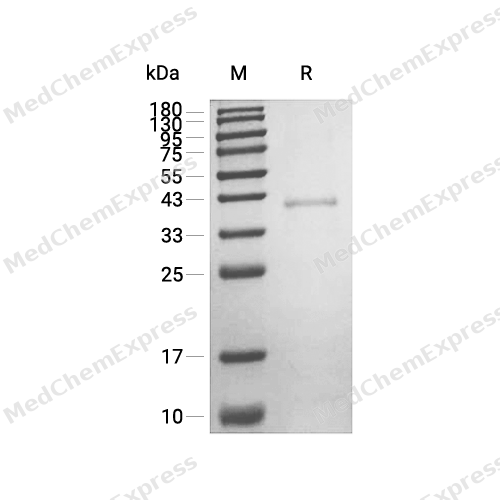
Purity - SDS-PAGE
-
Bioactivity - ELISA
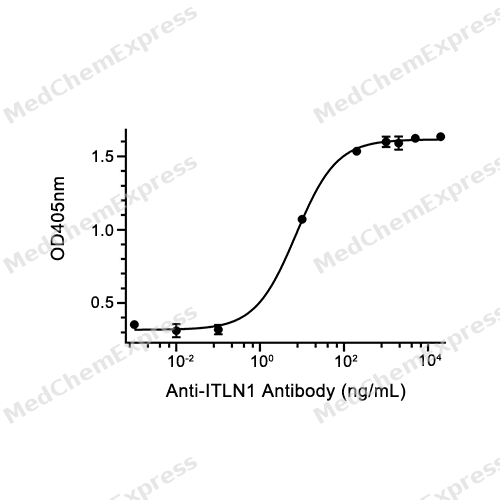
Bioactivity - ELISA


Publications (1)
-
Journal Impact Factor
-
Most Recent
-
Arthritis Res Ther
Omentin-1 reduced synovial M1 macrophages through SIRT6 signaling pathway and alleviated knee osteoarthritis response in mice. [Abstract]2025 Nov 18;27(1):216. PMID: 41254811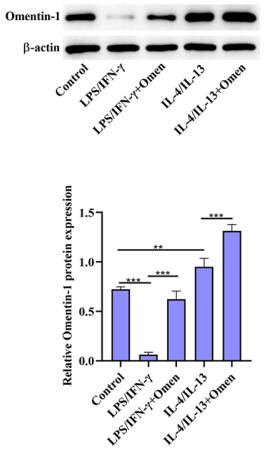
Intelectin-1/ITLN1 Protein, Human (N-His, C-Myc) purchased from MedChemExpress. Usage Cited in: Arthritis Res Ther. 2025 Nov 18;27(1):216. [Abstract]
Western blot was used to determine the relative expression of Omentin-1 protein in Raw264.7 cells. Omentin-1 promoted the transformation of Raw264.7 cells into the M2 phenotype while inhibiting the conversion to the M1 phenotype. Raw264.7 cells were induced to differentiate into M1 macrophages by LPS (10 pg/mL) and IFN-γ (IFN-gamma Protein, Human (CHO); 20 ng/mL) for 24 h, while they were induced to differentiate into M2 macrophages by IL-4 (20 ng/mL) and IL-13 (20 ng/mL). After 24 h, Omentin-1 was added to the cell culture medium, and the incubation was continued for an additional 24 h


Technical Parameters
-
Species Human
-
Source E. coli
-
Tag N-10*His;C-Myc
-
Accession
Q8WWA0 (T19-S298)
-
Gene ID55600
-
Protein Length
Full Length of Mature Protein
-
Synonyms
ITLN1; Galactofuranose-Binding Lectin; Intelectin 1; Endothelial Lectin HL-1; ITLN; Intelectin-1; LFR; FLJ20022; Omentin; ITLN-1; HIntL; INTL; HL-1; Intelectin Variant; Intelectin 1 (Galactofuranose Binding); HL1; Intestinal Lactoferrin Receptor
-
AA Sequence
TDEANTYFKEWTCSSSPSLPRSCKEIKDECPSAFDGLYFLRTENGVIYQTFCDMTSGGGGWTLVASVHENDMRGKCTVGDRWSSQQGSKAVYPEGDGNWANYNTFGSAEAATSDDYKNPGYYDIQAKDLGIWHVPNKSPMQHWRNSSLLRYRTDTGFLQTLGHNLFGIYQKYPVKYGEGKCWTDNGPVIPVVYDFGDAQKTASYYSPYGQREFTAGFVQFRVFNNERAANALCAGMRVTGCNTEHHCIGGGGYFPEASPQQCGDFSGFDWSGYGTHVGYS
-
Molecular Weight
Approximately 36 kDa, based on SDS-PAGE under reducing conditions.
-
Purity
≥ 90%, as determined by reducing SDS-PAGE.


Product Properties
Lyophilized powder
1.Lyophilized from a 0.22 μm filtered solution of 10 mM Tris-HCl, 1 mM EDTA, 6% Trehalose, pH 8.0.
2.Lyophilized from a 0.22 μm filtered solution of PBS, pH 7.4, 6% trehalose.
Please refer to the lot-specific COA for specific buffer information.
Note: For SPR assay, please replace the buffer. Primary amine components (e.g., Tris, imidazole) can affect protein-coupled chips.
<1 EU/μg, determined by LAL method.
It is not recommended to reconstitute to a concentration less than 100 μg/mL in ddH2O.
Stored at -20°C for 2 years from date of receipt. After reconstitution, it is stable at 4°C for 1 week or -20°C for longer (with carrier protein). It is recommended to freeze aliquots at -20°C or -80°C for extended storage.
Room temperature in continental US; may vary elsewhere.


Documentation
-
Data Sheet (237 KB)
-
SDS (252 KB)
- English - EN (252 KB)
- Français - FR (252 KB)
- Deutsch - DE (252 KB)
- Norwegian - NO (252 KB)
- Español - ES (252 KB)
- Swedish - SV (252 KB)
- Italian - IT (252 KB)
- Korean - KR (252 KB)
- Portuguese - PT (252 KB)
-
Handling Instructions (2659 KB)

Calculators
Concentration (start) × Volume (start) = Concentration (final) × Volume (final)


 Powered by Bioz

