



Intermediate capsid protein VP6, Rotavirus A (sf9, His, Myc)

Based on 1 Customer Validation
The intermediate capsid protein VP6 self-assembles into an icosahedral capsid with T=13 symmetry, forming the middle layer of the virus particle. It contains 230 VP6 trimers that protect dsRNA and prevent host cell antiviral responses. Intermediate capsid protein VP6, Rotavirus A (sf9, His, myc ) is the recombinant Virus-derived Intermediate capsid protein VP6, expressed by Sf9 insect cells , with N-His, C-Myc labeled tag.
- Species: Virus
- Source: Sf9 insect cells
-
Storage:Stored at -20°C for 2 years from date of receipt. After reconstitution, it is stable at 4°C for 1 week or -20°C for longer (with carrier protein). It is recommended to freeze aliquots at -20°C or -80°C for extended storage.


To place orders, for customer services and technical support, please contact: MedChemExpress USA
Tel: 609-228-6898 E-mail: [email protected] [email protected]


-
 Biological Activity
-
Technical Parameters
-
Product Properties
- Documentation
- Help & FAQs




Biological Activity
Description
The intermediate capsid protein VP6 self-assembles into an icosahedral capsid with T=13 symmetry, forming the middle layer of the virus particle. It contains 230 VP6 trimers that protect dsRNA and prevent host cell antiviral responses. Intermediate capsid protein VP6, Rotavirus A (sf9, His, myc ) is the recombinant Virus-derived Intermediate capsid protein VP6, expressed by Sf9 insect cells , with N-His, C-Myc labeled tag.
Background
The intermediate capsid protein VP6 functions as a self-assembling component, forming an icosahedral capsid with T=13 symmetry. This capsid, comprising 230 VP6 trimers, constitutes the middle concentric layer of the viral mature particle. During the virus replication cycle, VP6, along with the innermost VP2 capsid, remains intact following cell entry, providing protection to the dsRNA from degradation and preventing unfavorable antiviral responses in the host cell. The VP6 capsid plays a crucial role in the transcription activity of the double-layered particle (DLP), where nascent transcripts are transcribed within its structural confines and extruded through the channels at the five-fold axes. VP6 interacts with the inner capsid protein VP2, the outer capsid glycoprotein VP7, and the outer capsid protein VP5*, forming essential interactions for the overall functionality of the viral capsid.
MCE Validation Data
-
Purity - SDS-PAGE
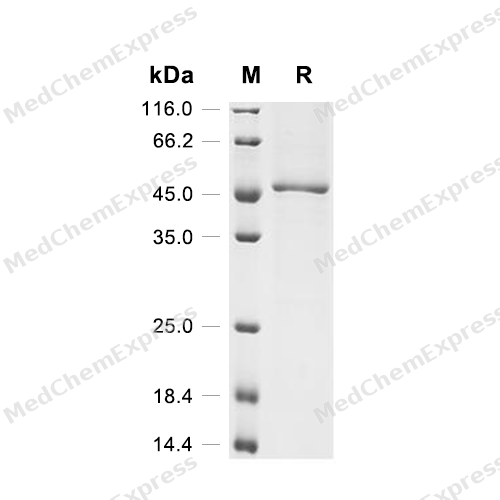
Purity - SDS-PAGE


Technical Parameters
-
Species Virus
-
Source Sf9 insect cells
-
Tag N-His;C-Myc
-
Accession
P03530 (M1-K397)
-
Gene ID/
-
Molecular Construction
-
N-term
-
10*His
-
VP6 (M1-K397)
Accession # P03530 -
C-term
-
-
Protein Length
Full Length
-
Synonyms
Intermediate capsid protein VP6
-
AA Sequence
MEVLYSLSKTLKDARDKIVEGTLYSNVSDLIQQFNQMIVTMNGNDFQTGGIGNLPVRNWTFDFGLLGTTLLNLDANYVENARTIIEYFIDFIDNVCMDEMARESQRNGVAPQSEALRKLAGIKFKRINFDNSSEYIENWNLQNRRQRTGFVFHKPNIFPYSASFTLNRSQPMHDNLMGTMWLNAGSEIQVAGFDYSCAINAPANIQQFEHIVQLRRALTTATITLLPDAERFSFPRVINSADGATTWFFNPVILRPNNVEVEFLLNGQIINTYQARFGTIIARNFDAIRLLFQLMRPPNMTPAVNALFPQAQPFQHHATVGLTLRIESAVCESVLADANETLLANVTAVRQEYAIPVGPVFPPGMNWTELITNYSPSREDNLQRVFTVASIRSMLIK
-
Predicted Molecular Mass
48.8 kDa
-
Molecular Weight
Approximately 48 kDa, based on SDS-PAGE under reducing conditions.
-
Purity
≥ 90%, as determined by reducing SDS-PAGE.


Product Properties
Lyophilized powder.
1.Lyophilized from a 0.22 μm filtered solution of PBS, pH 7.4.
2.Lyophilized from a 0.22 μm filtered solution of PBS, pH 7.4, 6% trehalose.
Please refer to the lot-specific COA for specific buffer information.
<1 EU/μg, determined by LAL method.
It is not recommended to reconstitute to a concentration less than 100 μg/mL in ddH2O. For long term storage it is recommended to add a carrier protein (0.1% BSA, 5% HSA, 10% FBS or 5% Trehalose).
Stored at -20°C for 2 years from date of receipt. After reconstitution, it is stable at 4°C for 1 week or -20°C for longer (with carrier protein). It is recommended to freeze aliquots at -20°C or -80°C for extended storage.
Room temperature in continental US; may vary elsewhere.


Documentation
-
Data Sheet (237 KB)
-
SDS (252 KB)
- English - EN (252 KB)
- Français - FR (252 KB)
- Deutsch - DE (252 KB)
- Norwegian - NO (252 KB)
- Español - ES (252 KB)
- Swedish - SV (252 KB)
- Italian - IT (252 KB)
- Korean - KR (252 KB)
- Portuguese - PT (252 KB)
-
Handling Instructions (2659 KB)

Calculators
Concentration (start) × Volume (start) = Concentration (final) × Volume (final)


 Powered by Bioz

