



KGF-2/FGF-10 Protein, Human (N-His)
Based on 1 publication(s) in Google Scholar
KGF-2/FGF-10 proteins coordinate embryonic development, regulate cell proliferation and differentiation, and are indispensable in branching morphogenesis. This multifunctional protein may aid in wound healing. KGF-2/FGF-10 Protein, Human (N-His) is the recombinant human-derived KGF-2/FGF-10 protein, expressed by E. coli , with N-His labeled tag.
- Species: Human
- Source: E. coli
-
Storage:Stored at -20°C for 2 years from date of receipt. After reconstitution, it is stable at 4°C for 1 week or -20°C for longer (with carrier protein). It is recommended to freeze aliquots at -20°C or -80°C for extended storage.


To place orders, for customer services and technical support, please contact: MedChemExpress USA
Tel: 609-228-6898 E-mail: [email protected] [email protected]


-
 Biological Activity
-
Technical Parameters
-
Product Properties
- Documentation
- Help & FAQs


-

HY-P70558
Noggin Protein, Human (HEK293) -
HY-101952
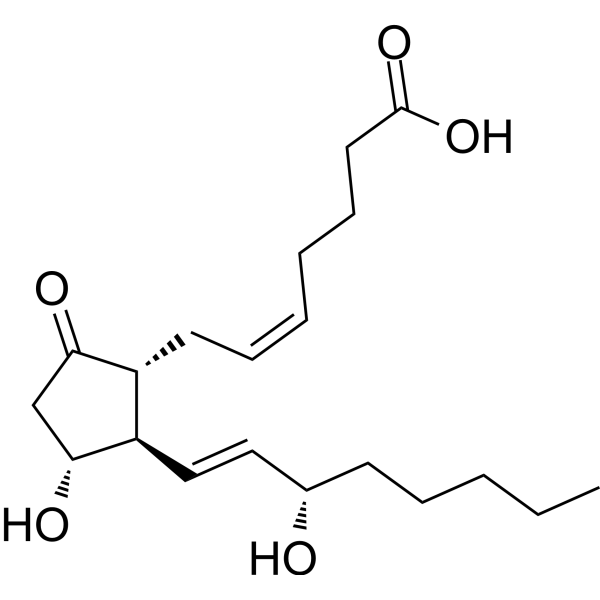
Prostaglandin E2 -
HY-P7109
EGF Protein, Human -
HY-B0150
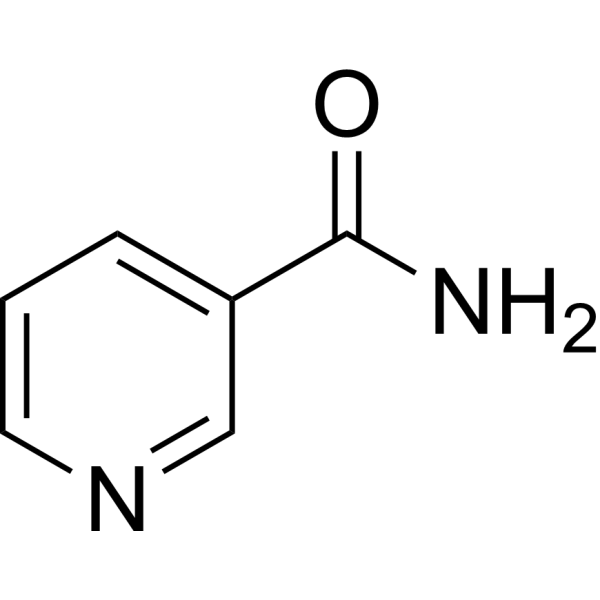
Nicotinamide -
HY-P70597
KGF/FGF-7 Protein, Human -
HY-10583
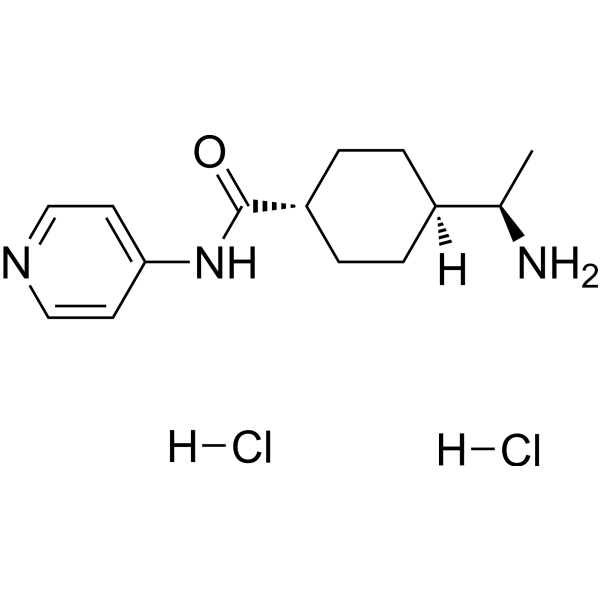
Y-27632 dihydrochloride -
HY-P70453B
Wnt3a Surrogate Protein, Human (HEK293, Fc) -
HY-10432
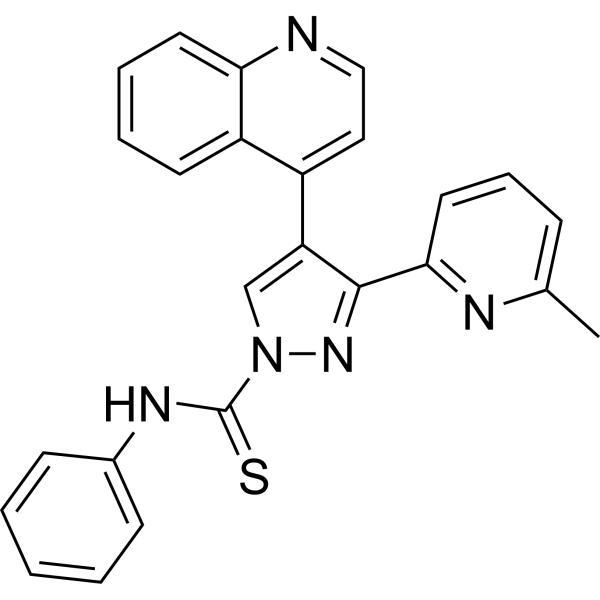
A 83-01 -
HY-P7114
RSPO1/R-spondin-1 Protein, Human (CHO, His) -
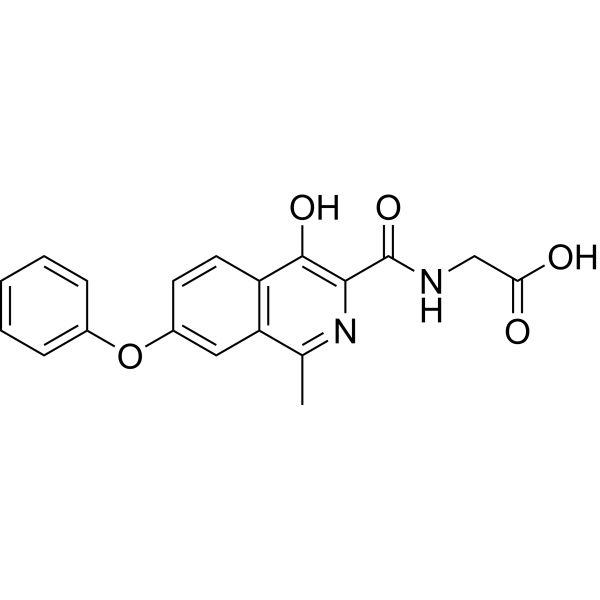
HY-13426
Roxadustat -
HY-P70311
Activin A Protein, Human/Mouse/Rat (HEK293) -
HY-P7331A
FGF basic/bFGF Protein, Human (154a.a, His)


Biological Activity
Description
KGF-2/FGF-10 proteins coordinate embryonic development, regulate cell proliferation and differentiation, and are indispensable in branching morphogenesis. This multifunctional protein may aid in wound healing. KGF-2/FGF-10 Protein, Human (N-His) is the recombinant human-derived KGF-2/FGF-10 protein, expressed by E. coli , with N-His labeled tag.
Background
KGF-2/FGF-10 Protein assumes a crucial role in orchestrating embryonic development, exerting regulatory control over essential processes such as cell proliferation and differentiation. Its significance extends to the intricate domain of normal branching morphogenesis, where KGF-2/FGF-10 is indispensable. This versatile protein may also contribute to wound healing processes. Through crucial interactions, it engages with FGFR1 and FGFR2, forming molecular complexes that underlie its multifaceted functions. Furthermore, KGF-2/FGF-10 interacts with FGFBP1, emphasizing its intricate network of associations in orchestrating cellular responses and developmental events.
Verified Bioactivity
Measured in a cell proliferation assay using 4MBr-5 rhesus monkey epithelial cells. The ED50 for this effect is 9.599-57.42 ng/mL.
MCE Validation Data
-
Purity - SDS-PAGE
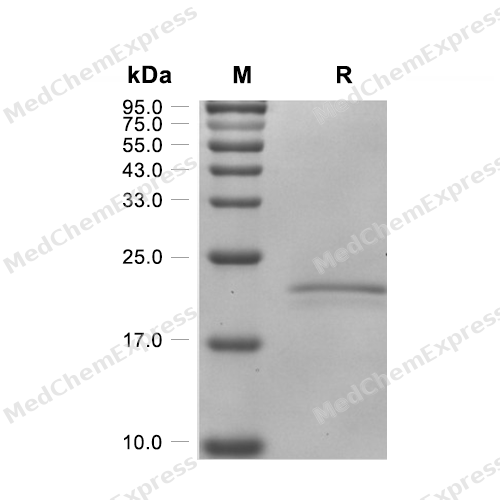
Purity - SDS-PAGE
-
Bioactivity - Cell-Based Assay
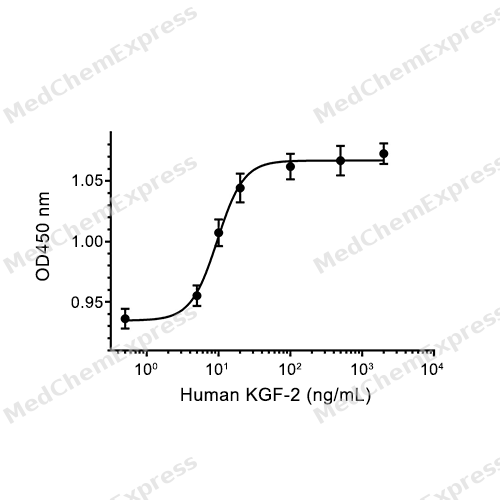
Bioactivity - Cell-Based Assay


Publications (1)
-
Journal Impact Factor
-
Most Recent


Technical Parameters
-
Species Human
-
Source E. coli
-
Tag N-6*His
-
Accession
O15520 (L40-S208)
-
Molecular Construction
-
N-term
-
6*His
-
FGF-10 (L40-S208)
Accession # O15520 -
C-term
-
-
Protein Length
Full Length of Mature Protein
-
Synonyms
FGF10; Produced By Fibroblasts Of Urinary Bladder Lamina Propria; Fibroblast Growth Factor 10; Fibroblast Growth Factor; Keratinocyte Growth Factor 2; LADD3; FGF-10; FGF
-
AA Sequence
LGQDMVSPEATNSSSSSFSSPSSAGRHVRSYNHLQGDVRWRKLFSFTKYFLKIEKNGKVSGTKKENCPYSILEITSVEIGVVAVKAINSNYYLAMNKKGKLYGSKEFNNDCKLKERIEENGYNTYASFNWQHNGRQMYVALNGKGAPRRGQKTRRKNTSAHFLPMVVHS
-
Predicted Molecular Mass
19.4 kDa
-
Molecular Weight
Approximately 21 kDa, based on SDS-PAGE under reducing conditions.
-
Purity
≥ 95%, as determined by reducing SDS-PAGE.


Product Properties
Lyophilized powder
1.Lyophilized from a 0.22 μm filtered solution of 20 mM PB, 150 mM NaCl, pH 7.4.
2.Lyophilized from a 0.22 μm filtered solution of PBS, pH 7.4.
3.Lyophilized from a 0.22 μm filtered solution of 50 mM Tris-HCl, 300 mM NaCl, pH 7.4.
Please refer to the lot-specific COA for specific buffer information.
Note: For SPR assay, please replace the buffer. Primary amine components (e.g., Tris, imidazole) can affect protein-coupled chips.
<1 EU/μg, determined by LAL method.
It is not recommended to reconstitute to a concentration less than 100 μg/mL in ddH2O. For long term storage it is recommended to add a carrier protein (0.1% BSA, 5% HSA, 10% FBS or 5% Trehalose).
Stored at -20°C for 2 years from date of receipt. After reconstitution, it is stable at 4°C for 1 week or -20°C for longer (with carrier protein). It is recommended to freeze aliquots at -20°C or -80°C for extended storage.
Room temperature in continental US; may vary elsewhere.


Documentation
-
Data Sheet (236 KB)
-
SDS (252 KB)
- English - EN (252 KB)
- Français - FR (252 KB)
- Deutsch - DE (252 KB)
- Norwegian - NO (252 KB)
- Español - ES (252 KB)
- Swedish - SV (252 KB)
- Italian - IT (252 KB)
- Korean - KR (252 KB)
- Portuguese - PT (252 KB)
-
Handling Instructions (2659 KB)

Calculators
Concentration (start) × Volume (start) = Concentration (final) × Volume (final)


 Powered by Bioz

