



Klotho Protein, Human (CHO, His)
Based on 1 publication(s) in Google Scholar
Klotho Protein exhibits weak glycosidase activity against glucuronidated steroids and is inactive in vivo due to the lack of essential active site Glu residues. It regulates calcium and phosphorus homeostasis by inhibiting the synthesis of active vitamin D. Klotho Protein, Human (CHO, His) is the recombinant human-derived Klotho protein, expressed by CHO , with C-10*His labeled tag.
- Species: Human
- Source: CHO
-
Storage:Stored at -20°C for 2 years from date of receipt. After reconstitution, it is stable at 4°C for 1 week or -20°C for longer (with carrier protein). It is recommended to freeze aliquots at -20°C or -80°C for extended storage.


To place orders, for customer services and technical support, please contact: MedChemExpress USA
Tel: 609-228-6898 E-mail: [email protected] [email protected]


-
 Biological Activity
-
Technical Parameters
-
Product Properties
- Documentation
- Help & FAQs


-
HY-B0351
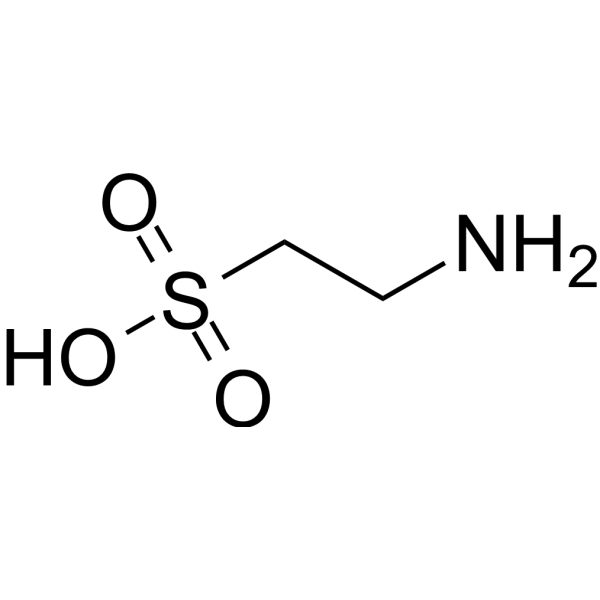
TaurineAutophagy Inducer -
HY-10219
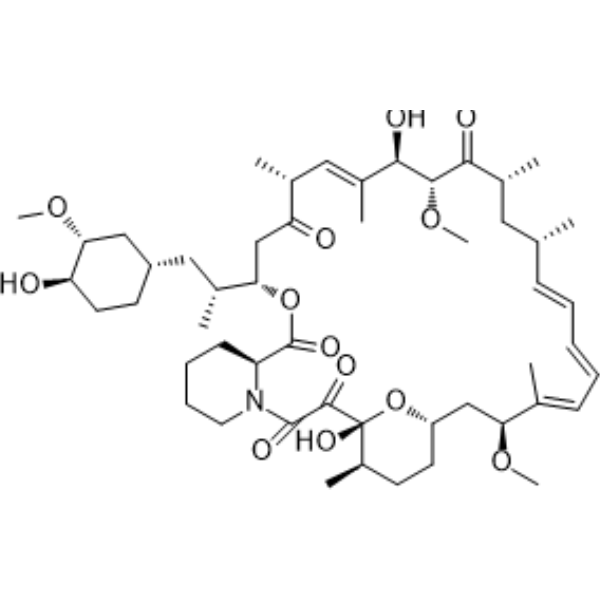
RapamycinmTOR Inhibitor -
HY-15371
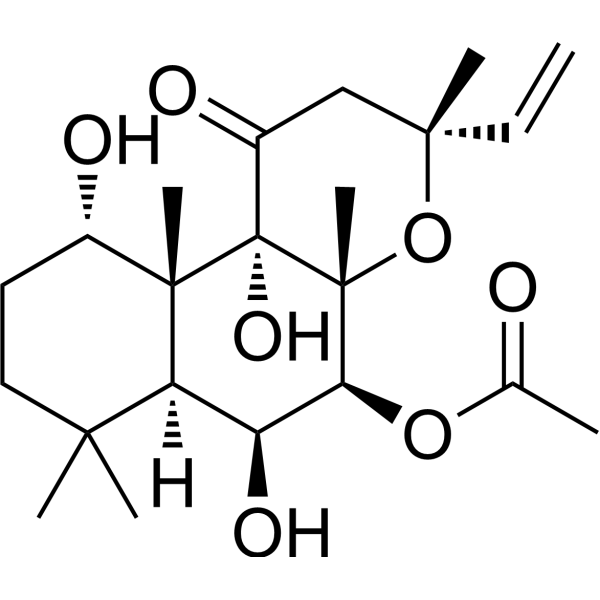
ForskolinAdenylate Cyclase Activator -
HY-10254
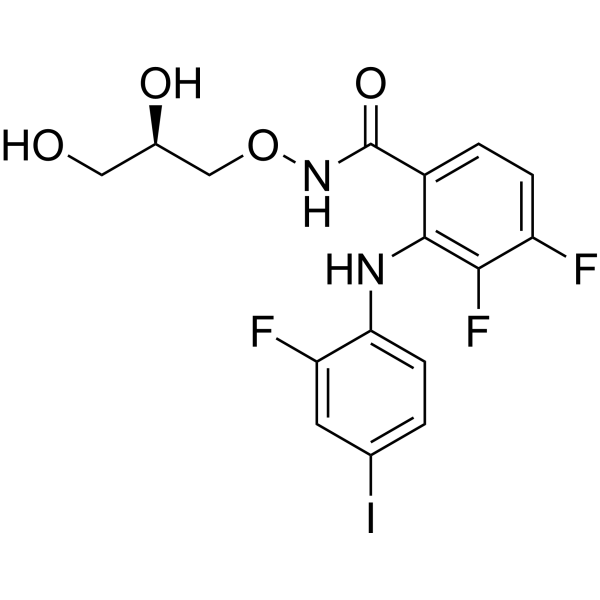
MirdametinibMEK Inhibitor -
HY-10583
Y-27632 dihydrochlorideROCK Inhibitor -
HY-13689
Go 6983PKC Inhibitor -

HY-P70618
PF-4/CXCL4 Protein, Human (HEK293, His) -
HY-P7013
FGF-23 Protein, Human


Biological Activity
Description
Klotho Protein exhibits weak glycosidase activity against glucuronidated steroids and is inactive in vivo due to the lack of essential active site Glu residues. It regulates calcium and phosphorus homeostasis by inhibiting the synthesis of active vitamin D. Klotho Protein, Human (CHO, His) is the recombinant human-derived Klotho protein, expressed by CHO , with C-10*His labeled tag.
Background
The Klotho protein exhibits weak glycosidase activity towards glucuronylated steroids, but its in vivo inactivity as a glycosidase is suggested by the absence of essential active site Glu residues at positions 239 and 872. Additionally, Klotho may play a role in the regulation of calcium and phosphorus homeostasis by inhibiting the synthesis of active vitamin D. As an essential factor for the specific interaction between FGF23 and FGFR1, Klotho contributes to crucial signaling pathways. Furthermore, the Klotho peptide, generated by cleaving the membrane-bound isoform, is proposed to function as an anti-aging circulating hormone. This hormone has the potential to extend lifespan by inhibiting insulin/IGF1 signaling, presenting Klotho as a multifunctional protein with implications in both metabolic regulation and the aging process.
Verified Bioactivity
1.The EC50 as determined by the dose-dependent stimulation of the proliferation of murine NIH/3T3 is less than 1 μg/mL.
2.Immobilized rHuFGF-23 at 2.0 μg/mL (100 μL/well) can bind Klotho Protein, Human with EC50 of 0.64-1.25 μg/mL.
MCE Validation Data
-
Purity - SDS-PAGE
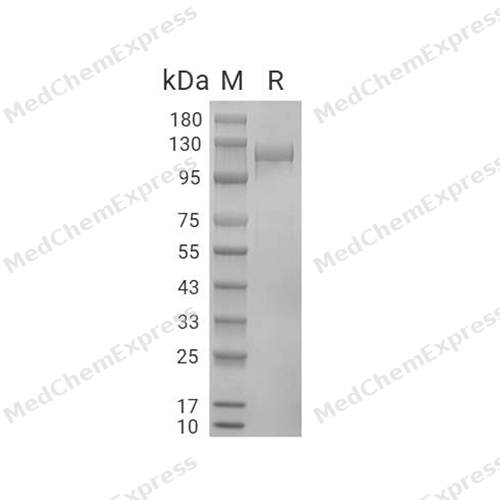
Purity - SDS-PAGE
-
Bioactivity - Cell-Based Assay
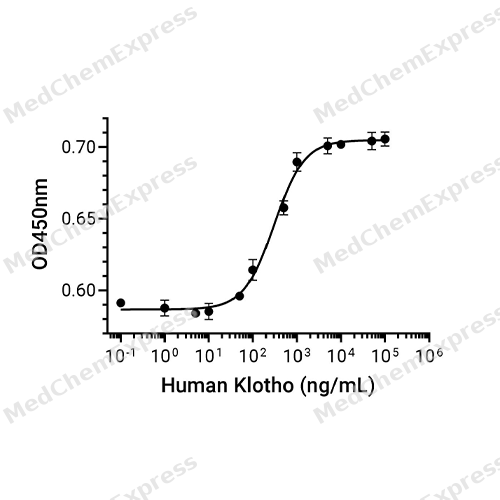
Bioactivity - Cell-Based Assay


Publications (1)
-
Journal Impact Factor
-
Most Recent
-
Tissue Cell
2026 Feb:98:103198. PMID: 41161232


Technical Parameters
-
Species Human
-
Source CHO
-
Tag C-10*His
-
Accession
Q9UEF7 (E34-S981)
-
Molecular Construction
-
N-term
-
Klotho (E34-S981)
Accession # Q9UEF7 -
10*His
-
C-term
-
-
Protein Length
Extracellular Domain
-
Synonyms
KL; Alpha-Klotho; Klotho; HFTC3; KLA
-
AA Sequence
EPGDGAQTWARFSRPPAPEAAGLFQGTFPDGFLWAVGSAAYQTEGGWQQHGKGASIWDTFTHHPLAPPGDSRNASLPLGAPSPLQPATGDVASDSYNNVFRDTEALRELGVTHYRFSISWARVLPNGSAGVPNREGLRYYRRLLERLRELGVQPVVTLYHWDLPQRLQDAYGGWANRALADHFRDYAELCFRHFGGQVKYWITIDNPYVVAWHGYATGRLAPGIRGSPRLGYLVAHNLLLAHAKVWHLYNTSFRPTQGGQVSIALSSHWINPRRMTDHSIKECQKSLDFVLGWFAKPVFIDGDYPESMKNNLSSILPDFTESEKKFIKGTADFFALCFGPTLSFQLLDPHMKFRQLESPNLRQLLSWIDLEFNHPQIFIVENGWFVSGTTKRDDAKYMYYLKKFIMETLKAIKLDGVDVIGYTAWSLMDGFEWHRGYSIRRGLFYVDFLSQDKMLLPKSSALFYQKLIEKNGFPPLPENQPLEGTFPCDFAWGVVDNYIQVDTTLSQFTDLNVYLWDVHHSKRLIKVDGVVTKKRKSYCVDFAAIQPQIALLQEMHVTHFRFSLDWALILPLGNQSQVNHTILQYYRCMASELVRVNITPVVALWQPMAPNQGLPRLLARQGAWENPYTALAFAEYARLCFQELGHHVKLWITMNEPYTRNMTYSAGHNLLKAHALAWHVYNEKFRHAQNGKISIALQADWIEPACPFSQKDKEVAERVLEFDIGWLAEPIFGSGDYPWVMRDWLNQRNNFLLPYFTEDEKKLIQGTFDFLALSHYTTILVDSEKEDPIKYNDYLEVQEMTDITWLNSPSQVAVVPWGLRKVLNWLKFKYGDLPMYIISNGIDDGLHAEDDQLRVYYMQNYINEALKAHILDGINLCGYFAYSFNDRTAPRFGLYRYAADQFEPKASMKHYRKIIDSNGFPGPETLERFCPEEFTVCTECSFFHTRKS
-
Molecular Weight
Approximately 110-130 kDa, based on SDS-PAGE under reducing conditions.
-
Purity
≥ 95%, as determined by reducing SDS-PAGE.


Product Properties
Lyophilized powder
1.Lyophilized from a 0.2 μm filtered solution of PBS, 50% Glycerol, pH 7.4.
2.Lyophilized from a 0.2 μm filtered solution of PBS, pH 7.4, 5% Trehalose.
Please refer to the lot-specific COA for specific buffer information.
<0.1 EU/μg, determined by LAL method.
It is not recommended to reconstitute to a concentration less than 100 μg/mL in ddH2O. For long term storage it is recommended to add a carrier protein (0.1% BSA, 5% HSA, 10% FBS or 5% Trehalose).
Stored at -20°C for 2 years from date of receipt. After reconstitution, it is stable at 4°C for 1 week or -20°C for longer (with carrier protein). It is recommended to freeze aliquots at -20°C or -80°C for extended storage.
Room temperature in continental US; may vary elsewhere.


Documentation
-
Data Sheet (241 KB)
-
SDS (252 KB)
- English - EN (252 KB)
- Français - FR (252 KB)
- Deutsch - DE (252 KB)
- Norwegian - NO (252 KB)
- Español - ES (252 KB)
- Swedish - SV (252 KB)
- Italian - IT (252 KB)
- Korean - KR (252 KB)
- Portuguese - PT (252 KB)
-
Handling Instructions (2659 KB)

Calculators
Concentration (start) × Volume (start) = Concentration (final) × Volume (final)


 Powered by Bioz

