



Kras4B Protein, Human (N-His)

Based on 1 Customer Validation
The Kras4B protein interacts specifically with GPR31, dependent on farnesylation. This binding suggests a regulatory role for Kras4B in association with GPR31, emphasizing the importance of the farnesylation process. Comprehensive exploration into the molecular details of this interaction is crucial to understand the precise mechanisms and functional implications in cellular processes or signaling pathways. Kras4B Protein, Human (His) is the recombinant human-derived Kras4B protein, expressed by E. coli , with N-6*His labeled tag.
- Species: Human
- Source: E. coli
-
Storage:Stored at -20°C for 2 years from date of receipt. After reconstitution, it is stable at 4°C for 1 week or -20°C for longer (with carrier protein). It is recommended to freeze aliquots at -20°C or -80°C for extended storage.


To place orders, for customer services and technical support, please contact: MedChemExpress USA
Tel: 609-228-6898 E-mail: [email protected] [email protected]


-
 Biological Activity
-
Technical Parameters
-
Product Properties
- Documentation
- Help & FAQs




Biological Activity
Description
The Kras4B protein interacts specifically with GPR31, dependent on farnesylation. This binding suggests a regulatory role for Kras4B in association with GPR31, emphasizing the importance of the farnesylation process. Comprehensive exploration into the molecular details of this interaction is crucial to understand the precise mechanisms and functional implications in cellular processes or signaling pathways. Kras4B Protein, Human (His) is the recombinant human-derived Kras4B protein, expressed by E. coli , with N-6*His labeled tag.
Background
The Kras4B protein establishes a specific interaction with GPR31, and this binding is contingent on farnesylation. This interaction underscores the potential regulatory role of Kras4B in conjunction with GPR31, suggesting a dependence on the farnesylation process. Further exploration into the molecular intricacies of this interaction is essential to unravel the precise mechanisms and functional implications associated with the interplay between Kras4B and GPR31 in cellular processes or signaling pathways.
Verified Bioactivity
No Enzyme activity.
MCE Validation Data
-
Purity - SDS-PAGE
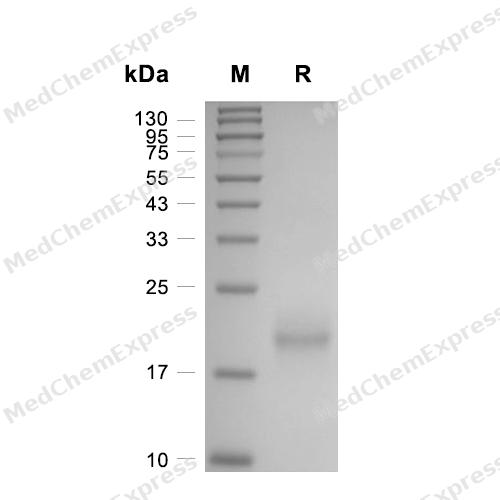
Purity - SDS-PAGE


Technical Parameters
-
Species Human
-
Source E. coli
-
Tag N-6*His
-
Accession
P01116-2 (M1-Q150)
-
Gene ID3845
-
Molecular Construction
-
N-term
-
6*His
-
Kras4B (M1-Q150)
Accession # P01116-2 -
C-term
-
-
Protein Length
Partial
-
Synonyms
KRAS; Kras-Enoph1 Fusion Protein; Prev. KRAS2; PR310 C-K-Ras Oncogene; GTPase KRas; Small Monomeric GTPase; K-Ras4B; C-Kirsten-Ras Protein; KRAS1; Proto-Oncogene GTPase; V-Ki-Ras2 Kirsten Rat Sarcoma 2 Viral Oncogene Homolog; KRAS-ENOPH Fusion; Kirsten Ra
-
AA Sequence
MTEYKLVVVGAGGVGKSALTIQLIQNHFVDEYDPTIEDSYRKQVVIDGETCLLDILDTAGQEEYSAMRDQYMRTGEGFLCVFAINNTKSFEDIHHYREQIKRVKDSEDVPMVLVGNKCDLPSRTVDTKQAQDLARSYGIPFIETSAKTRQ
-
Predicted Molecular Mass
17 kDa
-
Molecular Weight
Approximately 19 kDa, based on SDS-PAGE under reducing conditions.
-
Purity
≥ 95%, as determined by reducing SDS-PAGE.


Product Properties
Lyophilized powder.
Lyophilized from a 0.22 μm filtered solution of PBS, pH 7.4, 8% trehalose.
<1 EU/μg, determined by LAL method.
It is not recommended to reconstitute to a concentration less than 100 μg/mL in ddH2O.
Stored at -20°C for 2 years from date of receipt. After reconstitution, it is stable at 4°C for 1 week or -20°C for longer (with carrier protein). It is recommended to freeze aliquots at -20°C or -80°C for extended storage.
Room temperature in continental US; may vary elsewhere.


Documentation
-
Data Sheet (235 KB)
-
SDS (252 KB)
- English - EN (252 KB)
- Français - FR (252 KB)
- Deutsch - DE (252 KB)
- Norwegian - NO (252 KB)
- Español - ES (252 KB)
- Swedish - SV (252 KB)
- Italian - IT (252 KB)
- Korean - KR (252 KB)
- Portuguese - PT (252 KB)
-
Handling Instructions (2659 KB)

Calculators
Concentration (start) × Volume (start) = Concentration (final) × Volume (final)


 Powered by Bioz

