



Legumain Protein, Human (HEK293, C-His)
Based on 1 publication(s) in Google Scholar
Legumain proteins can slowly cleave aspartyl bonds, especially under acidic conditions.Legumain Protein, Human (HEK293, C-His) is the recombinant human-derived Legumain protein, expressed by HEK293 , with C-6*His labeled tag.
- Species: Human
- Source: HEK293
-
Storage:Stored at -20°C for 2 years from date of receipt. After reconstitution, it is stable at 4°C for 1 week or -20°C for longer (with carrier protein). It is recommended to freeze aliquots at -20°C or -80°C for extended storage.


To place orders, for customer services and technical support, please contact: MedChemExpress USA
Tel: 609-228-6898 E-mail: [email protected] [email protected]


-
 Biological Activity
-
Technical Parameters
-
Product Properties
- Documentation
- Help & FAQs




Biological Activity
Description
Legumain proteins can slowly cleave aspartyl bonds, especially under acidic conditions.Legumain Protein, Human (HEK293, C-His) is the recombinant human-derived Legumain protein, expressed by HEK293 , with C-6*His labeled tag.
Background
Legumain protein exhibits a strict specificity for the hydrolysis of asparaginyl bonds. Additionally, it demonstrates the ability to cleave aspartyl bonds slowly, particularly in acidic conditions, further expanding its enzymatic versatility. Functionally, Legumain is integral to the processing of proteins for MHC class II antigen presentation within the lysosomal/endosomal system. It also plays a crucial role in MHC class I antigen presentation in cross-presenting dendritic cells by facilitating the cleavage and maturation of Perforin-2 (MPEG1), thereby promoting antigen translocation in the cytosol, as indicated by recent research findings. Moreover, Legumain is essential for normal lysosomal protein degradation in renal proximal tubules and is required for the degradation of internalized EGFR, highlighting its importance in cellular processes and the regulation of cell proliferation.
Verified Bioactivity
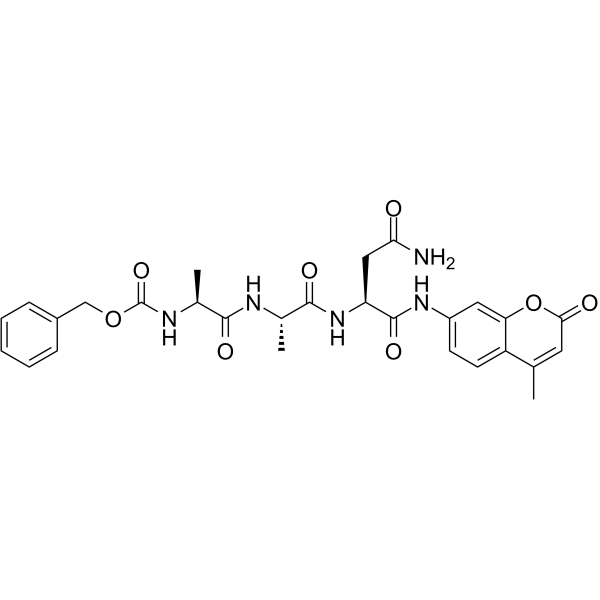
Measured by its ability to cleave the fluorogenic peptide substrate, Z-Ala-Ala-Asn-AMC (HY-136626). The specific activity is >250 pmol/min/µg. (Activation description: The proenzyme needs to be activated in acid buffer for an activated form.)
MCE Validation Data
-
Purity - SDS-PAGE
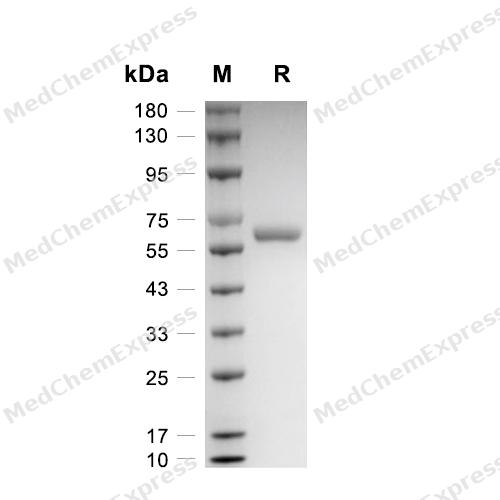
Purity - SDS-PAGE

Assay Procedure
Materials
Activation buffer: 0.1 M NaOAc, 0.1 M NaCl, pH 4.0
Assay buffer: 50 mM MES, 250 mM NaCl, pH 5.0
Test protein: Legumain Protein, Human (HEK293, C-His) (HY-P70897A)
Substrate: Z-Ala-Ala-Asn-AMC (HY-136626) , dissolved in DMSO to a concentration of 5 mM.
Standard: 7-amino, 4-Methyl Coumarin (AMC, HY-137784)
Procedure
1. Dilute AMC in assay buffer to concentrations of 0, 6.25, 12.5, 25, 50, and 100 μmol/L. Add 100 μL of each dilution to a black microplate well.
2. Measure fluorescence at excitation/emission wavelengths of 380 nm/460 nm in kinetic mode for 5 minutes.
3. Plot the measured RFU values on the y-axis and the standard concentrations on the x-axis to generate a standard curve and obtain the curve equation.
4. Dilute the protein to 100 μg/mL in activation buffer and incubate at 37°C for 2 hours.
5. Dilute the protein solution to 10 ng/μL in detection buffer.
6. Dilute the substrate to 200 μM in assay buffer.
7. Add 50 μL of 10 ng/μL Human Legumain to the wells, followed by 50 μL of 200 μM substrate to initiate the reaction.
8. Read in kinetic mode for 5 minutes at excitation and emission wavelengths of 380 nm and 460 nm, respectively.
9. Calculate specific activity:
|
Specific Activity (pmol/min/μg) = |
Adjusted Vmax* (RFU/min) x Conversion Factor ** (pmol/RFU) |


Publications (1)
-
Journal Impact Factor
-
Most Recent
-
Proc Natl Acad Sci U S A
2026 Apr 14;123(15):e2520128123. PMID: 41945431


Technical Parameters
-
Species Human
-
Source HEK293
-
Tag C-6*His
-
Accession
AAH03061.1 (I18-Y433)
-
Gene ID5641
-
Molecular Construction
-
N-term
-
Legumain (I18-Y433)
Accession # AAH03061.1 -
6*His
-
C-term
-
-
Protein Length
Full Length of Mature Protein
-
Synonyms
LGMN; LGMN1; Prev. PRSC1; AEP; Asparaginyl Endopeptidase; Cysteine Protease 1; Protease, Cysteine 1; Legumain; Protease, Cysteine, 1 (Legumain)
-
AA Sequence
IPIDDPEDGGKHWVVIVAGSNGWYNYRHQADACHAYQIIHRNGIPDEQIVVMMYDDIAYSEDNPTPGIVINRPNGTDVYQGVPKDYTGEDVTPQNFLAVLRGDAEAVKGIGSGKVLKSGPQDHVFIYFTDHGSTGILVFPNEDLHVKDLNETIHYMYKHKMYRKMVFYIEACESGSMMNHLPDNINVYATTAANPRESSYACYYDEKRSTYLGDWYSVNWMEDSDVEDLTKETLHKQYHLVKSHTNTSHVMQYGNKTISTMKVMQFQGMKRKASSPVPLPPVTHLDLTPSPDVPLTIMKRKLMNTNDLEESRQLTEEIQRHLDARHLIEKSVRKIVSLLAASEAEVEQLLSERAPLTGHSCYPEALLHFRTHCFNWHSPTYEYALRHLYVLVNLCEKPYPLHRIKLSMDHVCLGHY
-
Predicted Molecular Mass
48.5 kDa
-
Molecular Weight
Approximately 55-60 kDa, based on SDS-PAGE under reducing conditions, due to the glycosylation.
-
Glycosylation
Yes
-
Purity
≥ 95%, as determined by reducing SDS-PAGE.


Product Properties
Lyophilized powder
Lyophilized from a 0.22 μm filtered solution of PBS, pH 7.4, 5% trehalose.
<1 EU/μg, determined by LAL method.
It is not recommended to reconstitute to a concentration less than 100 μg/mL in ddH2O.
Stored at -20°C for 2 years from date of receipt. After reconstitution, it is stable at 4°C for 1 week or -20°C for longer (with carrier protein). It is recommended to freeze aliquots at -20°C or -80°C for extended storage.
Room temperature in continental US; may vary elsewhere.


Documentation
-
Data Sheet (238 KB)
-
SDS (252 KB)
- English - EN (252 KB)
- Français - FR (252 KB)
- Deutsch - DE (252 KB)
- Norwegian - NO (252 KB)
- Español - ES (252 KB)
- Swedish - SV (252 KB)
- Italian - IT (252 KB)
- Korean - KR (252 KB)
- Portuguese - PT (252 KB)
-
Handling Instructions (2659 KB)

Calculators
Concentration (start) × Volume (start) = Concentration (final) × Volume (final)


 Powered by Bioz

