



Melanotransferrin/CD228 Protein, Mouse (HEK293, His)

Based on 1 Customer Validation
Melanotransferrin/CD228 protein is involved in cellular iron uptake, undergoing internalization and recycling to the cell membrane. Each subunit binds a single iron atom, suggesting a role in intracellular iron transport. Melanotransferrin/CD228 also exhibits potential zinc binding, showcasing versatile metal ion interactions. Melanotransferrin/CD228 Protein, Mouse (HEK293, His) is the recombinant mouse-derived Melanotransferrin/CD228 protein, expressed by HEK293 , with C-His labeled tag.
- Species: Mouse
- Source: HEK293
-
Storage:Stored at -20°C for 2 years from date of receipt. After reconstitution, it is stable at 4°C for 1 week or -20°C for longer (with carrier protein). It is recommended to freeze aliquots at -20°C or -80°C for extended storage.


To place orders, for customer services and technical support, please contact: MedChemExpress USA
Tel: 609-228-6898 E-mail: [email protected] [email protected]


-
 Biological Activity
-
Technical Parameters
-
Product Properties
- Documentation
- Help & FAQs




Biological Activity
Description
Melanotransferrin/CD228 protein is involved in cellular iron uptake, undergoing internalization and recycling to the cell membrane. Each subunit binds a single iron atom, suggesting a role in intracellular iron transport. Melanotransferrin/CD228 also exhibits potential zinc binding, showcasing versatile metal ion interactions. Melanotransferrin/CD228 Protein, Mouse (HEK293, His) is the recombinant mouse-derived Melanotransferrin/CD228 protein, expressed by HEK293 , with C-His labeled tag.
Background
Melanotransferrin/CD228 protein is implicated in cellular iron uptake, where it appears to undergo internalization and subsequent recycling back to the cell membrane. Each subunit of this protein has the capacity to bind a single atom of iron, suggesting its role in intracellular iron transport. Additionally, Melanotransferrin/CD228 could potentially bind zinc, indicating a versatility in metal ion binding capabilities.
Verified Bioactivity
Measured in a cell proliferation assay using SH-SY5Y cells. The ED50 for this effect is 1.088 μg/mL, corresponding to a specific activity is 919.118 units/mg.
MCE Validation Data
-
Purity - SDS-PAGE
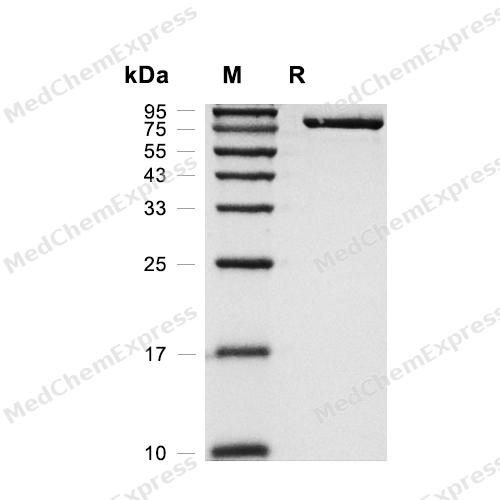
Purity - SDS-PAGE
-
Bioactivity - Cell-Based Assay
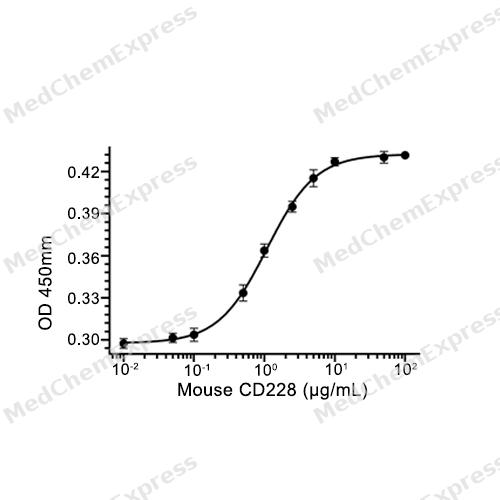
Bioactivity - Cell-Based Assay


Technical Parameters
-
Species Mouse
-
Source HEK293
-
Tag C-10*His
-
Accession
Q9R0R1 (V20-Q708)
-
Molecular Construction
-
N-term
-
Melanotransferrin (V20-Q708)
Accession # Q9R0R1 -
His
-
C-term
-
-
Protein Length
Full Length of Melanotransferrin Chain
-
Synonyms
MELTF; Antigen P97 (Melanoma Associated) Identified By Monoclonal Antibodies 133.2 And 96.5; Prev. MFI2; FLJ38863; MAP97; MGC4856; CD228; Melanoma-Associated Antigen P97; MTF1; CD228 Antigen; MTf; Melanotransferrin; Membrane-Bound Transferrin-Like Protein
-
AA Sequence
VMEVQWCTISDAEQQKCKDMSEAFQGAGIRPSLLCVQGNSADHCVQLIKEQKADAITLDGGAIYEAGKEHGLKPVVGEVYDQDIGTSYYAVAVVRRNSNVTINTLKGVKSCHTGINRTVGWNVPVGYLVESGHLSVMGCDVLKAVGDYFGGSCVPGTGETSHSESLCRLCRGDSSGHNVCDKSPLERYYDYSGAFRCLAEGAGDVAFVKHSTVLENTDGNTLPSWGKSLMSEDFQLLCRDGSRADITEWRRCHLAKVPAHAVVVRGDMDGGLIFQLLNEGQLLFSHEDSSFQMFSSKAYSQKNLLFKDSTLELVPIATQNYEAWLGQEYLQAMKGLLCDPNRLPHYLRWCVLSAPEIQKCGDMAVAFSRQNLKPEIQCVSAESPEHCMEQIQAGHTDAVTLRGEDIYRAGKVYGLVPAAGELYAEEDRSNSYFVVAVARRDSSYSFTLDELRGKRSCHPYLGSPAGWEVPIGSLIQRGFIRPKDCDVLTAVSQFFNASCVPVNNPKNYPSALCALCVGDEKGRNKCVGSSQERYYGYSGAFRCLVEHAGDVAFVKHTTVFENTNGHNPEPWASHLRWQDYELLCPNGARAEVDQFQACNLAQMPSHAVMVRPDTNIFTVYGLLDKAQDLFGDDHNKNGFQMFDSSKYHSQDLLFKDATVRAVPVREKTTYLDWLGPDYVVALEGMLSQQ
-
Molecular Weight
Approximately 80 kDa, based on SDS-PAGE under reducing conditions.
-
Glycosylation
Yes
-
Purity
≥ 95%, as determined by reducing SDS-PAGE.


Product Properties
Lyophilized powder.
Lyophilized from a 0.22 μm filtered solution of PBS, pH 7.4.
<1 EU/μg, determined by LAL method.
It is not recommended to reconstitute to a concentration less than 100 μg/mL in ddH2O. For long term storage it is recommended to add a carrier protein (0.1% BSA, 5% HSA, 10% FBS or 5% Trehalose).
Stored at -20°C for 2 years from date of receipt. After reconstitution, it is stable at 4°C for 1 week or -20°C for longer (with carrier protein). It is recommended to freeze aliquots at -20°C or -80°C for extended storage.
Room temperature in continental US; may vary elsewhere.


Documentation
-
Data Sheet (239 KB)
-
SDS (251 KB)
- English - EN (251 KB)
- Français - FR (251 KB)
- Deutsch - DE (251 KB)
- Norwegian - NO (251 KB)
- Español - ES (251 KB)
- Swedish - SV (251 KB)
- Italian - IT (251 KB)
- Korean - KR (251 KB)
- Portuguese - PT (251 KB)
-
Handling Instructions (2659 KB)

Calculators
Concentration (start) × Volume (start) = Concentration (final) × Volume (final)


 Powered by Bioz

