



Muellerian-inhibiting factor/AMH Protein, Mouse (P.pastoris, His)

Based on 1 Customer Validation
Mullerian inhibitory factor (AMH) plays a crucial role in various reproductive processes. It contributes significantly to Mullerian duct degeneration in male fetal sex differentiation. Muellerian-inhibiting factor/AMH Protein, Mouse (P.pastoris, His) is the recombinant mouse-derived Muellerian-inhibiting factor/AMH protein, expressed by P. pastoris , with N-His labeled tag.
- Species: Mouse
- Source: P. pastoris
-
Storage:Stored at -20°C for 2 years from date of receipt. After reconstitution, it is stable at 4°C for 1 week or -20°C for longer (with carrier protein). It is recommended to freeze aliquots at -20°C or -80°C for extended storage.


To place orders, for customer services and technical support, please contact: MedChemExpress USA
Tel: 609-228-6898 E-mail: [email protected] [email protected]


-
 Biological Activity
-
Technical Parameters
-
Product Properties
- Documentation
- Help & FAQs




Biological Activity
Description
Mullerian inhibitory factor (AMH) plays a crucial role in various reproductive processes. It contributes significantly to Mullerian duct degeneration in male fetal sex differentiation. Muellerian-inhibiting factor/AMH Protein, Mouse (P.pastoris, His) is the recombinant mouse-derived Muellerian-inhibiting factor/AMH protein, expressed by P. pastoris , with N-His labeled tag.
Background
The Müllerian-inhibiting factor (AMH) protein plays a pivotal role in various reproductive processes. During male fetal sexual differentiation, it contributes significantly to Muellerian duct regression. In the adult, AMH assumes a role in Leydig cell differentiation and function. Conversely, in females, AMH acts as a negative regulator, impeding the primordial to primary follicle transition and reducing the FSH sensitivity of growing follicles. AMH exerts its effects by binding to its sole type II receptor, AMHR2, which recruits type I receptors ACVR1 and BMPR1A, subsequently activating the Smad pathway. Structurally, AMH exists as a homodimer, with disulfide linkages contributing to its stability. The diverse functions of AMH underscore its crucial involvement in orchestrating key events in both male and female reproductive development and maintenance.
Verified Bioactivity
Measured by its binding ability in a functional ELISA. When Recombinant Mouse Muellerian-inhibiting factor is immobilized at 3 µg/mL(100 µL/well) can bind Recombinant Mouse MISRII. The ED50 for this effect is 64.53 ng/mL.
MCE Validation Data
-
Bioactivity - ELISA
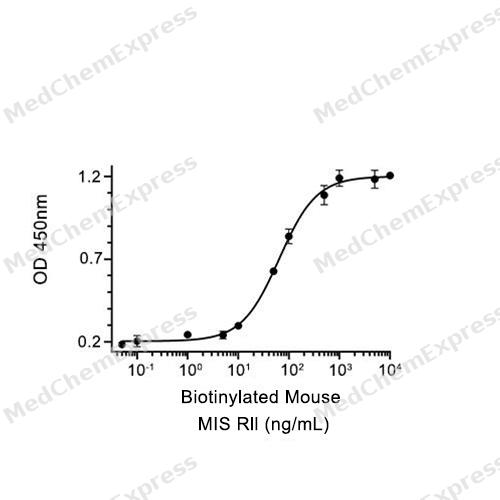
Bioactivity - ELISA


Technical Parameters
-
Species Mouse
-
Source P. pastoris
-
Tag N-His
-
Accession
P27106 (D450-C552)
-
Molecular Construction
-
N-term
-
His
-
AMH (D450-C552)
Accession # P27106 -
C-term
-
-
Protein Length
Partial
-
Synonyms
AMH; MIS; Anti-Mullerian Hormone; Anti-Muellerian Hormone; Muellerian-Inhibiting Substance; Mullerian Inhibiting Substance; Muellerian-Inhibiting Factor; Mullerian Inhibiting Factor; MIF
-
AA Sequence
DKGQDGPCALRELSVDLRAERSVLIPETYQANNCQGACRWPQSDRNPRYGNHVVLLLKMQARGAALGRLPCCVPTAYAGKLLISLSEERISADHVPNMVATEC
-
Predicted Molecular Mass
13.3 kDa
-
Molecular Weight
Approximately 24 kDa, based on SDS-PAGE under reducing conditions.
-
Purity
≥ 90%, as determined by reducing SDS-PAGE.


Product Properties
Lyophilized powder
Lyophilized from a 0.22 μm filtered solution of 20 mM Tris-HCl, 0.5 M NaCl, 6% Trehalose, pH 8.0 or PBS, 6% Trehalose, pH 7.4
Note: For SPR assay, please replace the buffer. Primary amine components (e.g., Tris, imidazole) can affect protein-coupled chips.
<1 EU/μg, determined by LAL method.
It is not recommended to reconstitute to a concentration less than 100 μg/mL in ddH2O.
Stored at -20°C for 2 years from date of receipt. After reconstitution, it is stable at 4°C for 1 week or -20°C for longer (with carrier protein). It is recommended to freeze aliquots at -20°C or -80°C for extended storage.
Room temperature in continental US; may vary elsewhere.


Documentation
-
Data Sheet (236 KB)
-
SDS (252 KB)
- English - EN (252 KB)
- Français - FR (252 KB)
- Deutsch - DE (252 KB)
- Norwegian - NO (252 KB)
- Español - ES (252 KB)
- Swedish - SV (252 KB)
- Italian - IT (252 KB)
- Korean - KR (252 KB)
- Portuguese - PT (252 KB)
-
Handling Instructions (2659 KB)

Calculators
Concentration (start) × Volume (start) = Concentration (final) × Volume (final)


 Powered by Bioz

