



Neurofilament light polypeptide/NEFL, Human (His-SUMO, myc)

Based on 1 Customer Validation
Neurofilament light chain polypeptide (NEFL), like NEFM and NEFH, is an important component of neurofilaments and maintains neuronal caliber. NEFL interacts cooperatively with PRPH and INA to facilitate the assembly of neuronal filamentous networks. Neurofilament light polypeptide/NEFL, Human (His-SUMO, myc) is the recombinant human-derived Neurofilament light polypeptide/NEFL, expressed by E. coli , with C-Myc, N-SUMO, N-10*His labeled tag.
- Species: Human
- Source: E. coli
-
Storage:Stored at -20°C for 2 years from date of receipt. After reconstitution, it is stable at 4°C for 1 week or -20°C for longer (with carrier protein). It is recommended to freeze aliquots at -20°C or -80°C for extended storage.


To place orders, for customer services and technical support, please contact: MedChemExpress USA
Tel: 609-228-6898 E-mail: [email protected] [email protected]


-
 Biological Activity
-
Technical Parameters
-
Product Properties
- Documentation
- Help & FAQs




Biological Activity
Description
Neurofilament light chain polypeptide (NEFL), like NEFM and NEFH, is an important component of neurofilaments and maintains neuronal caliber. NEFL interacts cooperatively with PRPH and INA to facilitate the assembly of neuronal filamentous networks. Neurofilament light polypeptide/NEFL, Human (His-SUMO, myc) is the recombinant human-derived Neurofilament light polypeptide/NEFL, expressed by E. coli , with C-Myc, N-SUMO, N-10*His labeled tag.
Background
Neurofilament light polypeptide (NEFL) is a crucial component of neurofilaments, typically comprising a triad of intermediate filament proteins—NEFL, NEFM, and NEFH—that collectively contribute to the maintenance of neuronal caliber. NEFL may also engage in cooperative interactions with other neuronal intermediate filament proteins such as PRPH and INA, participating in the intricate assembly of neuronal filamentous networks. In addition to forming homodimers, NEFL forms heterodimers with NEFH or NEFM, and these complexes can further hetero-oligomerize. Furthermore, NEFL establishes interactions with specific proteins, including ARHGEF28 and TRIM2, highlighting its involvement in molecular networks that regulate various aspects of neuronal structure and function.
MCE Validation Data
-
Purity - SDS-PAGE
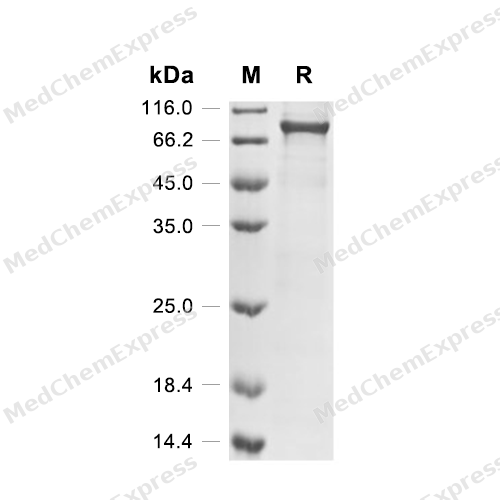
Purity - SDS-PAGE


Technical Parameters
-
Species Human
-
Source E. coli
-
Tag C-Myc;N-SUMO;N-10*His
-
Accession
P07196 (S2-D543)
-
Molecular Construction
-
N-term
-
10*His-SUMO
-
NEFL (S2-D543)
Accession # P07196 -
C-term
-
-
Protein Length
Full Length
-
Synonyms
NEFL; Light Molecular Weight Neurofilament Protein; Neurofilament Light Chain; Neurofilament Light Polypeptide Isoform 1; NF68; Neurofilament Light Polypeptide Isoform 2; NFL; Neurofilament Protein, Light Chain; PPP1R110; Neurofilament, Light Polypeptide;
-
AA Sequence
SSFSYEPYYSTSYKRRYVETPRVHISSVRSGYSTARSAYSSYSAPVSSSLSVRRSYSSSSGSLMPSLENLDLSQVAAISNDLKSIRTQEKAQLQDLNDRFASFIERVHELEQQNKVLEAELLVLRQKHSEPSRFRALYEQEIRDLRLAAEDATNEKQALQGEREGLEETLRNLQARYEEEVLSREDAEGRLMEARKGADEAALARAELEKRIDSLMDEISFLKKVHEEEIAELQAQIQYAQISVEMDVTKPDLSAALKDIRAQYEKLAAKNMQNAEEWFKSRFTVLTESAAKNTDAVRAAKDEVSESRRLLKAKTLEIEACRGMNEALEKQLQELEDKQNADISAMQDTINKLENELRTTKSEMARYLKEYQDLLNVKMALDIEIAAYRKLLEGEETRLSFTSVGSITSGYSQSSQVFGRSAYGGLQTSSYLMSTRSFPSYYTSHVQEEQIEVEETIEAAKAEEAKDEPPSEGEAEEEEKDKEEAEEEEAAEEEEAAKEESEEAKEEEEGGEGEEGEETKEAEEEEKKVEGAGEEQAAKKKD
-
Predicted Molecular Mass
81.4 kDa
-
Purity
≥ 90%, as determined by reducing SDS-PAGE.


Product Properties
Lyophilized powder
1.Lyophilized from a 0.22 μm filtered solution of PBS, 6% trehalose.
2.Lyophilized from a 0.22 μm filtered solution of 10 mM Tris-HCl, 1 mM EDTA, 6% trehalose.
Please refer to the lot-specific COA for specific buffer information.
Note: For SPR assay, please replace the buffer. Primary amine components (e.g., Tris, imidazole) can affect protein-coupled chips.
<1 EU/μg, determined by LAL method.
It is not recommended to reconstitute to a concentration less than 100 μg/mL in ddH2O.
Stored at -20°C for 2 years from date of receipt. After reconstitution, it is stable at 4°C for 1 week or -20°C for longer (with carrier protein). It is recommended to freeze aliquots at -20°C or -80°C for extended storage.
Room temperature in continental US; may vary elsewhere.


Documentation
-
Data Sheet (238 KB)
-
SDS (251 KB)
- English - EN (251 KB)
- Français - FR (251 KB)
- Deutsch - DE (251 KB)
- Norwegian - NO (251 KB)
- Español - ES (251 KB)
- Swedish - SV (251 KB)
- Italian - IT (251 KB)
- Korean - KR (251 KB)
- Portuguese - PT (251 KB)
-
Handling Instructions (2659 KB)

Calculators
Concentration (start) × Volume (start) = Concentration (final) × Volume (final)


 Powered by Bioz

