



Neuropilin-1 Protein, Human (HEK293, His)
Based on 3 publication(s) in Google Scholar
Neuropilin-1 protein plays an important role by binding to VEGF-165, possibly inhibiting its cellular binding and inducing apoptosis. This dual function suggests its role in regulating VEGF-mediated processes. Neuropilin-1 Protein, Human (HEK293, His) is the recombinant human-derived Neuropilin-1 protein, expressed by HEK293 , with C-His labeled tag.
- Species: Human
- Source: HEK293
-
Storage:Stored at -20°C for 2 years from date of receipt. After reconstitution, it is stable at 4°C for 1 week or -20°C for longer (with carrier protein). It is recommended to freeze aliquots at -20°C or -80°C for extended storage.


To place orders, for customer services and technical support, please contact: MedChemExpress USA
Tel: 609-228-6898 E-mail: [email protected] [email protected]


-
 Biological Activity
-
Technical Parameters
-
Product Properties
- Documentation
- Help & FAQs




Biological Activity
Description
Neuropilin-1 protein plays an important role by binding to VEGF-165, possibly inhibiting its cellular binding and inducing apoptosis. This dual function suggests its role in regulating VEGF-mediated processes. Neuropilin-1 Protein, Human (HEK293, His) is the recombinant human-derived Neuropilin-1 protein, expressed by HEK293 , with C-His labeled tag.
Background
The Neuropilin-1 protein assumes a significant role as it binds to VEGF-165, potentially inhibiting its binding to cells and inducing apoptosis by sequestering VEGF-165. This dual functionality suggests Neuropilin-1's involvement in the regulation of VEGF-mediated cellular processes. Additionally, Neuropilin-1 may interact with various members of the semaphorin family, indicating its versatility in binding to different ligands. Notably, its expression appears to exert an adverse effect on blood vessel number and integrity, suggesting a potential role in angiogenesis and vascular development. The diverse interactions and regulatory effects of Neuropilin-1 underscore its importance in orchestrating complex cellular processes and its potential implications in angiogenesis and apoptotic pathways.
Verified Bioactivity
1.Measured by its binding ability in a functional ELISA. Immobilized human Neuropilin-1, at 2 μg/mL (100 μL/well) can bind Biotinylated Human VEGF165 protein. The ED50 for this effect is 14.96 ng/mL.
2.Immobilized Recombinant Human / Cynomolgus VEGF / VEGFA / VEGF165 Protein at 2 μg/mL (100 μL/well) can bind Neuropilin-1, Human with a linear range of 32-160 μg/mL.
3.Measured by its ability to inhibit the cell growth of MCF-7 human breast cancer cell line. The ED50 for
this effect is 13.44 ng/mL, corresponding to a specific activity is 7.44×10⁴ U/mg.
4.Measured in a cell proliferation assay using HUVEC cells. The ED50 for this effect is 154.3 ng/mL,
corresponding to a specific activity is 6.48×10³ units/mg.
MCE Validation Data
-
Purity - SDS-PAGE
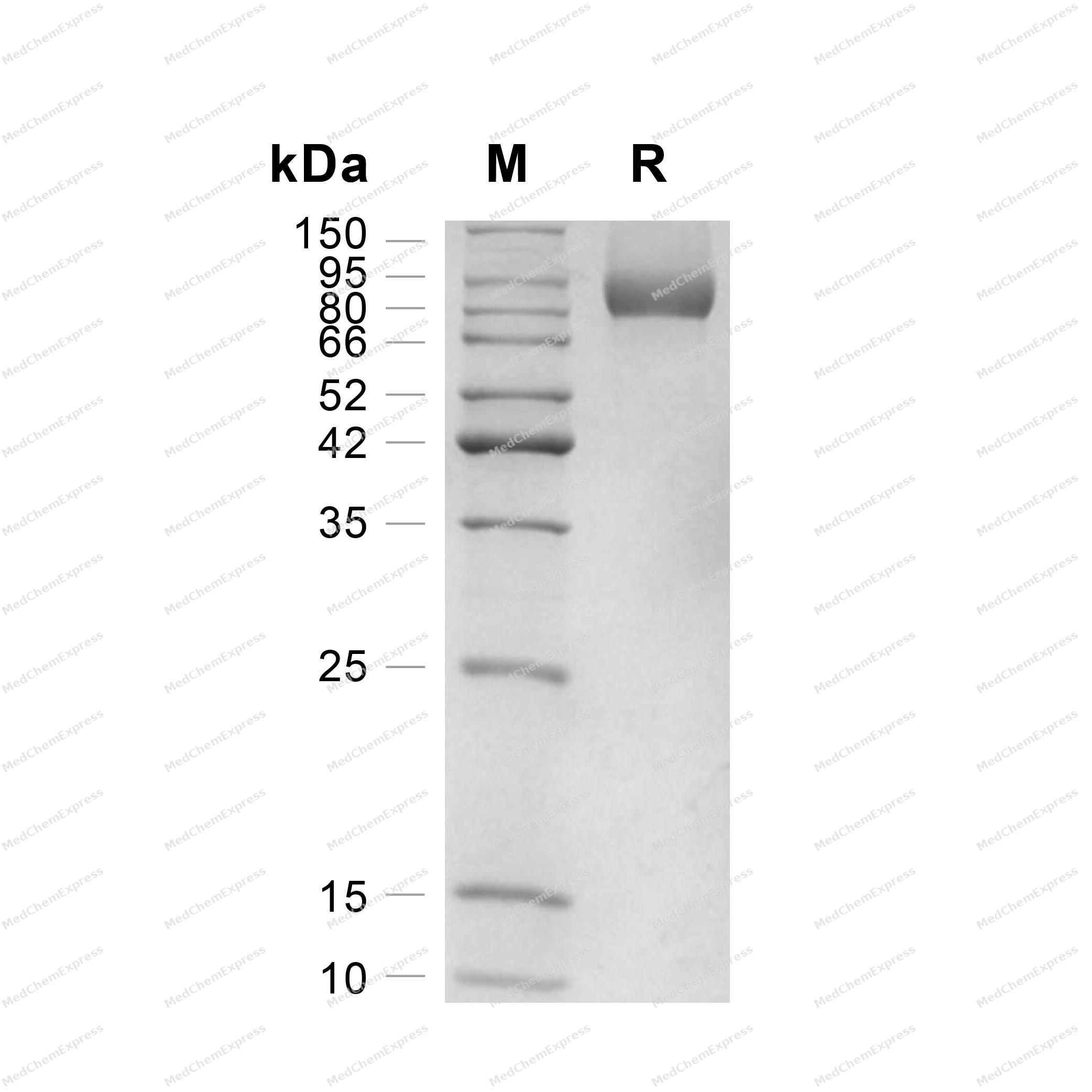
Purity - SDS-PAGE
-
Bioactivity - ELISA
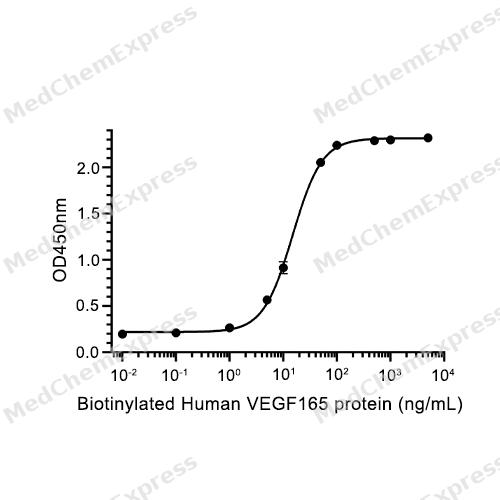
Bioactivity - ELISA


Publications (3)
-
Journal Impact Factor
-
Most Recent
-
-
Biochem Pharmacol
Pitavastatin overcomes multi-drug resistance in CRC and NSCLC by targeting the NRP1-ZFX axis. [Abstract]2025 Nov:241:117183. PMID: 40684995 -
Biol Pharm Bull
2024;47(1):166-174. PMID: 38220212


Technical Parameters
-
Species Human
-
Source HEK293
-
Tag C-His
-
Accession
AAH07533.1 (F22-K644)
-
Molecular Construction
-
N-term
-
Neuropilin-1 (F22-K644)
Accession # AAH07533.1 -
His
-
C-term
-
-
Protein Length
Partial Extracellular Domain
-
Synonyms
NRP1; Transmembrane Receptor; Neuropilin 1; CD304 Antigen; VEGF165R; DKFZp686M1967; NRP; Neuropilin; Neuropilin-1; BDCA4; CD304; NP1; Vascular Endothelial Cell Growth Factor 165 Receptor
-
AA Sequence
FRNDKCGDTIKIESPGYLTSPGYPHSYHPSEKCEWLIQAPDPYQRIMINFNPHFDLEDRDCKYDYVEVFDGENENGHFRGKFCGKIAPPPVVSSGPFLFIKFVSDYETHGAGFSIRYEIFKRGPECSQNYTTPSGVIKSPGFPEKYPNSLECTYIVFAPKMSEIILEFESFDLEPDSNPPGGMFCRYDRLEIWDGFPDVGPHIGRYCGQKTPGRIRSSSGILSMVFYTDSAIAKEGFSANYSVLQSSVSEDFKCMEALGMESGEIHSDQITASSQYSTNWSAERSRLNYPENGWTPGEDSYREWIQVDLGLLRFVTAVGTQGAISKETKKKYYVKTYKIDVSSNGEDWITIKEGNKPVLFQGNTNPTDVVVAVFPKPLITRFVRIKPATWETGISMRFEVYGCKITDYPCSGMLGMVSGLISDSQITSSNQGDRNWMPENIRLVTSRSGWALPPAPHSYINEWLQIDLGEEKIVRGIIIQGGKHRENKVFMRKFKIGYSNNGSDWKMIMDDSKRKAKSFEGNNNYDTPELRTFPALSTRFIRIYPERATHGGLGLRMELLGCEVEAPTAGPTTPNGNLVDECDDDQANCHSGTGDDFQLTGGTTVLATEKPTVIDSTIQSGIK
-
Molecular Weight
Approximately 75-116 kDa, based on SDS-PAGE under reducing conditions, due to the glycosylation.
-
Glycosylation
Yes
-
Purity
≥ 95%, as determined by reducing SDS-PAGE.


Product Properties
Lyophilized powder.
1.Lyophilized from a 0.22 μm filtered solution of PBS, pH 7.4.
2.Lyophilized from a 0.22 μm filtered solution of 20 mM PB, 150 mM NaCl, pH 7.4.
Please refer to the lot-specific COA for specific buffer information.
<1 EU/μg, determined by LAL method.
It is not recommended to reconstitute to a concentration less than 100 μg/mL in ddH2O. For long term storage it is recommended to add a carrier protein (0.1% BSA, 5% HSA, 10% FBS or 5% Trehalose).
Stored at -20°C for 2 years from date of receipt. After reconstitution, it is stable at 4°C for 1 week or -20°C for longer (with carrier protein). It is recommended to freeze aliquots at -20°C or -80°C for extended storage.
Room temperature in continental US; may vary elsewhere.


Documentation
-
Data Sheet (240 KB)
-
SDS (252 KB)
- English - EN (252 KB)
- Français - FR (252 KB)
- Deutsch - DE (252 KB)
- Norwegian - NO (252 KB)
- Español - ES (252 KB)
- Swedish - SV (252 KB)
- Italian - IT (252 KB)
- Korean - KR (252 KB)
- Portuguese - PT (252 KB)
-
Handling Instructions (2659 KB)

Calculators
Concentration (start) × Volume (start) = Concentration (final) × Volume (final)


 Powered by Bioz

