



Osteopontin/OPN Protein, Rat (CHO, His)
Based on 2 publication(s) in Google Scholar
Osteopontin/OPN Protein, a key non-collagenous bone protein, strongly binds to hydroxyapatite, crucial for the mineralized matrix.It likely plays a vital role in mediating cell-extracellular matrix interactions.Additionally, as a cytokine, OPN stimulates interferon-gamma and interleukin-12 production, while inhibiting interleukin-10, pivotal for the type I immunity pathway.Osteopontin/OPN Protein, Rat (CHO, His) is the recombinant rat-derived Osteopontin/OPN protein, expressed by CHO , with C-6*His labeled tag.
- Species: Rat
- Source: CHO
-
Storage:Stored at -20°C for 2 years from date of receipt. After reconstitution, it is stable at 4°C for 1 week or -20°C for longer (with carrier protein). It is recommended to freeze aliquots at -20°C or -80°C for extended storage.


To place orders, for customer services and technical support, please contact: MedChemExpress USA
Tel: 609-228-6898 E-mail: [email protected] [email protected]


-
 Biological Activity
-
Technical Parameters
-
Product Properties
- Documentation
- Help & FAQs




Biological Activity
Description
Osteopontin/OPN Protein, a key non-collagenous bone protein, strongly binds to hydroxyapatite, crucial for the mineralized matrix.It likely plays a vital role in mediating cell-extracellular matrix interactions.Additionally, as a cytokine, OPN stimulates interferon-gamma and interleukin-12 production, while inhibiting interleukin-10, pivotal for the type I immunity pathway.Osteopontin/OPN Protein, Rat (CHO, His) is the recombinant rat-derived Osteopontin/OPN protein, expressed by CHO , with C-6*His labeled tag.
Background
Osteopontin (OPN) protein, a significant non-collagenous bone protein, tightly binds to hydroxyapatite and plays a crucial role in the mineralized matrix. It is likely essential for facilitating interactions between cells and the extracellular matrix. Furthermore, OPN acts as a cytokine, promoting the production of interferon-gamma and interleukin-12, while inhibiting the production of interleukin-10. These functions are vital in the pathway that leads to type I immunity.
Verified Bioactivity
Measured by the ability of the immobilized protein to support the adhesion of HEK293 human embryonic kidney cells. When 1 x 10⁵ cells/well are added to Recombinant Rat Osteopontin/OPN coated plates, cell adhesion is enhanced in a dose dependent manner after 1 hour incubation at 37°C. The ED50 for this effect is < 1.50 µg/mL.
MCE Validation Data
-
Purity - SDS-PAGE
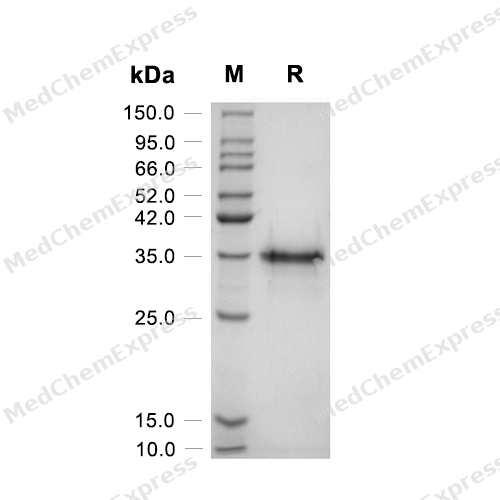
Purity - SDS-PAGE
-
Bioactivity - Cell-Based Assay
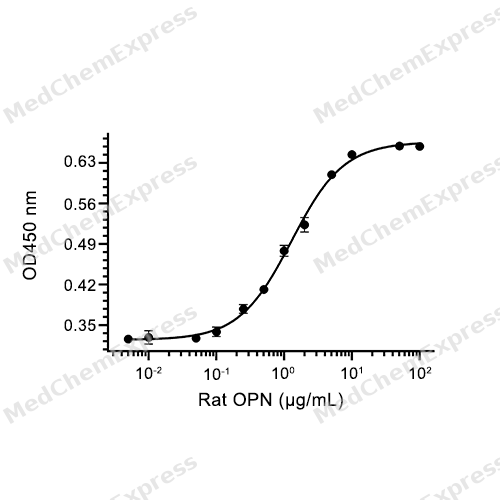
Bioactivity - Cell-Based Assay


Publications (2)
-
Journal Impact Factor
-
Most Recent
-
Bone Res
Single cell atlas decodes the molecular dynamics of scar repair after human rotator cuff tear. [Abstract]2026 Feb 5;14(1):17. PMID: 41644521 -
Nat Commun
Single-cell and spatial transcriptome analyses reveal tumor heterogeneity and immune remodeling involved in pituitary neuroendocrine tumor progression. [Abstract]2025 May 30;16(1):5007. PMID: 40442104


Technical Parameters
-
Species Rat
-
Source CHO
-
Tag C-6*His
-
Accession
P08721 (L17-N317)
-
Molecular Construction
-
N-term
-
OPN (L17-N317)
Accession # P08721 -
6*His
-
C-term
-
-
Protein Length
Full Length of Mature Protein
-
Synonyms
SPP1; Uropontin; Prev. BNSP; Osteopontin/Immunoglobulin Alpha 1 Heavy Chain Constant Region Fusion Protein; Prev. OPN; CDNA FLJ54682, Highly Similar To Osteopontin; Osteopontin; Secreted Phosphoprotein 1 Variant 6; Lnc-PKD2-2-3; Bone Sialoprotein I; ETA-1
-
AA Sequence
LPVKVAEFGSSEEKAHYSKHSDAVATWLKPDPSQKQNLLAPQNSVSSEETDDFKQETLPSNSNESHDHMDDDDDDDDDGDHAESEDSVNSDESDESHHSDESDESFTASTQADVLTPIAPTVDVPDGRGDSLAYGLRSKSRSFPVSDEQYPDATDEDLTSRMKSQESDEAIKVIPVAQRLSVPSDQDSNGKTSHESSQLDEPSVETHSLEQSKEYKQRASHESTEQSDAIDSAEKPDAIDSAERSDAIDSQASSKASLEHQSHEFHSHEDKLVLDPKSKEDDRYLKFRISHELESSSSEVN
-
Predicted Molecular Mass
34.1 kDa
-
Molecular Weight
Approximately 60-65 kDa, based on SDS-PAGE under reducing conditions.
-
Glycosylation
Yes
-
Purity
≥ 95%, as determined by reducing SDS-PAGE.


Product Properties
Lyophilized powder
1.Lyophilized from a 0.22 μm filtered solution of 20 mM PB, 150 mM NaCl, pH 7.4.
2.Lyophilized from a 0.22 μm filtered solution of PBS, pH 7.4.
Please refer to the lot-specific COA for specific buffer information.
<1 EU/μg, determined by LAL method.
It is not recommended to reconstitute to a concentration less than 100 μg/mL in ddH2O. For long term storage it is recommended to add a carrier protein (0.1% BSA, 5% HSA, 10% FBS or 5% Trehalose).
Stored at -20°C for 2 years from date of receipt. After reconstitution, it is stable at 4°C for 1 week or -20°C for longer (with carrier protein). It is recommended to freeze aliquots at -20°C or -80°C for extended storage.
Room temperature in continental US; may vary elsewhere.


Documentation
-
Data Sheet (237 KB)
-
SDS (252 KB)
- English - EN (252 KB)
- Français - FR (252 KB)
- Deutsch - DE (252 KB)
- Norwegian - NO (252 KB)
- Español - ES (252 KB)
- Swedish - SV (252 KB)
- Italian - IT (252 KB)
- Korean - KR (252 KB)
- Portuguese - PT (252 KB)
-
Handling Instructions (2659 KB)

Calculators
Concentration (start) × Volume (start) = Concentration (final) × Volume (final)


 Powered by Bioz

