



Pepsinogen C/PGC Protein, Rat (HEK293, His)

Based on 1 Customer Validation
Pepsinogen C (PGC) functions as an enzyme with the ability to hydrolyze a diverse range of proteins.Pepsinogen C/PGC Protein, Rat (HEK293, His) is the recombinant rat-derived Pepsinogen C/PGC protein, expressed by HEK293 , with C-His labeled tag.
- Species: Rat
- Source: HEK293
-
Storage:Stored at -20°C for 2 years from date of receipt. After reconstitution, it is stable at 4°C for 1 week or -20°C for longer (with carrier protein). It is recommended to freeze aliquots at -20°C or -80°C for extended storage.


To place orders, for customer services and technical support, please contact: MedChemExpress USA
Tel: 609-228-6898 E-mail: [email protected] [email protected]


-
 Biological Activity
-
Technical Parameters
-
Product Properties
- Documentation
- Help & FAQs




Biological Activity
Description
Pepsinogen C (PGC) functions as an enzyme with the ability to hydrolyze a diverse range of proteins.Pepsinogen C/PGC Protein, Rat (HEK293, His) is the recombinant rat-derived Pepsinogen C/PGC protein, expressed by HEK293 , with C-His labeled tag.
Background
Pepsinogen C (PGC) is an enzyme that functions as a precursor to the digestive enzyme pepsin. PGC possesses the ability to hydrolyze a diverse range of proteins. This enzyme is primarily synthesized and secreted by the gastric chief cells in the stomach lining. Once released into the acidic environment of the stomach, PGC undergoes cleavage to form pepsin, an active protease responsible for breaking down dietary proteins into smaller peptides. The conversion of PGC to pepsin is facilitated by the low pH of the stomach, triggering the activation of this zymogen. The role of PGC in the digestive process is crucial for the initial breakdown of ingested proteins, enabling their subsequent digestion and absorption in the gastrointestinal tract. Understanding the activation and function of PGC contributes to insights into the intricate mechanisms of protein digestion and gastric physiology.
Verified Bioactivity
Measured by its ability to cleave the fluorogenic peptide substrate, Mca-RPPGFSAFK(Dnp)-OH. The specific activity is 41133.212 pmol/min/μg that incubate at room temperature for 10 minutes.
MCE Validation Data
-
Purity - SDS-PAGE
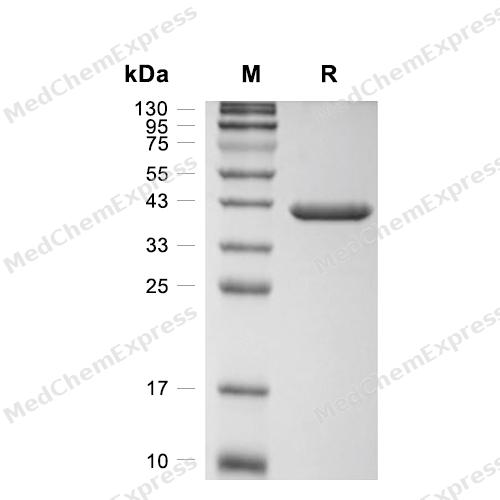
Purity - SDS-PAGE


Technical Parameters
-
Species Rat
-
Source HEK293
-
Tag C-6*His
-
Accession
P04073 (S17-V392)
-
Molecular Construction
-
N-term
-
PGC (S17-V392)
Accession # P04073 -
His
-
C-term
-
-
Protein Length
Full Length of Mature Protein
-
Synonyms
PGC; Pepsinogen Group II; Progastricsin; Preprogastricsin; Pepsinogen C; Pepsin C; Gastricsin; PEPC; Progastricsin (Pepsinogen C); PGII
-
AA Sequence
SLLRVPLRKMKSIRETMKEQGVLKDFLKTHKYDPGQKYHFGNFGDYSVLYEPMAYMDASYFGEISIGTPPQNFLVLFDTGSSNLWVSSVYCQSEACTTHARFNPSKSSTYYTEGQTFSLQYGTGSLTGFFGYDTLTVQSIQVPNQEFGLSENEPGTNFVYAQFDGIMGLAYPGLSSGGATTALQGMLGEGALSQPLFGVYLGSQQGSNGGQIVFGGVDKNLYTGEITWVPVTQELYWQITIDDFLIGDQASGWCSSQGCQGIVDTGTSLLVMPAQYLSELLQTIGAQEGEYGEYFVSCDSVSSLPTLSFVLNGVQFPLSPSSYIIQEDNFCMVGLESISLTSESGQPLWILGDVFLRSYYAIFDMGNNKVGLATSV
-
Molecular Weight
Approximately 43 kDa, based on SDS-PAGE under reducing conditions.
-
Purity
≥ 95%, as determined by reducing SDS-PAGE.


Product Properties
Lyophilized powder.
Lyophilized from a 0.22 μm filtered solution of 50 mM Tris, 150 mM NaCl, pH 7.5.
Note: For SPR assay, please replace the buffer. Primary amine components (e.g., Tris, imidazole) can affect protein-coupled chips.
<1 EU/μg, determined by LAL method.
It is not recommended to reconstitute to a concentration less than 100 μg/mL in ddH2O. For long term storage it is recommended to add a carrier protein (0.1% BSA, 5% HSA, 10% FBS or 5% Trehalose).
Stored at -20°C for 2 years from date of receipt. After reconstitution, it is stable at 4°C for 1 week or -20°C for longer (with carrier protein). It is recommended to freeze aliquots at -20°C or -80°C for extended storage.
Room temperature in continental US; may vary elsewhere.


Documentation
-
Data Sheet (238 KB)
-
SDS (251 KB)
- English - EN (251 KB)
- Français - FR (251 KB)
- Deutsch - DE (251 KB)
- Norwegian - NO (251 KB)
- Español - ES (251 KB)
- Swedish - SV (251 KB)
- Italian - IT (251 KB)
- Korean - KR (251 KB)
- Portuguese - PT (251 KB)
-
Handling Instructions (2659 KB)

Calculators
Concentration (start) × Volume (start) = Concentration (final) × Volume (final)


 Powered by Bioz

