



PLA2G7 Protein, Human (HEK293, His)

Based on 1 Customer Validation
PLA2G7 Protein is a lipoprotein-associated calcium-independent phospholipase A2 involved in phospholipid catabolism during inflammatory and oxidative stress responses. It is also a secreted enzyme that catalyzes the degradation of platelet-activating factor to biologically inactive products. PLA2G7 can hydrolyze phospholipids with long fatty acyl chains, only if they carry oxidized functional groups. PLA2G7 Protein, Human (HEK293, His) is the recombinant human-derived PLA2G7 protein, expressed by HEK293 , with C-6*His labeled tag.
- Species: Human
- Source: HEK293
-
Storage:Stored at -80°C for 1 year from date of receipt. It is stable at -20°C for 3 months after opening. It is recommended to freeze aliquots at -80°C for extended storage. Avoid repeated freeze-thaw cycles.


To place orders, for customer services and technical support, please contact: MedChemExpress USA
Tel: 609-228-6898 E-mail: [email protected] [email protected]


-
 Biological Activity
-
Technical Parameters
-
Product Properties
- Documentation
- Help & FAQs




Biological Activity
Description
PLA2G7 Protein is a lipoprotein-associated calcium-independent phospholipase A2 involved in phospholipid catabolism during inflammatory and oxidative stress responses. It is also a secreted enzyme that catalyzes the degradation of platelet-activating factor to biologically inactive products. PLA2G7 can hydrolyze phospholipids with long fatty acyl chains, only if they carry oxidized functional groups. PLA2G7 Protein, Human (HEK293, His) is the recombinant human-derived PLA2G7 protein, expressed by HEK293 , with C-6*His labeled tag.
Background
Platelet-activating factor acetylhydrolase (PLA2G7) is a lipoprotein-associated calcium-independent phospholipase A2 involved in phospholipid catabolism during inflammatory and oxidative stress responses. At the lipid-aqueous interface, PLA2G7 hydrolyzes the ester bond of fatty acyl group attached at sn-2 position of phospholipids, that specifically targets phospholipids with a short-chain fatty acyl group at sn-2 position. It also hydrolyzes and inactivates platelet-activating factor (PAF, 1-O-alkyl-2-acetyl-sn-glycero-3-phosphocholine), a potent pro-inflammatory signaling lipid that acts through PTAFR on various innate immune cells. In addition, PLA2G7 hydrolyzes oxidatively truncated phospholipids carrying an aldehyde group at omega position, preventing their accumulation in low-density lipoprotein (LDL) particles and uncontrolled pro-inflammatory effects. As part of high-density lipoprotein (HDL) particles, PLA2G7 can hydrolyze phospholipids having long-chain fatty acyl hydroperoxides at sn-2 position and protect against potential accumulation of these oxylipins in the vascular wall. PLA2G7 catalyzes the release from membrane phospholipids of F2-isoprostanes, lipid biomarkers of cellular oxidative damage[1][2][3][4][5].
Verified Bioactivity
Measured by its ability to cleave a colorimetric peptide substrate of 200μM 2-Thio-PAF, in the presence of 5,5’Dithio-bis(2-nitrobenzoic acid) (DTNB) that incubate at room temperature for 5 minutes. The specific activity is 27117.898 pmol/min/ug.
MCE Validation Data
-
Purity - SDS-PAGE
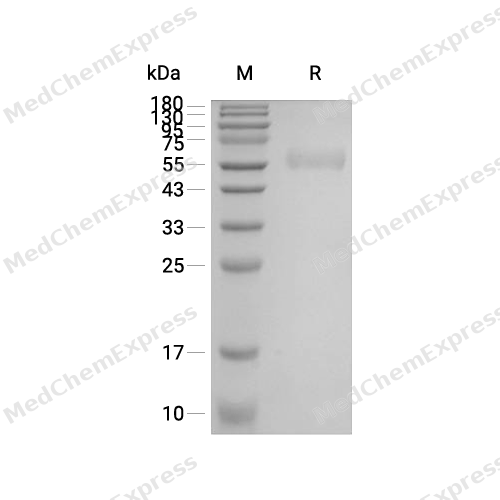
Purity - SDS-PAGE


Technical Parameters
-
Species Human
-
Source HEK293
-
Tag C-6*His
-
Accession
AAH38452.1 (F22-N441)
-
Molecular Construction
-
N-term
-
PLA2G7 (F22-N441)
Accession # AAH38452.1 -
6*His
-
C-term
-
-
Protein Length
Full Length of Platelet-activating factor acetylhydrolase Chain
-
Synonyms
PLA2G7; LDL-Associated Phospholipase A2; Phospholipase A2 Group VII; Group-VIIA Phospholipase A2; PAFAH; PAF 2-Acylhydrolase; LDL-PLA2; PAF Acetylhydrolase; Lp-PLA2; LDL-PLA(2); Phospholipase A2, Group VII (Platelet-Activating Factor Acetylhydrolase, Plasma); GVIIA-PLA2; 1-Alkyl-2-Acetylglycerophosphocholine Esterase; Lipoprotein-Associated Phospholipase A2; 2-Acetyl-1-Alkylglycerophosphocholine Esterase; PAFAD; Platelet-Activating Factor Acetylhydrolase
-
AA Sequence
FDWQYINPVAHMKSSAWVNKIQVLMAAASFGQTKIPRGNGPYSVGCTDLMFDHTNKGTFLRLYYPSQDNDRLDTLWIPNKEYFWGLSKFLGTHWLMGNILRLLFGSMTTPANWNSPLRPGEKYPLVVFSHGLGAFRTLYSAIGIDLASHGFIVAAVEHRDRSASATYYFKDQSAAEIGDKSWLYLRTLKQEEETHIRNEQVRQRAKECSQALSLILDIDHGKPVKNALDLKFDMEQLKDSIDREKIAVIGHSFGGATVIQTLSEDQRFRCGIALDAWMFPLGDEVYSRIPQPLFFINSEYFQYPANIIKMKKCYSPDKERKMITIRGSVHQNFADFTFATGKIIGHMLKLKGDIDSNAAIDLSNKASLAFLQKHLGLHKDFDQWDCLIEGDDENLIPGTNINTTNQHIMLQNSSGIEKYN
-
Predicted Molecular Mass
48.8 kDa
-
Molecular Weight
Approximately 50-68 kDa, based on SDS-PAGE under reducing conditions.
-
Glycosylation
Yes
-
Purity
≥ 90%, as determined by reducing SDS-PAGE.


Product Properties
Solution
Supplied as a 0.22 μm filtered solution of 50 mM NaAc, 150 mM NaCl, 10% Glycerol, pH 5.0.
<1 EU/μg, determined by LAL method.
Stored at -80°C for 1 year from date of receipt. It is stable at -20°C for 3 months after opening. It is recommended to freeze aliquots at -80°C for extended storage. Avoid repeated freeze-thaw cycles.
Shipping with dry ice.


Documentation
-
Data Sheet (238 KB)
-
SDS (254 KB)
- English - EN (254 KB)
- Français - FR (254 KB)
- Deutsch - DE (254 KB)
- Norwegian - NO (254 KB)
- Español - ES (254 KB)
- Swedish - SV (254 KB)
- Italian - IT (254 KB)
- Korean - KR (254 KB)
- Portuguese - PT (254 KB)
-
Handling Instructions (2659 KB)

Calculators
Concentration (start) × Volume (start) = Concentration (final) × Volume (final)


 Powered by Bioz

