



Proinsulin Protein, Human (His)
Based on 1 Customer Validation
Proinsulin is the precursor of insulin, a key hormone that regulates carbohydrate and lipid metabolism. Post-translational cleavage produces insulin, which consists of B and A chain peptides and a C peptide linked by disulfide bonds. Proinsulin Protein, Human (His) is the recombinant human-derived Proinsulin protein, expressed by E. coli , with N-6*His labeled tag.
- Species: Human
- Source: E. coli
-
Storage:Stored at -20°C for 2 years from date of receipt. After reconstitution, it is stable at 4°C for 1 week or -20°C for longer (with carrier protein). It is recommended to freeze aliquots at -20°C or -80°C for extended storage.


To place orders, for customer services and technical support, please contact: MedChemExpress USA
Tel: 609-228-6898 E-mail: [email protected] [email protected]


-
 Biological Activity
-
Technical Parameters
-
Product Properties
- Documentation
- Help & FAQs




Biological Activity
Description
Proinsulin is the precursor of insulin, a key hormone that regulates carbohydrate and lipid metabolism. Post-translational cleavage produces insulin, which consists of B and A chain peptides and a C peptide linked by disulfide bonds. Proinsulin Protein, Human (His) is the recombinant human-derived Proinsulin protein, expressed by E. coli , with N-6*His labeled tag.
Background
Proinsulin Protein, encoded by this gene, is the precursor of insulin, a crucial peptide hormone that plays a pivotal role in regulating carbohydrate and lipid metabolism. Following the removal of the precursor signal peptide, proinsulin undergoes post-translational cleavage, generating three peptides: the B chain and A chain peptides, which covalently link to form insulin, and C-peptide. The binding of insulin to the insulin receptor (INSR) stimulates glucose uptake, a process integral to metabolic homeostasis. Various mutant alleles with diverse phenotypic effects, such as insulin-dependent diabetes mellitus, permanent neonatal diabetes mellitus, maturity-onset diabetes of the young type 10, and hyperproinsulinemia, have been identified. Notably, expression of this gene is predominantly restricted to the pancreas, emphasizing its central role in glucose regulation and metabolism within pancreatic tissues. Additionally, a read-through gene, INS-IGF2, overlaps with this gene at the 5' region and with the IGF2 gene at the 3' region, further contributing to the complexity of regulatory mechanisms in this genomic locus.
Verified Bioactivity
Measured in a serum-free cell proliferation assay using MCF-7 human breast cancer cells. The ED50 for this effect is 0.5182μg/mL.
MCE Validation Data
-
Purity - SDS-PAGE
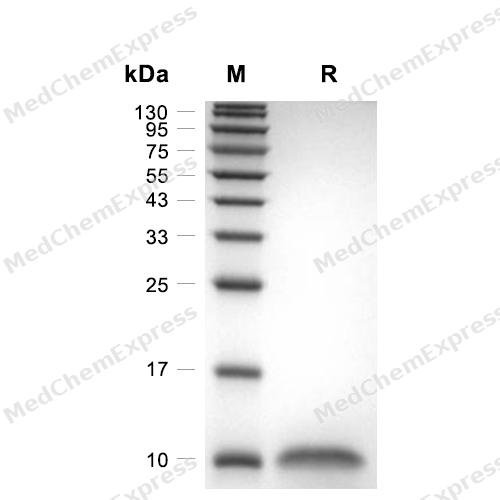
Purity - SDS-PAGE
-
Bioactivity - Cell-Based Assay
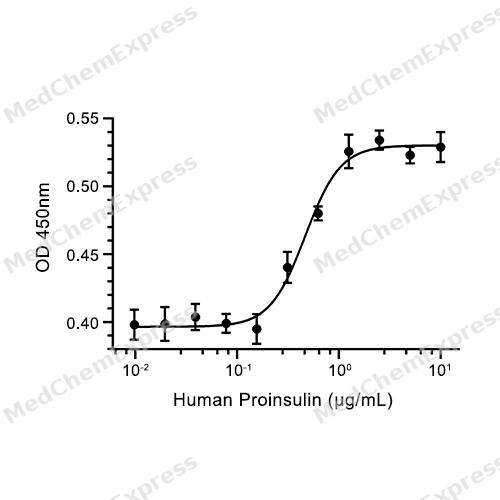
Bioactivity - Cell-Based Assay


Technical Parameters
-
Species Human
-
Source E. coli
-
Tag N-6*His
-
Accession
NP_000198.1 (F25-N110)
-
Gene ID3630
-
Molecular Construction
-
N-term
-
6*His
-
Proinsulin (F25-N110)
Accession # NP_000198 -
C-term
-
-
Protein Length
Full Length of Mature Protein
-
Synonyms
INS; Proinsulin; Prev. IDDM1; PNDM4; Prev. IDDM2; IDDM; Insulin-Dependent Diabetes Mellitus 2; ILPR; Preproinsulin; IRDN; Insulin; MODY10
-
AA Sequence
FVNQHLCGSHLVEALYLVCGERGFFYTPKTRREAEDLQVGQVELGGGPGAGSLQPLALEGSLQKRGIVEQCCTSICSLYQLENYCN
-
Molecular Weight
Approximately 9 kDa, based on SDS-PAGE under reducing conditions.
-
Purity
≥ 95%, as determined by reducing SDS-PAGE.


Product Properties
Lyophilized powder.
Lyophilized from a 0.22 μm filtered solution of PBS, pH 7.4, 8% trehalose.
<1 EU/μg, determined by LAL method.
It is not recommended to reconstitute to a concentration less than 100 μg/mL in PBS.
Stored at -20°C for 2 years from date of receipt. After reconstitution, it is stable at 4°C for 1 week or -20°C for longer (with carrier protein). It is recommended to freeze aliquots at -20°C or -80°C for extended storage.
Room temperature in continental US; may vary elsewhere.


Documentation
-
Data Sheet (235 KB)
-
SDS (251 KB)
- English - EN (251 KB)
- Français - FR (251 KB)
- Deutsch - DE (251 KB)
- Norwegian - NO (251 KB)
- Español - ES (251 KB)
- Swedish - SV (251 KB)
- Italian - IT (251 KB)
- Korean - KR (251 KB)
- Portuguese - PT (251 KB)
-
Handling Instructions (2659 KB)

Calculators
Concentration (start) × Volume (start) = Concentration (final) × Volume (final)


 Powered by Bioz

