



SBDS Protein, Human (His)

Based on 1 Customer Validation
The SBDS protein is indispensable for ribosome biogenesis and cooperates with EFL1 to trigger GTP-dependent EIF6 release from 60S preribosomes in the cytoplasm. This activates ribosomes, allowing 80S ribosome assembly and recycling of EIF6 to the nucleus. SBDS Protein, Human (His) is the recombinant human-derived SBDS protein, expressed by E. coli , with N-His labeled tag.
- Species: Human
- Source: E. coli
-
Storage:Stored at -20°C for 2 years from date of receipt. After reconstitution, it is stable at 4°C for 1 week or -20°C for longer (with carrier protein). It is recommended to freeze aliquots at -20°C or -80°C for extended storage.


To place orders, for customer services and technical support, please contact: MedChemExpress USA
Tel: 609-228-6898 E-mail: [email protected] [email protected]


-
 Biological Activity
-
Technical Parameters
-
Product Properties
- Documentation
- Help & FAQs




Biological Activity
Description
The SBDS protein is indispensable for ribosome biogenesis and cooperates with EFL1 to trigger GTP-dependent EIF6 release from 60S preribosomes in the cytoplasm. This activates ribosomes, allowing 80S ribosome assembly and recycling of EIF6 to the nucleus. SBDS Protein, Human (His) is the recombinant human-derived SBDS protein, expressed by E. coli , with N-His labeled tag.
Background
The SBDS protein is essential for the formation of mature ribosomes and the process of ribosome biogenesis. It works in conjunction with EFL1 to trigger the GTP-dependent release of EIF6 from 60S pre-ribosomes in the cytoplasm. This release activates ribosomes, allowing for the assembly of 80S ribosomes and facilitating the recycling of EIF6 back to the nucleus. In the nucleus, EIF6 is crucial for 60S rRNA processing and nuclear export. The SBDS protein is also necessary for normal protein synthesis levels and may have roles in cellular stress resistance, DNA damage response, and cell proliferation. It associates with the 60S ribosomal subunit and interacts with NPM1, RPA1, PRKDC, NIP7, EFL1, and CLN3. Additionally, it forms a complex with the 60S ribosomal subunit, SBDS, and EFL1.
MCE Validation Data
-
Purity - SDS-PAGE
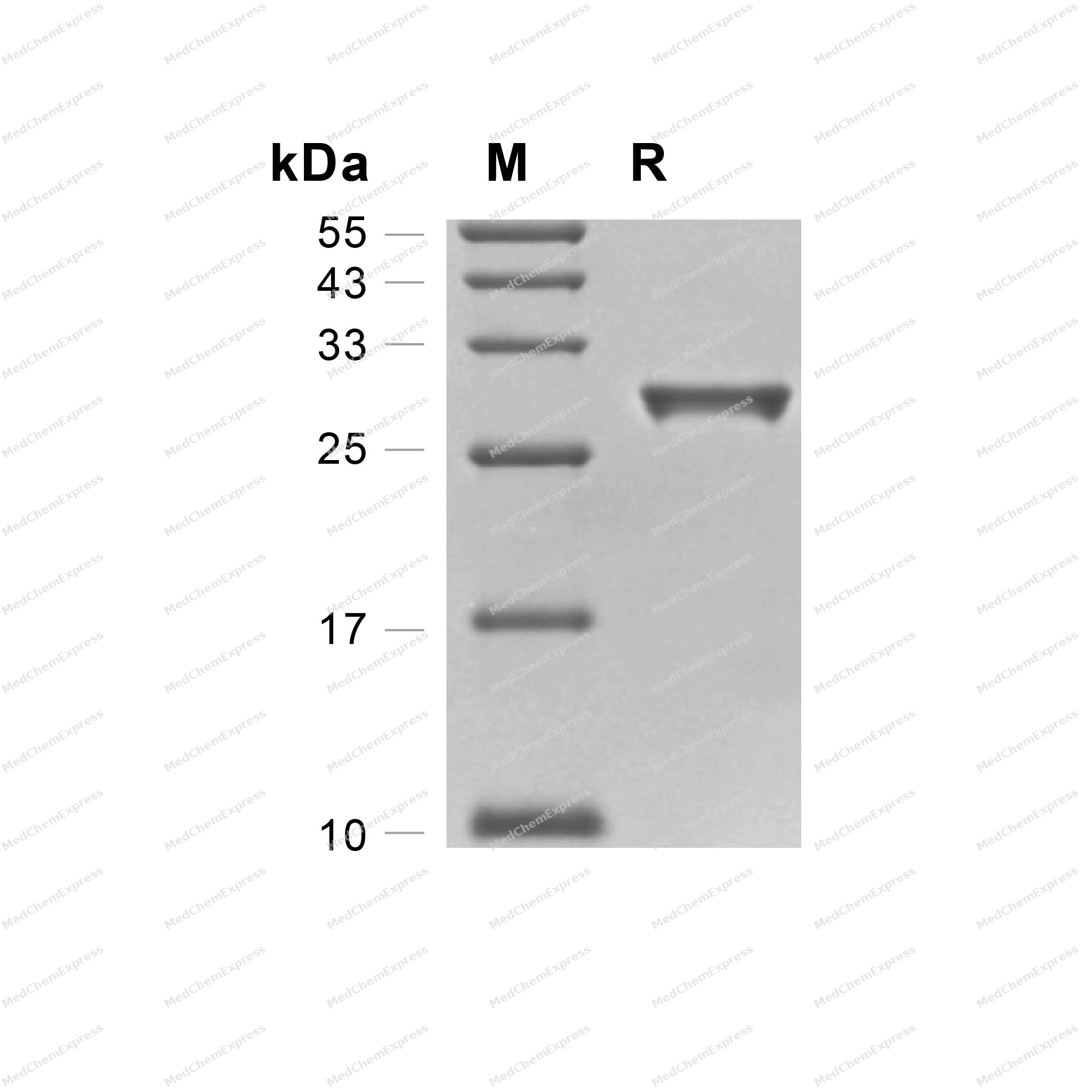
Purity - SDS-PAGE


Technical Parameters
-
Species Human
-
Source E. coli
-
Tag N-His
-
Accession
Q9Y3A5 (M1-E250)
-
Molecular Construction
-
N-term
-
His
-
SBDS (M1-E250)
Accession # Q9Y3A5 -
C-term
-
-
Protein Length
Full Length
-
Synonyms
SBDS; SDS; SBDS Ribosome Maturation Factor; SBDS, Ribosome Assembly Guanine Nucleotide Exchange Factor; Ribosome Maturation Protein SBDS; FLJ10917; CGI-97; Shwachman-Bodian-Diamond Syndrome Isoform 3; SDO1; Shwachman-Bodian-Diamond Syndrome Protein; SWDS;
-
AA Sequence
MSIFTPTNQIRLTNVAVVRMKRAGKRFEIACYKNKVVGWRSGVEKDLDEVLQTHSVFVNVSKGQVAKKEDLISAFGTDDQTEICKQILTKGEVQVSDKERHTQLEQMFRDIATIVADKCVNPETKRPYTVILIERAMKDIHYSVKTNKSTKQQALEVIKQLKEKMKIERAHMRLRFILPVNEGKKLKEKLKPLIKVIESEDYGQQLEIVCLIDPGCFREIDELIKKETKGKGSLEVLNLKDVEEGDEKFE
-
Molecular Weight
Approximately 30-36 kDa, based on SDS-PAGE under reducing conditions.
-
Purity
≥ 95%, as determined by reducing SDS-PAGE.


Product Properties
Lyophilized powder.
Lyophilized from a 0.22 μm filtered solution of PBS, 10% glycerol.
<1 EU/μg, determined by LAL method.
It is not recommended to reconstitute to a concentration less than 100 μg/mL in ddH2O. For long term storage it is recommended to add a carrier protein (0.1% BSA, 5% HSA, 10% FBS or 5% Trehalose).
Stored at -20°C for 2 years from date of receipt. After reconstitution, it is stable at 4°C for 1 week or -20°C for longer (with carrier protein). It is recommended to freeze aliquots at -20°C or -80°C for extended storage.
Room temperature in continental US; may vary elsewhere.


Documentation
-
Data Sheet (236 KB)
-
SDS (252 KB)
- English - EN (252 KB)
- Français - FR (252 KB)
- Deutsch - DE (252 KB)
- Norwegian - NO (252 KB)
- Español - ES (252 KB)
- Swedish - SV (252 KB)
- Italian - IT (252 KB)
- Korean - KR (252 KB)
- Portuguese - PT (252 KB)
-
Handling Instructions (2659 KB)

Calculators
Concentration (start) × Volume (start) = Concentration (final) × Volume (final)


 Powered by Bioz

