



Semaphorin-4A/SEMA4A Protein, Human (HEK293, His)

Based on 1 Customer Validation
Semaphorin-4A/SEMA4A is the cell surface receptor for PLXNB1, PLXNB2, PLXNB3, and PLXND1 and is essential for intercellular signaling. It induces TIMD2 phosphorylation, inhibits angiogenesis, and collapses axonal growth cones. Semaphorin-4A/SEMA4A Protein, Human (HEK293, His) is the recombinant human-derived Semaphorin-4A/SEMA4A protein, expressed by HEK293 , with C-His labeled tag.
- Species: Human
- Source: HEK293
-
Storage:Stored at -20°C for 2 years from date of receipt. After reconstitution, it is stable at 4°C for 1 week or -20°C for longer (with carrier protein). It is recommended to freeze aliquots at -20°C or -80°C for extended storage.


To place orders, for customer services and technical support, please contact: MedChemExpress USA
Tel: 609-228-6898 E-mail: [email protected] [email protected]


-
 Biological Activity
-
Technical Parameters
-
Product Properties
- Documentation
- Help & FAQs




Biological Activity
Description
Semaphorin-4A/SEMA4A is the cell surface receptor for PLXNB1, PLXNB2, PLXNB3, and PLXND1 and is essential for intercellular signaling. It induces TIMD2 phosphorylation, inhibits angiogenesis, and collapses axonal growth cones. Semaphorin-4A/SEMA4A Protein, Human (HEK293, His) is the recombinant human-derived Semaphorin-4A/SEMA4A protein, expressed by HEK293 , with C-His labeled tag.
Background
Semaphorin-4A (SEMA4A) serves as a cell surface receptor for PLXNB1, PLXNB2, PLXNB3, and PLXND1, playing a pivotal role in cell-cell signaling. This multifaceted protein is implicated in the regulation of glutamatergic and GABAergic synapse development, fostering inhibitory synapses in a PLXNB1-dependent manner and excitatory synapses in a PLXNB2-dependent manner. Additionally, SEMA4A contributes to adaptive immunity by priming antigen-specific T-cells, promoting the differentiation of Th1 T-helper cells, and facilitating the phosphorylation of TIMD2. Furthermore, SEMA4A exerts inhibitory effects on angiogenesis, induces axon growth cone collapse, and hinders axonal extension by providing localized signals that specify territories inaccessible for growing axons. Its intricate role is underscored by interactions with PLXNB1, PLXNB2, PLXNB3, PLXND1, and TIMD2, emphasizing its involvement in diverse cellular processes.
Verified Bioactivity
Measured by its binding ability in a functional ELISA. When Human Semaphorin 4A is immobilized at 2.0 µg/mL(100 μL/well)can bind Human LILRB2/CD85d/ILT4(HY-P70168). The ED50 for this effect is 0.5264-0.5706 μg/mL.
MCE Validation Data
-
Purity - SDS-PAGE
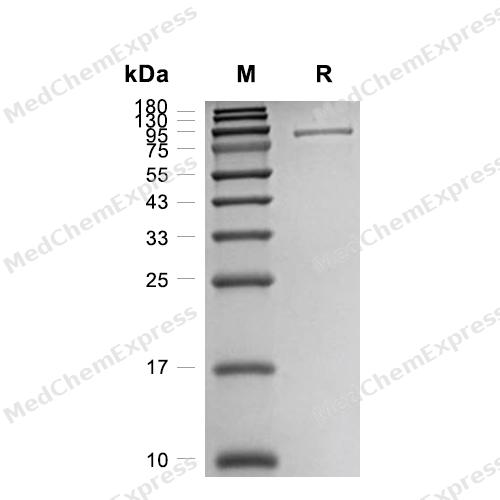
Purity - SDS-PAGE
-
Bioactivity - ELISA
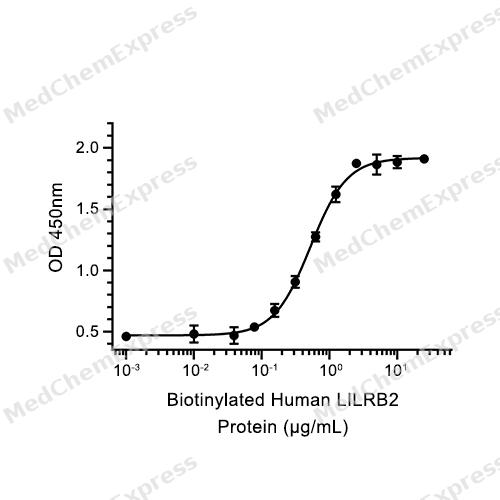
Bioactivity - ELISA


Technical Parameters
-
Species Human
-
Source HEK293
-
Tag C-His
-
Accession
Q9H3S1-1 (G33-H683)
-
Molecular Construction
-
N-term
-
SEMA4A (G33-H683)
Accession # Q9H3S1-1 -
His
-
C-term
-
-
Protein Length
Extracellular Domain
-
Synonyms
SEMA4A; Semaphorin-4A; Prev. SEMAB; FLJ12287; CORD10; Sema B; SemB; RP35; Sema Domain, Immunoglobulin Domain (Ig), Transmembrane Domain (TM) And Short Cytoplasmic Domain, (Semaphorin) 4A; SEMB; Semaphorin 4A; Semaphorin-B
-
AA Sequence
GGGQGPMPRVRYYAGDERRALSFFHQKGLQDFDTLLLSGDGNTLYVGAREAILALDIQDPGVPRLKNMIPWPASDRKKSECAFKKKSNETQCFNFIRVLVSYNVTHLYTCGTFAFSPACTFIELQDSYLLPISEDKVMEGKGQSPFDPAHKHTAVLVDGMLYSGTMNNFLGSEPILMRTLGSQPVLKTDNFLRWLHHDASFVAAIPSTQVVYFFFEETASEFDFFERLHTSRVARVCKNDVGGEKLLQKKWTTFLKAQLLCTQPGQLPFNVIRHAVLLPADSPTAPHIYAVFTSQWQVGGTRSSAVCAFSLLDIERVFKGKYKELNKETSRWTTYRGPETNPRPGSCSVGPSSDKALTFMKDHFLMDEQVVGTPLLVKSGVEYTRLAVETAQGLDGHSHLVMYLGTTTGSLHKAVVSGDSSAHLVEEIQLFPDPEPVRNLQLAPTQGAVFVGFSGGVWRVPRANCSVYESCVDCVLARDPHCAWDPESRTCCLLSAPNLNSWKQDMERGNPEWACASGPMSRSLRPQSRPQIIKEVLAVPNSILELPCPHLSALASYYWSHGPAAVPEASSTVYNGSLLLIVQDGVGGLYQCWATENGFSYPVISYWVDSQDQTLALDPELAGIPREHVKVPLTRVSGGAALAAQQSYWPH
-
Molecular Weight
Approximately 75-80 kDa, based on SDS-PAGE under reducing conditions.
-
Glycosylation
Yes
-
Purity
≥ 90%, as determined by reducing SDS-PAGE.


Product Properties
Lyophilized powder.
1.Lyophilized from a 0.22 μm filtered solution of PBS, pH 7.4, 5% trehalose, 5% mannitol, 0.01% tween 80.
2.Lyophilized from a 0.22 μm filtered solution of PBS, pH 6.5, 8% trehalose.
Please refer to the lot-specific COA for specific buffer information.
<1 EU/μg, determined by LAL method.
It is not recommended to reconstitute to a concentration less than 100 μg/mL in ddH2O.
Stored at -20°C for 2 years from date of receipt. After reconstitution, it is stable at 4°C for 1 week or -20°C for longer (with carrier protein). It is recommended to freeze aliquots at -20°C or -80°C for extended storage.
Room temperature in continental US; may vary elsewhere.


Documentation
-
Data Sheet (240 KB)
-
SDS (252 KB)
- English - EN (252 KB)
- Français - FR (252 KB)
- Deutsch - DE (252 KB)
- Norwegian - NO (252 KB)
- Español - ES (252 KB)
- Swedish - SV (252 KB)
- Italian - IT (252 KB)
- Korean - KR (252 KB)
- Portuguese - PT (252 KB)
-
Handling Instructions (2659 KB)

Calculators
Concentration (start) × Volume (start) = Concentration (final) × Volume (final)


 Powered by Bioz

