



Serpin A5 Protein, Human (HEK293, His)
Based on 3 publication(s) in Google Scholar
Plasma serine protease inhibitor (SERPINA5) is a glycoproteins that inhibit serine proteases. SERPINA5 is involved in the regulation of intravascular and extravascular proteolytic activities, controls the sperm motility and fertilization and protect components of the genital tract. SERPINA5 also inhibits urinary-type plasminogen activator-dependent tumor cell invasion and metastasis. Serpin A5 Protein, Human (HEK293, His) is the recombinant human-derived Serpin A5 protein, expressed by HEK293 , with C-6*His labeled tag.
- Species: Human
- Source: HEK293
-
Storage:Stored at -20°C for 2 years from date of receipt. After reconstitution, it is stable at 4°C for 1 week or -20°C for longer (with carrier protein). It is recommended to freeze aliquots at -20°C or -80°C for extended storage.


To place orders, for customer services and technical support, please contact: MedChemExpress USA
Tel: 609-228-6898 E-mail: [email protected] [email protected]


-
 Biological Activity
-
Technical Parameters
-
Product Properties
- Documentation
- Help & FAQs




Biological Activity
Description
Plasma serine protease inhibitor (SERPINA5) is a glycoproteins that inhibit serine proteases. SERPINA5 is involved in the regulation of intravascular and extravascular proteolytic activities, controls the sperm motility and fertilization and protect components of the genital tract. SERPINA5 also inhibits urinary-type plasminogen activator-dependent tumor cell invasion and metastasis. Serpin A5 Protein, Human (HEK293, His) is the recombinant human-derived Serpin A5 protein, expressed by HEK293 , with C-6*His labeled tag.
Background
Plasma serine protease inhibitor (SERPINA5) is a member of the serpin family of proteins, a group of glycoproteins that inhibit serine proteases. SERPINA5 is a heparin-dependent serine protease inhibitor acting in body fluids and secretions which inactivates serine proteases by binding irreversibly to their serine activation site.
SERPINA5 is involved in the regulation of intravascular and extravascular proteolytic activities in a bimodal fashion. SERPINA5 plays hemostatic roles in the blood plasma, acts as a procoagulant and pro-inflammatory factor by inhibiting the anticoagulant activated protein C factor as well as the generation of activated protein C factor by the thrombin/thrombomodulin complex. Otherwise, SERPINA5 can acts as an anticoagulant factor by inhibiting blood coagulation factors like prothrombin, factor XI, factor Xa, plasma kallikrein and fibrinolytic enzymes such as tissue- and urinary-type plasminogen activators.
In seminal plasma, SERPINA5 inactivates several serine proteases implicated in the reproductive system as SERPINA5 inhibits the serpin acrosin to indirectly protect component of the male genital tract from being degraded by excessive released acrosin; inhibits tissue- and urinary-type plasminogen activator, prostate-specific antigen and kallikrein activities; has a control on the sperm motility and fertilization; inhibits the activated protein C-catalyzed degradation of SEMG1 and SEMG2; regulates the degradation of semenogelin during the process of transfer of spermatozoa from the male reproductive tract into the female tract.
In urine, SERPINA5 inhibits urinary-type plasminogen activator and kallikrein activities. SERPINA5 inactivates membrane-anchored serine proteases activities such as MPRSS7 and TMPRSS11E; inhibits urinary-type plasminogen activator-dependent tumor cell invasion and metastasis, SERPINA5 may also play a non-inhibitory role in seminal plasma and urine as a hydrophobic hormone carrier by its binding to retinoic acid[1][2][3].
Verified Bioactivity
Measured by its ability to inhibit Recombinant Human Coagulation Factor II/Thrombin cleavage of a fluorogenic peptide substrate Boc-VPR-AMC. The IC50 value is 1.91 nM.
MCE Validation Data
-
Purity - SDS-PAGE
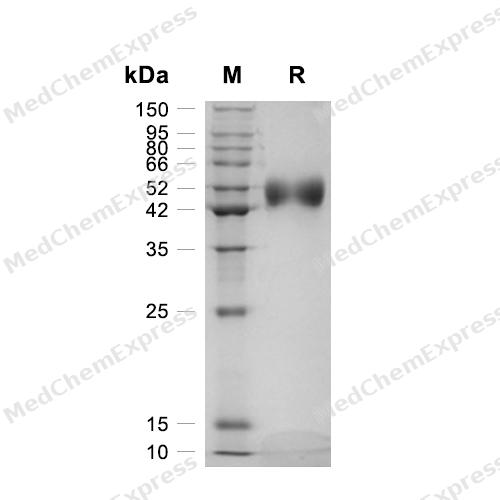
Purity - SDS-PAGE


Publications (3)
-
Journal Impact Factor
-
Most Recent
-
-
J Thromb Haemost
Met343Val mutation disrupts the shuttling of Trp380 leading to a low-activity conformer of activated protein C and causes thrombosis. [Abstract]2024 Aug;22(8):2270-2280. PMID: 38788977 -
Thromb Res
Mutation Ter462GlnextTer17 introduces a tail to C-terminus of protein C and causes venous thrombosis. [Abstract]2024 Aug:240:109044. PMID: 38824799


Technical Parameters
-
Species Human
-
Source HEK293
-
Tag C-6*His
-
Accession
AAH08915.1 (H20-P406)
-
Molecular Construction
-
N-term
-
Serpin A5 (H20-P406)
Accession # AAH08915.1 -
6*His
-
C-term
-
-
Protein Length
Partial
-
Synonyms
SERPINA5; Acrosomal Serine Protease Inhibitor; Prev. PLANH3; PAI-3; Prev. PCI; Plasminogen Activator Inhibitor III; PROCI; Plasminogen Activator Inhibitor-3; PAI3; Plasminogen Activator Inhibitor 3; Protein C Inhibitor; Serpin A5; Serine (Or Cysteine) Pro
-
AA Sequence
HRHHPREMKKRVEDLHVGATVAPSSRRDFTFDLYRALASAAPSQNIFFSPVSISMSLAMLSLGAGSSTKMQILEGLGLNLQKSSEKELHRGFQQLLQELNQPRDGFQLSLGNALFTDLVVDLQDTFVSAMKTLYLADTFPTNFRDSAGAMKQINDYVAKQTKGKIVDLLKNLDSNAVVIMVNYIFFKAKWETSFNHKGTQEQDFYVTSETVVRVPMMSREDQYHYLLDRNLSCRVVGVPYQGNATALFILPSEGKMQQVENGLSEKTLRKWLKMFKKRQLELYLPKFSIEGSYQLEKVLPSLGISNVFTSHADLSGISNHSNIQVSEMVHKAVVEVDESGTRAAAATGTIFTFRSARLNSQRLVFNRPFLMFIVDNNILFLGKVNRP
-
Molecular Weight
Approximately 50-60 kDa, based on SDS-PAGE under reducing conditions.
-
Glycosylation
Yes
-
Purity
≥ 95%, as determined by reducing SDS-PAGE.


Product Properties
Lyophilized powder.
Lyophilized from a 0.2 μm filtered solution of 20 mM MES, 150 mM NaCl, pH 5.5.
<1 EU/μg, determined by LAL method.
It is not recommended to reconstitute to a concentration less than 100 μg/mL in ddH2O. For long term storage it is recommended to add a carrier protein (0.1% BSA, 5% HSA, 10% FBS or 5% Trehalose).
Stored at -20°C for 2 years from date of receipt. After reconstitution, it is stable at 4°C for 1 week or -20°C for longer (with carrier protein). It is recommended to freeze aliquots at -20°C or -80°C for extended storage.
Room temperature in continental US; may vary elsewhere.


Documentation
-
Data Sheet (263 KB)
-
SDS (252 KB)
- English - EN (252 KB)
- Français - FR (252 KB)
- Deutsch - DE (252 KB)
- Norwegian - NO (252 KB)
- Español - ES (252 KB)
- Swedish - SV (252 KB)
- Italian - IT (252 KB)
- Korean - KR (252 KB)
- Portuguese - PT (252 KB)
-
Handling Instructions (2659 KB)

Calculators
Concentration (start) × Volume (start) = Concentration (final) × Volume (final)


 Powered by Bioz

