



PEDF/Serpin F1 Protein, Human (HEK293, N-His)
Based on 1 publication(s) in Google Scholar
Serpin F1 protein, a neurotrophic factor, crucially promotes extensive neuronal differentiation in retinoblastoma cells and serves as a potent inhibitor of angiogenesis. Unlike active serpins, Serpin F1 does not undergo the typical S (stressed) to R (relaxed) conformational transition, lacking serine protease inhibitory activity. It also interacts with PNPLA2, enhancing the phospholipase A2 activity of PNPLA2. PEDF/Serpin F1 Protein, Human (HEK293, N-His) is the recombinant human-derived Serpin F1 protein, expressed by HEK293 , with N-6*His labeled tag.
- Species: Human
- Source: HEK293
-
Storage:Stored at -20°C for 2 years from date of receipt. After reconstitution, it is stable at 4°C for 1 week or -20°C for longer (with carrier protein). It is recommended to freeze aliquots at -20°C or -80°C for extended storage.


To place orders, for customer services and technical support, please contact: MedChemExpress USA
Tel: 609-228-6898 E-mail: [email protected] [email protected]


-
 Biological Activity
-
Technical Parameters
-
Product Properties
- Documentation
- Help & FAQs




Biological Activity
Description
Serpin F1 protein, a neurotrophic factor, crucially promotes extensive neuronal differentiation in retinoblastoma cells and serves as a potent inhibitor of angiogenesis. Unlike active serpins, Serpin F1 does not undergo the typical S (stressed) to R (relaxed) conformational transition, lacking serine protease inhibitory activity. It also interacts with PNPLA2, enhancing the phospholipase A2 activity of PNPLA2. PEDF/Serpin F1 Protein, Human (HEK293, N-His) is the recombinant human-derived Serpin F1 protein, expressed by HEK293 , with N-6*His labeled tag.
Background
Neurotrophic protein Serpin F1 plays a pivotal role in promoting extensive neuronal differentiation in retinoblastoma cells. Additionally, it functions as a potent inhibitor of angiogenesis. Notably, Serpin F1 does not undergo the S (stressed) to R (relaxed) conformational transition typical of active serpins, resulting in the absence of serine protease inhibitory activity. Furthermore, it interacts with PNPLA2, fostering the phospholipase A2 activity of PNPLA2.
Verified Bioactivity
Measured by its ability to enhance the adhesion of Saos-2 human osteosarcoma cells to bovine Collagen I coated plate. The ED50 this effect is 0.2506 μg/mL, corresponding to a specific activity is 3.99×10³ units/mg.
MCE Validation Data
-
Purity - SDS-PAGE
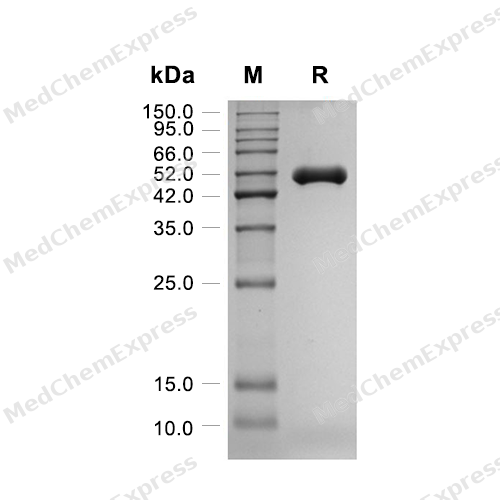
Purity - SDS-PAGE
-
Bioactivity - Cell-Based Assay
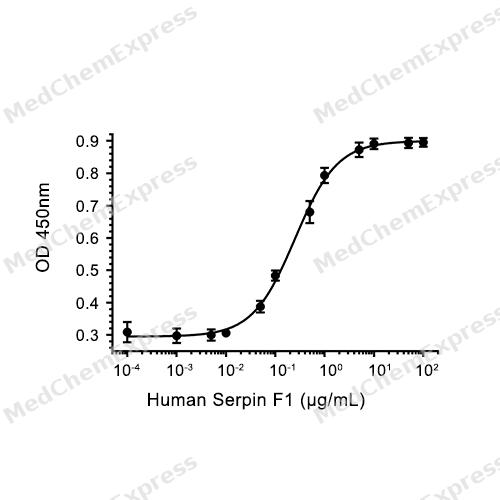
Bioactivity - Cell-Based Assay


Publications (1)
-
Journal Impact Factor
-
Most Recent
-
Diabetes Metab Syndr Obes
PEDF Alleviates Diabetic Renal Fibrosis by Degrading Kidney Ectopic Fat Deposition and Inhibiting Metabolic Reprogramming of Renal Tubular Epithelial Cells. [Abstract]2025 Nov 14:18:4211-4227. PMID: 41262465


Technical Parameters
-
Species Human
-
Source HEK293
-
Tag N-6*His
-
Accession
P36955 (Q20-P418)
-
Molecular Construction
-
N-term
-
6*His
-
Serpin F1 (Q20-P418)
Accession # P36955 -
C-term
-
-
Protein Length
Full Length of Mature Protein
-
Synonyms
SERPINF1; Testis Tissue Sperm-Binding Protein Li 70n; Prev. PEDF; Serpin Peptidase Inhibitor, Clade F (Alpha-2 Antiplasmin, Pigment Epithelium Derived Factor), Member 1; EPC-1; Proliferation-Inducing Protein 35; Pigment Epithelium-Derived Factor; Serpin F
-
AA Sequence
QNPASPPEEGSPDPDSTGALVEEEDPFFKVPVNKLAAAVSNFGYDLYRVRSSTSPTTNVLLSPLSVATALSALSLGAEQRTESIIHRALYYDLISSPDIHGTYKELLDTVTAPQKNLKSASRIVFEKKLRIKSSFVAPLEKSYGTRPRVLTGNPRLDLQEINNWVQAQMKGKLARSTKEIPDEISILLLGVAHFKGQWVTKFDSRKTSLEDFYLDEERTVRVPMMSDPKAVLRYGLDSDLSCKIAQLPLTGSMSIIFFLPLKVTQNLTLIEESLTSEFIHDIDRELKTVQAVLTVPKLKLSYEGEVTKSLQEMKLQSLFDSPDFSKITGKPIKLTQVEHRAGFEWNEDGAGTTPSPGLQPAHLTFPLDYHLNQPFIFVLRDTDTGALLFIGKILDPRGP
-
Predicted Molecular Mass
45.2 kDa
-
Molecular Weight
Approximately 49 kDa, based on SDS-PAGE under reducing conditions.
-
Glycosylation
Yes
-
Purity
≥ 95%, as determined by reducing SDS-PAGE.


Product Properties
Lyophilized powder.
Lyophilized from a 0.2 μm filtered solution of 20 mM PB,150 mM NaCl, pH 7.4.
<1 EU/μg, determined by LAL method.
It is not recommended to reconstitute to a concentration less than 100 μg/mL in ddH2O. For long term storage it is recommended to add a carrier protein (0.1% BSA, 5% HSA, 10% FBS or 5% Trehalose).
Stored at -20°C for 2 years from date of receipt. After reconstitution, it is stable at 4°C for 1 week or -20°C for longer (with carrier protein). It is recommended to freeze aliquots at -20°C or -80°C for extended storage.
Room temperature in continental US;may vary elsewhere.


Documentation
-
Data Sheet (238 KB)
-
SDS (252 KB)
- English - EN (252 KB)
- Français - FR (252 KB)
- Deutsch - DE (252 KB)
- Norwegian - NO (252 KB)
- Español - ES (252 KB)
- Swedish - SV (252 KB)
- Italian - IT (252 KB)
- Korean - KR (252 KB)
- Portuguese - PT (252 KB)
-
Handling Instructions (2659 KB)

Calculators
Concentration (start) × Volume (start) = Concentration (final) × Volume (final)


 Powered by Bioz

