



SNAP25 Protein, Human (His)
Based on 1 publication(s) in Google Scholar
SNAP25 is a key t-SNARE in neurotransmitter release, regulating synaptic function and plasma membrane recycling. It cooperates with CENPF to affect vesicle docking and membrane fusion. SNAP25 Protein, Human (His) is the recombinant human-derived SNAP25 protein, expressed by E. coli , with N-His labeled tag.
- Species: Human
- Source: E. coli
-
Storage:Stored at -80°C for 1 year from date of receipt. It is stable at -20°C for 3 months after opening. It is recommended to freeze aliquots at -80°C for extended storage. Avoid repeated freeze-thaw cycles.


To place orders, for customer services and technical support, please contact: MedChemExpress USA
Tel: 609-228-6898 E-mail: [email protected] [email protected]


-
 Biological Activity
-
Technical Parameters
-
Product Properties
- Documentation
- Help & FAQs




Biological Activity
Description
SNAP25 is a key t-SNARE in neurotransmitter release, regulating synaptic function and plasma membrane recycling. It cooperates with CENPF to affect vesicle docking and membrane fusion. SNAP25 Protein, Human (His) is the recombinant human-derived SNAP25 protein, expressed by E. coli , with N-His labeled tag.
Background
SNAP25, a t-SNARE integral to the molecular orchestration of neurotransmitter release, assumes a pivotal role in synaptic function within specific neuronal systems. Forming associations with proteins involved in vesicle docking and membrane fusion, SNAP25 intricately regulates plasma membrane recycling through interaction with CENPF. Its modulatory influence extends to the gating characteristics of the delayed rectifier voltage-dependent potassium channel KCNB1 in pancreatic beta cells. As part of the SNARE core complex, comprised of SNAP25, VAMP2, and STX1A, it constitutes the fundamental catalytic machinery for complex neurotransmitter release. Recruitment to the SNARE complex is facilitated by the binding of STX1A to STXBP1. Additionally, SNAP25 participates in diverse complexes involving SYT1, SV2B, syntaxin-1, CPLX1, and BLOC1S6. Interactions with HSC70, SYT9, DNAJC5, CENPF, EQTN, HGS, KCNB1, OTOF, RIMS1, SNAPIN, STXBP6, TRIM9, ZDHHC13, ZDHHC17, PLCL1, PRRT2, SNCA, PRPH2, ROM1, and STX3 further underscore its intricate molecular engagements, highlighting its multifaceted contributions to cellular processes and signaling pathways.
MCE Validation Data
-
Purity - SDS-PAGE
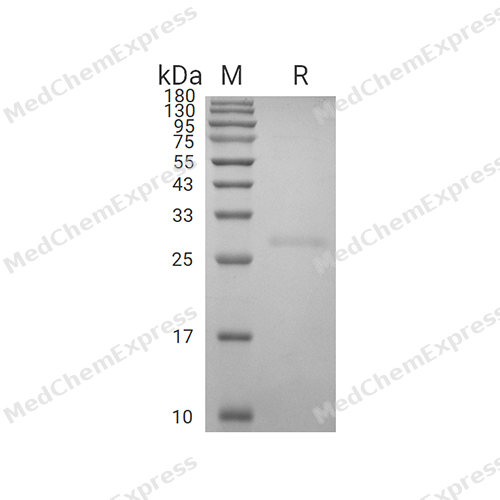
Purity - SDS-PAGE


Publications (1)
-
Journal Impact Factor
-
Most Recent
-
J Integr Neurosci
Muscone Protects Against Ferroptosis-Induced Injury in Models of Acute Ischemic Stroke by Modulating Snap25 Protein. [Abstract]2025 Jun 19;24(6):39116. PMID: 40613374


Technical Parameters
-
Species Human
-
Source E. coli
-
Tag N-His
-
Accession
P60880 (M1-G206)
-
Molecular Construction
-
N-term
-
His
-
SNAP25 (M1-G206)
Accession # P60880 -
C-term
-
-
Protein Length
Full Length
-
Synonyms
SNAP25; SEC9; Prev. SNAP; Synaptosomal-Associated Protein, 25kDa; SNAP-25; SUP; Synaptosomal-Associated Protein 25; Synaptosomal-Associated 25 KDa Protein; DJ1068F16.2; Synaptosome Associated Protein 25kDa; BA416N4.2; Super Protein; RIC-4; DEE117; RIC4; C
-
AA Sequence
MAEDADMRNELEEMQRRADQLADESLESTRRMLQLVEESKDAGIRTLVMLDEQGEQLERIEEGMDQINKDMKEAEKNLTDLGKFCGLCVCPCNKLKSSDAYKKAWGNNQDGVVASQPARVVDEREQMAISGGFIRRVTNDARENEMDENLEQVSGIIGNLRHMALDMGNEIDTQNRQIDRIMEKADSNKTRIDEANQRATKMLGSG
-
Predicted Molecular Mass
24.8 kDa
-
Molecular Weight
Approximately 28 kDa, based on SDS-PAGE under reducing conditions.
-
Purity
≥ 90%, as determined by reducing SDS-PAGE.


Product Properties
Solution
Supplied as a 0.22 μm filtered solution of PBS, pH 7.4.
<1 EU/μg, determined by LAL method.
Stored at -80°C for 1 year from date of receipt. It is stable at -20°C for 3 months after opening. It is recommended to freeze aliquots at -80°C for extended storage. Avoid repeated freeze-thaw cycles.
Shipping with dry ice.


Documentation
-
Data Sheet (236 KB)
-
SDS (252 KB)
- English - EN (252 KB)
- Français - FR (252 KB)
- Deutsch - DE (252 KB)
- Norwegian - NO (252 KB)
- Español - ES (252 KB)
- Swedish - SV (252 KB)
- Italian - IT (252 KB)
- Korean - KR (252 KB)
- Portuguese - PT (252 KB)
-
Handling Instructions (2659 KB)

Calculators
Concentration (start) × Volume (start) = Concentration (final) × Volume (final)


 Powered by Bioz

