



Tissue Factor Protein, Cynomolgus (HEK293, His)
Based on 1 Customer Validation
F3 Protein, a cell surface receptor, plays a significant role in regulating blood coagulation and promoting cell adhesion. Dysregulation of F3 Protein has been associated with various disorders, including thrombosis and cancer. Targeting F3 Protein may offer potential therapeutic interventions in these conditions by inhibiting blood clot formation and preventing tumor cell adhesion and metastasis. Tissue Factor Protein, Cynomolgus (HEK293, His) is the recombinant cynomolgus-derived Tissue Factor protein, expressed by HEK293 , with C-His labeled tag.
- Species: Cynomolgus
- Source: HEK293
-
Storage:Stored at -20°C for 2 years from date of receipt. After reconstitution, it is stable at 4°C for 1 week or -20°C for longer (with carrier protein). It is recommended to freeze aliquots at -20°C or -80°C for extended storage.


To place orders, for customer services and technical support, please contact: MedChemExpress USA
Tel: 609-228-6898 E-mail: [email protected] [email protected]


-
 Biological Activity
-
Technical Parameters
-
Product Properties
- Documentation
- Help & FAQs




Biological Activity
Description
F3 Protein, a cell surface receptor, plays a significant role in regulating blood coagulation and promoting cell adhesion. Dysregulation of F3 Protein has been associated with various disorders, including thrombosis and cancer. Targeting F3 Protein may offer potential therapeutic interventions in these conditions by inhibiting blood clot formation and preventing tumor cell adhesion and metastasis. Tissue Factor Protein, Cynomolgus (HEK293, His) is the recombinant cynomolgus-derived Tissue Factor protein, expressed by HEK293 , with C-His labeled tag.
Background
F3 Protein, also known as tissue factor (TF), serves as the initiator of blood coagulation by forming a complex with circulating factor VII or VIIa. This complex, [TF:VIIa], triggers the activation of factors IX or X through specific limited proteolysis. In normal hemostasis, TF plays a crucial role in initiating the assembly and propagation of the coagulation protease cascade on the cell surface. Furthermore, F3 Protein interacts with HSPE, and this interaction is hindered by heparin. The interaction promotes the generation of activated factor X and activates coagulation in the presence of activated factor VII.
Verified Bioactivity
Measured by its ability to activate Coagulation Factor VII in cleaving a fluorogenic peptide substrate Boc-VPR-AMC. The AC50 is 6.991 μg/mL, as measured under the described conditions, corresponding to a specific activity is 143.041 units/mg.
MCE Validation Data
-
Purity - SDS-PAGE
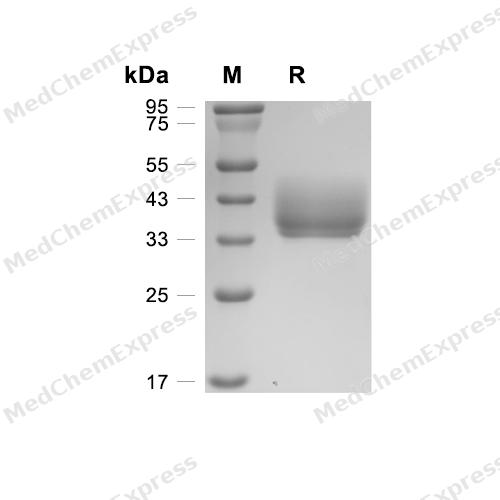
Purity - SDS-PAGE


Technical Parameters
-
Species Cynomolgus
-
Source HEK293
-
Tag C-His
-
Accession
A0A2K5VX02 (S33-E252)
-
Gene ID102131431
-
Molecular Construction
-
N-term
-
Tissue Factor (S33-E252)
Accession # A0A2K5VX02 -
His
-
C-term
-
-
Protein Length
Partial
-
Synonyms
F3; Coagulation Factor III (Thromboplastin, Tissue Factor); Coagulation Factor III, Tissue Factor; Coagulation Factor III; TF; Thromboplastin; Tissue Factor; CD142 Antigen; CD142; TFA
-
AA Sequence
SGTTNTVAAYNLTWKSTNFKTILEWEPKPINQVYTVQISTKSGDWKSKCFYTADTECDLTDEIVKDVKQTYLARVFSYPAGHVESTGSTEEPPYENSPEFTPYLETNLGQPTIQSFEQVGTKVNVTVQDEWTLVRRNDTFLSLRDVFGKDLIYTLYYWKSSSSGKKTAKTNTNEFLIDVDKGENYCFSVQAVIPSRRTANRKSTDSPVECMGHEKGESRE
-
Molecular Weight
Approximately 35-45 kDa, based on SDS-PAGE under reducing conditions, due to the glycosylation.
-
Purity
≥ 95%, as determined by reducing SDS-PAGE.


Product Properties
Lyophilized powder.
Lyophilized from a 0.22 μm filtered solution of 50 mM Tris, 150 mM NaCl, pH 7.5.
Note: For SPR assay, please replace the buffer. Primary amine components (e.g., Tris, imidazole) can affect protein-coupled chips.
<1 EU/μg, determined by LAL method.
It is not recommended to reconstitute to a concentration less than 100 μg/mL in ddH2O. For long term storage it is recommended to add a carrier protein (0.1% BSA, 5% HSA, 10% FBS or 5% Trehalose).
Stored at -20°C for 2 years from date of receipt. After reconstitution, it is stable at 4°C for 1 week or -20°C for longer (with carrier protein). It is recommended to freeze aliquots at -20°C or -80°C for extended storage.
Room temperature in continental US; may vary elsewhere.


Documentation
-
Data Sheet (237 KB)
-
SDS (252 KB)
- English - EN (252 KB)
- Français - FR (252 KB)
- Deutsch - DE (252 KB)
- Norwegian - NO (252 KB)
- Español - ES (252 KB)
- Swedish - SV (252 KB)
- Italian - IT (252 KB)
- Korean - KR (252 KB)
- Portuguese - PT (252 KB)
-
Handling Instructions (2659 KB)

Calculators
Concentration (start) × Volume (start) = Concentration (final) × Volume (final)


 Powered by Bioz

