



TL1A/TNFSF15 Trimer Protein, Human (HEK293, His-Flag)
Based on 1 Customer Validation
The TL1A protein (VEGI protein), belongs to the tumor necrosis factor (TNF) family and is a receptor for TNFRSF25 and TNFRSF6B. TL1A is involved in the activation of NF-κB and C-Jun pathways, which can be used as a regulator of mucosal immunity and participate in the immune pathway of inflammatory bowel disease (IBD) pathogenesis. TL1A originates from endothelial cells and inhibits the proliferation of breast cancer, epithelial and myeloid tumor cells. The human TL1A protein has a transmembrane domain (36-56 a.a.) that can be cleaved into membrane-type and soluble peptide fragments. TL1A/TNFSF15 Trimer Protein, Human (HEK293, His-Flag) is the extracullar part of TL1A protein (D91-L251), produced in HEK293 cells with N-terminal His- and Flag-tag.
- Species: Human
- Source: HEK293
-
Storage:Stored at -20°C for 2 years from date of receipt. After reconstitution, it is stable at 4°C for 1 week or -20°C for longer (with carrier protein). It is recommended to freeze aliquots at -20°C or -80°C for extended storage.


To place orders, for customer services and technical support, please contact: MedChemExpress USA
Tel: 609-228-6898 E-mail: [email protected] [email protected]


-
 Biological Activity
-
Technical Parameters
-
Product Properties
- Documentation
- References
- Help & FAQs




Biological Activity
Description
The TL1A protein (VEGI protein), belongs to the tumor necrosis factor (TNF) family and is a receptor for TNFRSF25 and TNFRSF6B. TL1A is involved in the activation of NF-κB and C-Jun pathways, which can be used as a regulator of mucosal immunity and participate in the immune pathway of inflammatory bowel disease (IBD) pathogenesis[1][2]. TL1A originates from endothelial cells and inhibits the proliferation of breast cancer, epithelial and myeloid tumor cells[3]. The human TL1A protein has a transmembrane domain (36-56 a.a.) that can be cleaved into membrane-type and soluble peptide fragments. TL1A/TNFSF15 Trimer Protein, Human (HEK293, His-Flag) is the extracullar part of TL1A protein (D91-L251), produced in HEK293 cells with N-terminal His- and Flag-tag.
Background
TL1A (Tumor necrosis factor-like cytokine 1A), also known as TNF ligand-related molecule 1 and vascular endothelial cell growth inhibitor (VEGI), is the receptor for TNFRSF25 and TNFRSF6B, acts as a regulator of mucosal immunity and participates in immunological pathways involved in the inflammatory bowel diseases (IBD) pathogenesis[1]. TL1A belongs to the tumor necrosis factor family, derived from endothelial cell. It is a ligand for DR3 and decoy receptor TR6/DcR3, the interaction with DR3 promotes T cell expansion during an immune response, whereas TR6 has an opposing effect. Moreover, DR3 is the death domain-containing receptor, that is upregulated during T cell activation. TL1A shows an inducible expression by TNF and IL-1alpha, and induces NF-kappaB activation and apoptosis in DR3-expressing cell lines. Meanwhile, TL1A acts as a costimulator that increases IL-2 responsiveness and secretion of proinflammatory cytokines[2]. In addition, TL1A activates c-Jun N-terminal kinase. TL1A also activates caspase-3 leading to PARP cleavage, and inhibits the proliferation of breast carcinoma, epithelial, and myeloid tumor cells. TL1A promotes proliferation of normal human fibroblast cells. These results suggest that VEGI, a new member of the TNF family, has a signaling pathway similar to TNF and is most likely a multifunctional cytokine[3]. Human TL1A protein has two glycosylated domains and one transmembrane domain (36-56 a.a.), and can be cleaved into membrane-type peptide fragments and soluble peptide fragments. The protein sequence of human is much different from mouse and rat with similarities of 68.42% and 70.45%, respectively.
In Vitro
TL1A (100 ng/mL; 15 min) interacts with TR6-Fc, results in NF-κB activation[2]. TL1A (72-251 a.a.; 100 ng/mL; 72 h) increases IL-2 responsiveness and induces cytokine release in anti-CD3- and anti-CD28-treated T cells[2]. TL1A (1 μg/mL; 12-24 h) induces IκB degradation in U-937 cells[3].
In Vivo
TL1A (human, 72-251 a.a.; 3 mg/kg; i.v.; daily for 5 d) enhances in vivo and ex vivo splenic alloactivation in C57BL/6 mice[2].
Verified Bioactivity
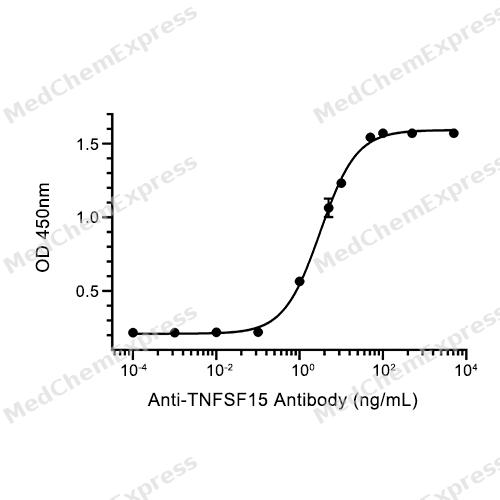
1.Immobilized Human TNFSF15 Trimer His at 0.5 μg/mL (100 μL/Well) on the plate. Dose response curve for Anti-TNFSF15 Antibody hFc with the EC50 of 10.2-18.7 ng/mL determined by ELISA.
2.Immobilized Human TNFSF15 Trimer, His Tag at 1 μg/mL (100 μl/Well) on the plate. Dose response curve for Anti-TNFSF15 Antibody, hFc Tag with the EC50 of ≤4 ng/mL determined by ELISA.
3.Measured by its binding ability in a functional ELISA. Immobilized Huamn TNFSF15 Trimer at 2 μg/mL (100 μL/Well) can bind Anti-TNFSF15 Antibody. The ED50 for this effect is ≤4 ng/mL.
MCE Validation Data
-
Purity - SDS-PAGE
Purity - SDS-PAGE
-
Bioactivity - ELISA
Bioactivity - ELISA


Technical Parameters
-
Species Human
-
Source HEK293
-
Tag N-Flag;N-6*His
-
Accession
O95150-1 (D91-L251)
-
Molecular Construction
-
N-term
-
6*His-Flag
-
TL1A (D91-L251)
Accession # O95150-1 -
C-term
-
-
Protein Length
Full Length of THD Domain
-
Synonyms
TNFSF15; TL1A; TNF Superfamily Member 15; Vascular Endothelial Growth Inhibitor-192A; Vascular Endothelial Cell Growth Inhibitor; Vascular Endothelial Growth Inhibitor; TNF Ligand-Related Molecule 1; TNF Superfamily Ligand TL1A; VEGI; MGC129934; TL1; MGC1
-
AA Sequence
DGDKPRAHLTVVRQTPTQHFKNQFPALHWEHELGLAFTKNRMNYTNKFLLIPESGDYFIYSQVTFRGMTSECSEIRQAGRPNKPDSITVVITKVTDSYPEPTQLLMGTKSVCEVGSNWFQPIYLGAMFSLQEGDKLMVNVSDISLVDYTKEDKTFFGAFLL
-
Predicted Molecular Mass
58.2 kDa
-
Molecular Weight
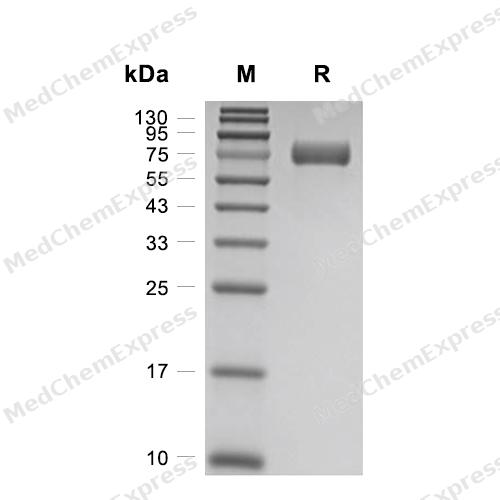
Approximately 60-80 kDa, based on SDS-PAGE under reducing conditions, due to the glycosylation.
-
Glycosylation
Yes
-
Purity
≥ 95%, as determined by reducing SDS-PAGE or Bis-Tris PAGE.


Product Properties
Lyophilized powder
Lyophilized from a 0.22 μm filtered solution of PBS, pH 7.4.
<1 EU/μg, determined by LAL method.
It is not recommended to reconstitute to a concentration less than 100 μg/mL in ddH2O. For long term storage it is recommended to add a carrier protein (0.1% BSA, 5% HSA, 10% FBS or 5% Trehalose).
Stored at -20°C for 2 years from date of receipt. After reconstitution, it is stable at 4°C for 1 week or -20°C for longer (with carrier protein). It is recommended to freeze aliquots at -20°C or -80°C for extended storage.
Room temperature in continental US; may vary elsewhere.


Documentation
-
Data Sheet (264 KB)
-
SDS (254 KB)
- English - EN (254 KB)
- Français - FR (254 KB)
- Deutsch - DE (254 KB)
- Norwegian - NO (254 KB)
- Español - ES (254 KB)
- Swedish - SV (254 KB)
- Italian - IT (254 KB)
- Korean - KR (254 KB)
- Portuguese - PT (254 KB)
-
Handling Instructions (2659 KB)


References
[1]. Furfaro F, et al. TL1A: A New Potential Target in the Treatment of Inflammatory Bowel Disease. Curr Drug Targets. 2021;22(7):760-769. [Content Brief]
[2]. Migone TS, et al. TL1A is a TNF-like ligand for DR3 and TR6/DcR3 and functions as a T cell costimulator. Immunity. 2002 Mar;16(3):479-92. [Content Brief]
[3]. Haridas V, et al. VEGI, a new member of the TNF family activates nuclear factor-kappa B and c-Jun N-terminal kinase and modulates cell growth. Oncogene. 1999 Nov 11;18(47):6496-504. [Content Brief]

Calculators
Concentration (start) × Volume (start) = Concentration (final) × Volume (final)


 Powered by Bioz

