



TM4SF2/TSPAN7 Protein, Human (HEK293, His)

Based on 1 Customer Validation
TM4SF2/TSPAN7 Protein is a member of the tetraspanin family. It mediate signal transduction events that play a role in the regulation of cell development, activation, growth and motility. TSPAN7 promotes apoptosis and inhibits tumor growth and cell cycle progression in BCa via the regulation of multiple key components of the PTEN/PI3K/AKT pathway. During cell differentiation, TSPAN7 emerges as a master regulator of morphological changes through cytoskeletal remodeling. TM4SF2/TSPAN7 Protein, Human (HEK293, His) is the recombinant human-derived TM4SF2/TSPAN7 protein, expressed by HEK293 , with C-His labeled tag.
- Species: Human
- Source: HEK293
-
Storage:Stored at -20°C for 2 years from date of receipt. After reconstitution, it is stable at 4°C for 1 week or -20°C for longer (with carrier protein). It is recommended to freeze aliquots at -20°C or -80°C for extended storage.


To place orders, for customer services and technical support, please contact: MedChemExpress USA
Tel: 609-228-6898 E-mail: [email protected] [email protected]


-
 Biological Activity
-
Technical Parameters
-
Product Properties
- Documentation
- Help & FAQs




Biological Activity
Description
TM4SF2/TSPAN7 Protein is a member of the tetraspanin family. It mediate signal transduction events that play a role in the regulation of cell development, activation, growth and motility. TSPAN7 promotes apoptosis and inhibits tumor growth and cell cycle progression in BCa via the regulation of multiple key components of the PTEN/PI3K/AKT pathway. During cell differentiation, TSPAN7 emerges as a master regulator of morphological changes through cytoskeletal remodeling. TM4SF2/TSPAN7 Protein, Human (HEK293, His) is the recombinant human-derived TM4SF2/TSPAN7 protein, expressed by HEK293 , with C-His labeled tag.
Background
Tetraspanin-7 (TSPAN7) is a member of the tetraspanin family. It mediate signal transduction events that play a role in the regulation of cell development, activation, growth and motility. Notably, this encoded cell surface glycoprotein has been demonstrated to exert a vital role in the control of neurite outgrowth. Overexpression of TSPAN7 activates Bax, cleaves caspase-3 and PTEN, and inhibits BCa cell growth through the PTEN/PI3K/AKT pathway. Low expression of TSPAN7 is associated with response to oxidative stress, regulation of MAPK, cell population of proliferation, response to tumor necrosis factor, regulation of cell migration, negative regulation of programmed cell death and angiogenesis. In addition, TSPAN7 plays an important role in the cytoskeletal organization required for the bone-resorbing function of osteoclasts by regulating signaling to Src, Pyk2, and microtubules[1][2].
Verified Bioactivity
When Recombinant Human TSPAN7 Protein is immobilized at 2 µg/mL (100 µL/well) can bind Rabbit Anti-TSPAN7 Antibody. The ED50 for this effect is 111.6 ng/mL.
MCE Validation Data
-
Purity - SDS-PAGE
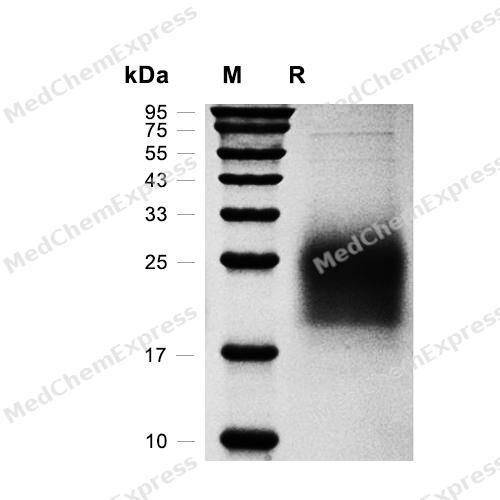
Purity - SDS-PAGE
-
Bioactivity - ELISA
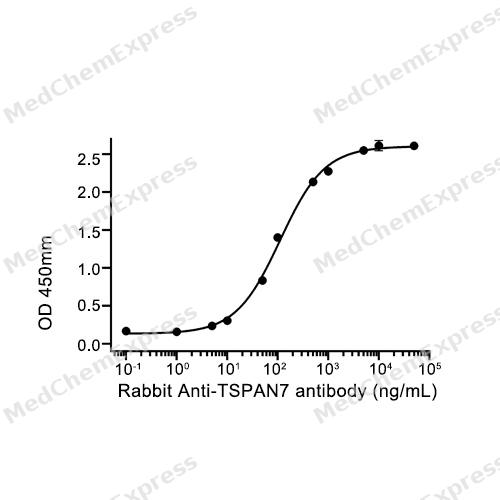
Bioactivity - ELISA


Technical Parameters
-
Species Human
-
Source HEK293
-
Tag C-His
-
Accession
AAH18036.1 (R113-M213)
-
Molecular Construction
-
N-term
-
TM4SF2 (R113-M213)
Accession # AAH18036.1 -
His
-
C-term
-
-
Protein Length
Extracellular Domain
-
Synonyms
Mxs1; Tm4sf2; Tetraspanin-7; Tspan-7; Cell surface glycoprotein A15; PE31; TALLA homolog; Transmembrane 4 superfamily member 2; CD antigen; CD231; XLID58; CCG-B7; TM4SF2b; Tetraspanin; Tetraspanin Protein; Transmembrane 4 Superfamily 2b; Transmembrane Pro
-
AA Sequence
RHEIKDTFLRTYTDTMQTYNGNDERSRAVDHVQRSLSCCGVQNYTNWSTSPYFLEHGIPPSCCMNETDCNPQDLHNLTVAATKVNQKGCYDLVTSFMETNM
-
Predicted Molecular Mass
11.6 kDa
-
Molecular Weight
Approximately 24-30 kDa, based on SDS-PAGE under reducing conditions.
-
Glycosylation
Yes
-
Purity
≥ 95%, as determined by reducing SDS-PAGE.


Product Properties
Lyophilized powder.
Lyophilized from a 0.22 μm filtered solution of PBS, pH 7.4.
<1 EU/μg, determined by LAL method.
It is not recommended to reconstitute to a concentration less than 100 μg/mL in ddH2O. For long term storage it is recommended to add a carrier protein (0.1% BSA, 5% HSA, 10% FBS or 5% Trehalose).
Stored at -20°C for 2 years from date of receipt. After reconstitution, it is stable at 4°C for 1 week or -20°C for longer (with carrier protein). It is recommended to freeze aliquots at -20°C or -80°C for extended storage.
Room temperature in continental US; may vary elsewhere.


Documentation
-
Data Sheet (236 KB)
-
SDS (251 KB)
- English - EN (251 KB)
- Français - FR (251 KB)
- Deutsch - DE (251 KB)
- Norwegian - NO (251 KB)
- Español - ES (251 KB)
- Swedish - SV (251 KB)
- Italian - IT (251 KB)
- Korean - KR (251 KB)
- Portuguese - PT (251 KB)
-
Handling Instructions (2659 KB)

Calculators
Concentration (start) × Volume (start) = Concentration (final) × Volume (final)


 Powered by Bioz

