



UMP-CMP kinase/CMPK1 Protein, Human (sf9, His)

Based on 1 Customer Validation
The UMP-CMP kinase (CMPK1) protein utilizes ATP as a phosphate donor to catalyze the phosphorylation of pyrimidine nucleoside monophosphate, thereby playing a key role in cellular processes. This enzymatic activity is integral to the de novo biosynthesis of pyrimidine nucleotides and contributes to the synthesis of important cellular building blocks. UMP-CMP kinase/CMPK1 Protein, Human (sf9, His) is the recombinant human-derived UMP-CMP kinase/CMPK1 protein, expressed by Sf9 insect cells, with N-6*His labeled tag.
- Species: Human
- Source: Sf9 insect cells
-
Storage:Stored at -20°C for 2 years from date of receipt. After reconstitution, it is stable at 4°C for 1 week or -20°C for longer (with carrier protein). It is recommended to freeze aliquots at -20°C or -80°C for extended storage.


To place orders, for customer services and technical support, please contact: MedChemExpress USA
Tel: 609-228-6898 E-mail: [email protected] [email protected]


-
 Biological Activity
-
Technical Parameters
-
Product Properties
- Documentation
- Help & FAQs




Biological Activity
Description
The UMP-CMP kinase (CMPK1) protein utilizes ATP as a phosphate donor to catalyze the phosphorylation of pyrimidine nucleoside monophosphate, thereby playing a key role in cellular processes. This enzymatic activity is integral to the de novo biosynthesis of pyrimidine nucleotides and contributes to the synthesis of important cellular building blocks. UMP-CMP kinase/CMPK1 Protein, Human (sf9, His) is the recombinant human-derived UMP-CMP kinase/CMPK1 protein, expressed by Sf9 insect cells, with N-6*His labeled tag.
Background
The UMP-CMP kinase, also known as CMPK1, is a crucial enzyme that catalyzes the phosphorylation of pyrimidine nucleoside monophosphates utilizing ATP as a phosphate donor. This enzymatic activity holds significance in de novo pyrimidine nucleotide biosynthesis, representing a key step in the synthesis of essential cellular components. CMPK1 exhibits a preference for uridine monophosphate (UMP) and cytidine monophosphate (CMP) as phosphate acceptors in this process. Additionally, CMPK1 displays broad nucleoside diphosphate kinase activity, emphasizing its versatility in catalyzing the transfer of phosphate groups between different nucleoside diphosphates. The multifaceted functions of CMPK1 underscore its pivotal role in cellular nucleotide metabolism and its potential implications for various cellular processes.
Verified Bioactivity
Measured by its ability to catalyze 1mM substrate CMP and 50 μM ATP that incubate at 37°C for 30 minutes. The specific activity is 52.56 pmo/min/μg.
MCE Validation Data
-
Purity - SDS-PAGE
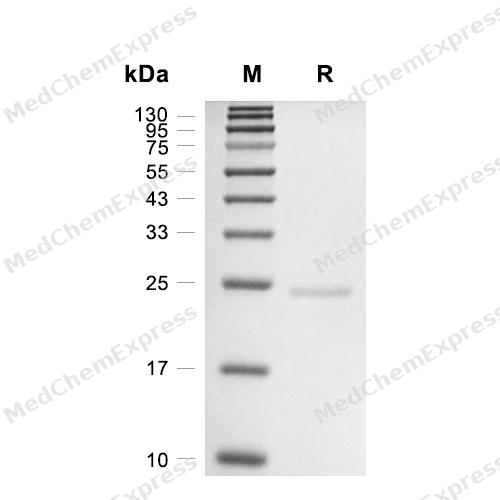
Purity - SDS-PAGE


Technical Parameters
-
Species Human
-
Source Sf9 insect cells
-
Tag N-6*His
-
Accession
P30085-1 (M1-G196)
-
Gene ID51727
-
Protein Length
Full Length of Isoform-1
-
Synonyms
CMPK1; CK; Prev. CMPK; Cytidylate Kinase; UMP-CMP Kinase; UMP/CMPK; UMP/CMP Kinase; UMPK; Uridine Monophosphate/Cytidine Monophosphate Kinase; CMK; Nucleoside-Diphosphate Kinase; UMK; Deoxycytidylate Kinase; Cytidine Monophosphate Kinase; DCMP Kinase; Uri
-
AA Sequence
MKPLVVFVLGGPGAGKGTQCARIVEKYGYTHLSAGELLRDERKNPDSQYGELIEKYIKEGKIVPVEITISLLKREMDQTMAANAQKNKFLIDGFPRNQDNLQGWNKTMDGKADVSFVLFFDCNNEICIERCLERGKSSGRSDDNRESLEKRIQTYLQSTKPIIDLYEEMGKVKKIDASKSVDEVFDEVVQIFDKEG
-
Predicted Molecular Mass
22.2 kDa
-
Molecular Weight
Approximately 24 kDa, based on SDS-PAGE under reducing conditions.
-
Purity
≥ 95%, as determined by reducing SDS-PAGE.


Product Properties
Lyophilized powder.
Lyophilized from a 0.22 μm filtered solution of 20 mM Tris-HCl, 500 mM NaCl, pH 7.4, 10% glycerol.
Note: For SPR assay, please replace the buffer. Primary amine components (e.g., Tris, imidazole) can affect protein-coupled chips.
<1 EU/μg, determined by LAL method.
It is not recommended to reconstitute to a concentration less than 100 μg/mL in ddH2O. For long term storage it is recommended to add a carrier protein (0.1% BSA, 5% HSA, 10% FBS or 5% Trehalose).
Stored at -20°C for 2 years from date of receipt. After reconstitution, it is stable at 4°C for 1 week or -20°C for longer (with carrier protein). It is recommended to freeze aliquots at -20°C or -80°C for extended storage.
Room temperature in continental US; may vary elsewhere.


Documentation
-
Data Sheet (237 KB)
-
SDS (251 KB)
- English - EN (251 KB)
- Français - FR (251 KB)
- Deutsch - DE (251 KB)
- Norwegian - NO (251 KB)
- Español - ES (251 KB)
- Swedish - SV (251 KB)
- Italian - IT (251 KB)
- Korean - KR (251 KB)
- Portuguese - PT (251 KB)
-
Handling Instructions (2659 KB)

Calculators
Concentration (start) × Volume (start) = Concentration (final) × Volume (final)


 Powered by Bioz

