



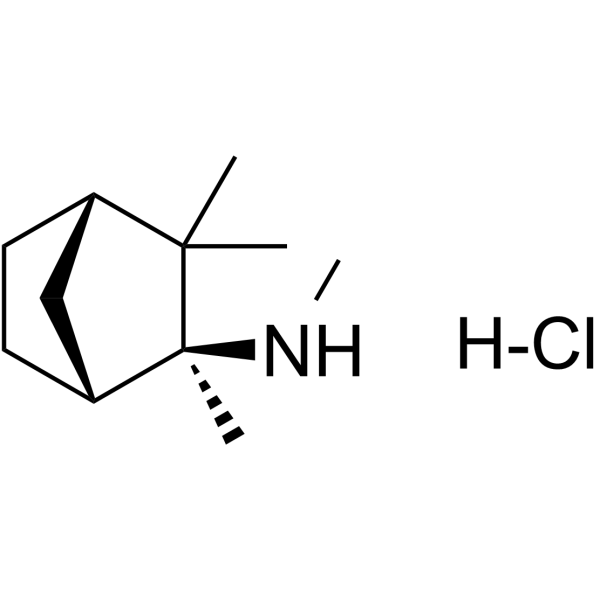
S-(+)-Mecamylamine hydrochloride

Based on 1 Customer Validation
S-(+)-Mecamylamine (hydrochloride) is a neuronal nicotinic receptor modulator with antidepressant activity.
연구목적의 판매만을 진행합니다. 환자를 대상으로 한 판매는 하지 않습니다.
- Purity : 99.0%
- CAS No.: 107596-30-5
- 화학식: C11H22ClN
- 분자량:203.75
-
보관:
4°C, sealed storage, away from moisture
* In solvent : -80°C, 6 months; -20°C, 1 month (sealed storage, away from moisture)

To place orders, for customer services and technical support, please contact: MedChemExpress USA
Tel: 609-228-6898 E-mail: [email protected] [email protected]


-
 Biological Activity
-
Chemical Information
- Protocol
- 순도&문서
- References
-
 Help & FAQs




Biological Activity
제품 설명
Clinical Trial
| NCT Number | Sponsor | Condition | Start Date |
Phase

|
|---|---|---|---|---|
| NCT01329991 | Plexxikon| | 2011-05 | PHASE1 |


Chemical Information
-
CAS No. 107596-30-5
-
Appearance Solid
-
분자량 203.75
-
화학식 C11H22ClN
-
Color White to off-white
-
SMILES
CN[C@]1([C@H]2C[C@H](CC2)C1(C)C)C.Cl
-
Synonyms
Dexmecamylamine hydrochloride; TC-5214 hydrochloride
-
선적
Room temperature in continental US; may vary elsewhere.
-
보관
4°C, sealed storage, away from moisture
* In solvent : -80°C, 6 months; -20°C, 1 month (sealed storage, away from moisture)

Protocol
-
Protocol for Tail Suspension Test (TST)
The Tail Suspension Test is a mouse behavioral assay in which an animal is suspended by the tail in an inescapable position, causing alternating escape-directed activity and immobility; the main readout is immobility time, and antidepressant-like treatments generally reduce immobility compared with vehicle controls. The assay detects behavioral response to acute inescapable stress rather than a molecular event; immobility is interpreted as passive stress-coping behavior, while reduced immobility is used as a predictive screen for antidepressant-like activity, with important limitations related to strain, locomotor activity, and tail-climbing behavior.
-
Protocol for Forced Swim Test (FST)
The Forced Swim Test is a rodent behavioral assay in which a mouse or rat is placed in an inescapable cylinder of water, and the main readout is the time spent immobile versus active escape-related behaviors such as swimming or climbing. Reduced immobility after treatment has historically been interpreted as antidepressant-like activity, but the assay should be interpreted as a behavioral response to acute inescapable stress rather than a complete model of human depression.


순도&문서
-
Data Sheet (266 KB)
-
SDS (393 KB)
- English - EN (393 KB)
- Français - FR (393 KB)
- Deutsch - DE (393 KB)
- Norwegian - NO (393 KB)
- Español - ES (393 KB)
- Swedish - SV (393 KB)
- Italian - IT (393 KB)
- Korean - KR (393 KB)
- Portuguese - PT (393 KB)
-
Handling Instructions (2659 KB)
References
[1]. Lippiello PM, Beaver JS, Gatto GJ, et al. TC-5214 (S-(+)-mecamylamine): a neuronal nicotinic receptor modulator with antidepressant activity. CNS Neurosci Ther. 2008;14(4):266-277. [Content Brief]
[2]. Vieta E, Thase ME, Naber D, et al. Efficacy and tolerability of flexibly-dosed adjunct TC-5214 (dexmecamylamine) in patients with major depressive disorder and inadequate response to prior antidepressant. Eur Neuropsychopharmacol. 2014;24(4):564-574. [Content Brief]

Calculators
Concentration (start) × Volume (start) = Concentration (final) × Volume (final)


S-(+)-Mecamylamine hydrochloride Related Classifications
HY-13047 Related Classifications
 Powered by Bioz