



Salvianolic acid D
Based on 1 publication(s) in Google Scholar
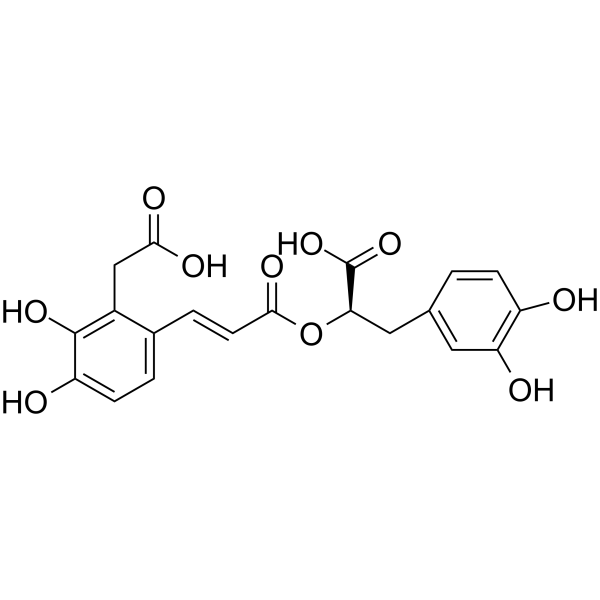
Salvianolic acid D is a depside. Salvianolic acid D can be isolated from Salvia miltiorrhiza (Danshen). Salvianolic acid D promotes the expression of Bcl-2, and inhibits the expressions of Bax, Cleaved caspase-3 and -9. Salvianolic acid D reduces the expression levels of TLR4, MyD88 and TRAF6 proteins both in vitro and in vivo, and significantly inhibits the nuclear translocation of NF-κB. Salvianolic acid D inhibits the cytoplasmic translocation of HMGB1. Salvianolic acid D suppresses inflammatory responses and alleviates cerebral ischemia-reperfusion injury. Salvianolic acid D serves as a potential antiplatelet active component.
For research use only. We do not sell to patients.
- Purity : 95.15%
- CAS No.: 142998-47-8
- Formula: C20H18O10
- Molecular Weight:418.35
-
Storage:Powder -20°C, 3 years , 4°C, 2 years ; In solvent -80°C, 6 months , -20°C, 1 month

To place orders, for customer services and technical support, please contact: MedChemExpress USA
Tel: 609-228-6898 E-mail: [email protected] [email protected]


-
 Biological Activity
-
Chemical Information
-
Solvent & Solubility
- Protocols
- Purity & Documentation
- References
-
 Help & FAQs


Publications Citing Use of MedChemExpress (MCE) Salvianolic acid D
MoreAll Caspase Isoforms
More

Biological Activity
Description
IC50 & Target
[1]|
Bcl-2 |
Bax |
Caspase-9 |
Caspase-3 |
TLR4 |
In Vitro
Salvianolic acid D (0.2-5 μM; 24 h) increases OGD/R-injured PC12 cell viability, inhibits apoptosis, reduces inflammatory cytokine production, and blocks HMGB1/TLR4/MyD88/NF-κB signaling when applied at 0.2, 1, or 5 μM for 24 hours post-OGD/R[1].
MedChemExpress (MCE) has not independently confirmed the accuracy of these methods. They are for reference only.
-
Cell Line:PC12
-
Concentration:0.2-5 μM
-
Incubation Time:24 h
-
Result:Inhibited the production of TNF-α, IL-1β, and IL-6 induced by OGD/R injury.
-
Cell Line:PC12
-
Concentration:0.2-5 μM
-
Incubation Time:24 h
-
Result:Concentration-dependently
decreased the levels of cleaved caspase-3.
Restrained cleaved caspase-9 induction process effectively.
Downregulated the release of cytochrome c.
In Vivo
MedChemExpress (MCE) has not independently confirmed the accuracy of these methods. They are for reference only.
-
Animal Model:Sprague-Dawley (SD) (male, 250 g, cerebral ischemia-reperfusion injury via MCAO/R model)[1]
-
Dosage:1 mg/kg; 3 mg/kg; 15 mg/kg
-
Administration:i.v.; twice (at onset of reperfusion and 12 h postreperfusion)
-
Result:Significantly reduced neurological deficit scores compared to I/R rats (P < 0.05 for 15 mg/kg, P < 0.01 for 1 mg/kg and 3 mg/kg).
Significantly reduced infarct volume at 15 mg/kg and 3 mg/kg doses (P < 0.01 for both).
Dose-dependently reduced brain water content compared to I/R rats (P < 0.05 for 1 mg/kg, P < 0.01 for 3 mg/kg and 15 mg/kg).
Significantly reduced Evans blue extravasation (P < 0.01 for all doses), indicating reduced blood-brain barrier permeability.
Significantly reduced TUNEL-positive cell percentage at 3 mg/kg and 15 mg/kg doses (P < 0.01 for both).
Reduced Bax/Bcl-2 ratio at all doses (P < 0.01 for all).
Reduced cleaved caspase-3 intensity at 1 mg/kg (P < 0.05), while 3 mg/kg and 15 mg/kg reduced cleaved caspase-3 and cleaved caspase-9 intensity (P < 0.01 for all).
Reduced cytochrome c intensity at 3 mg/kg (P < 0.05) and 15 mg/kg (P < 0.01).
Reduced brain tissue levels of TNF-α, IL-1β, and IL-6 at all doses (P < 0.01 for most comparisons).
Dose-dependently reduced serum HMGB1 levels at all doses (P < 0.01 for all).
Reduced TLR4, MyD88, and TRAF6 protein intensity in cortex and hippocampus at all doses (P < 0.05 or P < 0.01 vs.
I/R rats).
Reduced nuclear p-NF-κB p65/NF-κB p65 ratio in cortex and hippocampus (P < 0.01 for 3 mg/kg and 15 mg/kg, P < 0.05 for 1 mg/kg in some regions).
Reduced cytoplasmic HMGB1 intensity and increased nuclear HMGB1 intensity in cortex and hippocampus at all doses (P < 0.05 or P < 0.01 vs.
I/R rats).
Inhibited HMGB1 cytoplasmic translocation in neurons, astrocytes, and microglia in cortex and hippocampus at 15 mg/kg dose.


Chemical Information
-
CAS No. 142998-47-8
-
Appearance Solid
-
Molecular Weight 418.35
-
Formula C20H18O10
-
Color Light yellow to yellow
-
SMILES
OC1=CC=C(/C=C/C(O[C@@H](C(O)=O)CC2=CC(O)=C(O)C=C2)=O)C(CC(O)=O)=C1O
-
Structure Classification
-
Shipping
Room temperature in continental US; may vary elsewhere.
-
Storage
Powder -20°C 3 years 4°C 2 years In solvent -80°C 6 months -20°C 1 month


Publications (1)
-
Journal Impact Factor
-
Most Recent


Solvent & Solubility
In Vitro:
H2O : ≥ 50 mg/mL (119.52 mM)
* "≥" means soluble, but saturation unknown.
Please refer to the solubility information to select the appropriate solvent. Once prepared, please aliquot and store the solution to prevent product inactivation from repeated freeze-thaw cycles.
Storage method and period of stock solution: -80°C, 6 months; -20°C, 1 month. When stored at -80°C, please use it within 6 months. When stored at -20°C, please use it within 1 month.
* Note: If you choose water as the stock solution, please dilute it to the working solution, then filter and sterilize it with a 0.22 μm filter before use.
Please refer to the solubility information to select the appropriate solvent. Once prepared, please aliquot and store the solution to prevent product inactivation from repeated freeze-thaw cycles.
Storage method and period of stock solution: -80°C, 6 months; -20°C, 1 month. When stored at -80°C, please use it within 6 months. When stored at -20°C, please use it within 1 month.
* Note: If you choose water as the stock solution, please dilute it to the working solution, then filter and sterilize it with a 0.22 μm filter before use.
Concentration (start) × Volume (start) = Concentration (final) × Volume (final)


Purity & Documentation
-
Data Sheet (280 KB)
-
SDS (254 KB)
- English - EN (254 KB)
- Français - FR (254 KB)
- Deutsch - DE (254 KB)
- Norwegian - NO (254 KB)
- Español - ES (254 KB)
- Swedish - SV (254 KB)
- Italian - IT (254 KB)
- Korean - KR (254 KB)
- Portuguese - PT (254 KB)
-
Handling Instructions (2659 KB)
References
[1]. Zhang W, et al. Salvianolic Acid D Alleviates Cerebral Ischemia-Reperfusion Injury by Suppressing the Cytoplasmic Translocation and Release of HMGB1-Triggered NF-κB Activation to Inhibit Inflammatory Response. Mediators Inflamm. 2020;2020:9049614. Published 2020 Jan 22. [Content Brief]
[2]. Ai CB, et al. Salvianolic Acids D and E: Two New Depsides from Salvia miltiorrhiza. Planta Med. 1992;58(2):197-199. [Content Brief]
[3]. Chen Y, et al. A Platelet/CMC coupled with offline UPLC-QTOF-MS/MS for screening antiplatelet activity components from aqueous extract of Danshen. J Pharm Biomed Anal. 2016;117:178-183. [Content Brief]


Complete Stock Solution Preparation Table
Please refer to the solubility information to select the appropriate solvent. Once prepared, please aliquot and store the solution to prevent product inactivation from repeated freeze-thaw cycles.
Storage method and period of stock solution: -80°C, 6 months; -20°C, 1 month. When stored at -80°C, please use it within 6 months. When stored at -20°C, please use it within 1 month.
| Optional Solvent | Concentration Solvent Mass | 1 mg | 5 mg | 10 mg | 25 mg |
|---|---|---|---|---|---|
| H2O | 1 mM | 2.3903 mL | 11.9517 mL | 23.9034 mL | 59.7586 mL |
| 5 mM | 0.4781 mL | 2.3903 mL | 4.7807 mL | 11.9517 mL | |
| 10 mM | 0.2390 mL | 1.1952 mL | 2.3903 mL | 5.9759 mL | |
| 15 mM | 0.1594 mL | 0.7968 mL | 1.5936 mL | 3.9839 mL | |
| 20 mM | 0.1195 mL | 0.5976 mL | 1.1952 mL | 2.9879 mL | |
| 25 mM | 0.0956 mL | 0.4781 mL | 0.9561 mL | 2.3903 mL | |
| 30 mM | 0.0797 mL | 0.3984 mL | 0.7968 mL | 1.9920 mL | |
| 40 mM | 0.0598 mL | 0.2988 mL | 0.5976 mL | 1.4940 mL | |
| 50 mM | 0.0478 mL | 0.2390 mL | 0.4781 mL | 1.1952 mL | |
| 60 mM | 0.0398 mL | 0.1992 mL | 0.3984 mL | 0.9960 mL | |
| 80 mM | 0.0299 mL | 0.1494 mL | 0.2988 mL | 0.7470 mL | |
| 100 mM | 0.0239 mL | 0.1195 mL | 0.2390 mL | 0.5976 mL |
* Note: If you choose water as the stock solution, please dilute it to the working solution, then filter and sterilize it with a 0.22 μm filter before use.


Salvianolic acid D Related Classifications
HY-N0320 Related Classifications
 Powered by Bioz