



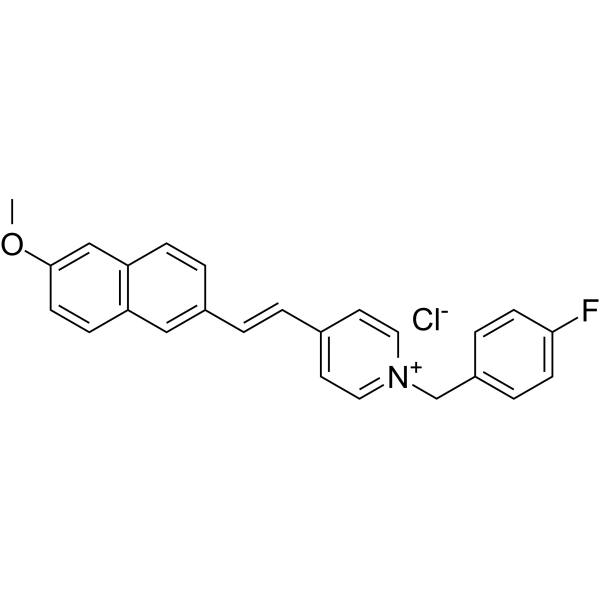
SB-1436
SB-1436 is an Cholinesterase (ChE) inhibitor, inhibits acetylcholinesterase (AChE), butyrylcholinesterase (BChE) and recombinant human acetylcholinesterase (rHuAChE) with IC50s of 0.176, 0.37 and 0.08 μM, respectively. SB-1436 inhibits AChE and BChE in a non-competitive manner with Kis of 0.046 and 0.115 μM, respectively. SB-1436 significantly stops the self-aggregation of Aβ, and can be used for neurological disease research.
For research use only. We do not sell to patients.
- CAS No.: 2925298-08-2
- Formula: C25H21ClFNO
- Molecular Weight:405.89
-
Storage:
Please store the product under the recommended conditions in the Certificate of Analysis.

To place orders, for customer services and technical support, please contact: MedChemExpress USA
Tel: 609-228-6898 E-mail: [email protected] [email protected]


-
 Biological Activity
-
Chemical Information
- Protocols
- Purity & Documentation
- References
-
 Help & FAQs




Biological Activity
Description
IC50 & Target
[1]|
EeAChE 0.176 μM (IC50) |
eqBCHE 0.37 μM (IC50) |
EeAChE 0.046 μM (Ki) |
eqBCHE 0.115 μM (Ki) |
In Vitro
SB-1436 (Compound 7av) (1 μM, 20 min) inhibits AChE, BChE and rHuAChE with IC50s of 0.176, 0.37 and 0.08 μM, respectively[1].
SB-1436 (0.78-100 μM, 48 hours) reduces the cell viability in J774A.1 and primary astrocytes cell lines[1].
MedChemExpress (MCE) has not independently confirmed the accuracy of these methods. They are for reference only.
-
Cell Line:J774A.1 cells and primary astrocytes
-
Concentration:0.78-100 μM
-
Incubation Time:48 hours
-
Result:Reduced the cell viability in J774A.1 and primary astrocytes cell lines, and its GI50 in both cell types is ∼6.25 μM.


Chemical Information
-
CAS No. 2925298-08-2
-
Molecular Weight 405.89
-
Formula C25H21ClFNO
-
SMILES
COC1=CC2=C(C=C(/C=C/C3=CC=[N+](CC4=CC=C(F)C=C4)C=C3)C=C2)C=C1.[Cl-]
-
Shipping
Room temperature in continental US; may vary elsewhere.
-
Storage
Please store the product under the recommended conditions in the Certificate of Analysis.


Purity & Documentation
References

Calculators
Concentration (start) × Volume (start) = Concentration (final) × Volume (final)


SB-1436 Related Classifications
HY-149300 Related Classifications
 Powered by Bioz