



Scospondistatin
Scospondistatin is an anti-angiogenic peptide that can inhibit proliferation and migration of human umbilical vein endothelial cells in vitro.
연구목적의 판매만을 진행합니다. 환자를 대상으로 한 판매는 하지 않습니다.
- CAS No.: 929555-18-0
- 화학식: C81H127N27O30S2
- 분자량:2023.17
-
보관:
Please store the product under the recommended conditions in the Certificate of Analysis.

To place orders, for customer services and technical support, please contact: MedChemExpress USA
Tel: 609-228-6898 E-mail: [email protected] [email protected]


-
 Biological Activity
-
Chemical Information
-
용액&용해도
- Protocol
- 순도&문서
- References
-
 Help & FAQs


All VEGFR Isoforms
More

Biological Activity
제품 설명
In Vitro
Scospondistatin (0.01-40 μg/mL; 3 d) inhibits human umbilical vein endothelial cells (HUVECs) proliferation in a dose-dependent manner[1].
Scospondistatin (30 μg/mL; 20 h) significantly inhibits the migration of HUVECs in the presence of VEGF[1].
MedChemExpress (MCE) has not independently confirmed the accuracy of these methods. They are for reference only.
-
Cell Line:HUVECs
-
Concentration:0.01, 0.1, 1, 10, 20, 30 and 40 μg/mL
-
Incubation Time:3 days
-
Result:Showed a monotonic dose response, with the anti-proliferative activity increasing with increasing the peptide concentration.
-
Cell Line:HUVECs
-
Concentration:1, 10 and 30 μg/mL
-
Incubation Time:20 h
-
Result:Significantly inhibited the migration of HUVECs in the presence of VEGF at 30 μg/mL.


Chemical Information
-
CAS No. 929555-18-0
-
분자량 2023.17
-
화학식 C81H127N27O30S2
-
Sequence Shortening
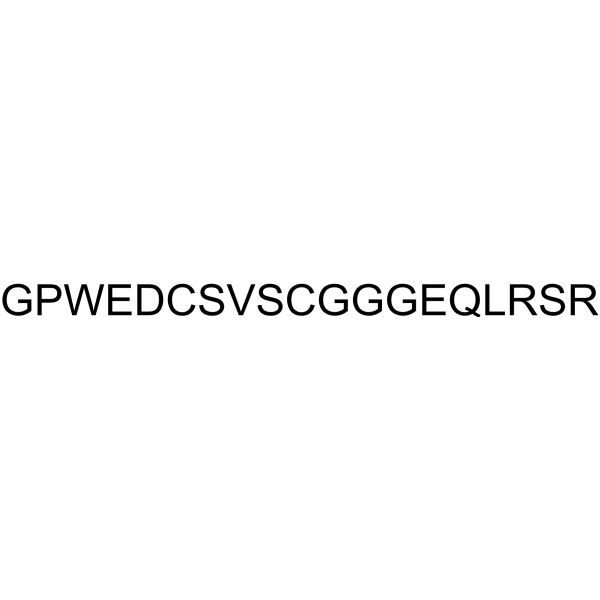
GPWEDCSVSCGGGEQLRSR
-
선적
Room temperature in continental US; may vary elsewhere.
-
보관
Please store the product under the recommended conditions in the Certificate of Analysis.


용액&용해도
In Vitro
H2O
Peptide Solubility and Storage Guidelines:
1. Calculate the length of the peptide.
2. Calculate the overall charge of the entire peptide according to the following table:
| Contents | Assign value | |
|---|---|---|
| Acidic amino acid | Asp (D), Glu (E), and the C-terminal -COOH. | -1 |
| Basic amino acid | Arg (R), Lys (K), His (H), and the N-terminal -NH2 | +1 |
| Neutral amino acid | Gly (G), Ala (A), Leu (L), Ile (I), Val (V), Cys (C), Met (M), Thr (T), Ser (S), Phe (F), Tyr (Y), Trp (W), Pro (P), Asn (N), Gln (Q) | 0 |
3. Recommended solution:
| Overall charge of peptide | Details |
|---|---|
| Negative (<0) |
1. Try to dissolve the peptide in water first. 2. If water fails, add NH4OH (<50 μL). 3. If the peptide still does not dissolve, add DMSO (50-100 μL) to solubilize the peptide. |
| Positive (>0) |
1. Try to dissolve the peptide in water first. 2. If water fails, try dissolving the peptide in a 10%-30% acetic acid solution. 3. If the peptide still does not dissolve, try dissolving the peptide in a small amount of DMSO. |
| Zero (=0) |
1. Try to dissolve the peptide in organic solvent (acetonitrile, methanol, etc.) first. 2. For very hydrophobic peptides, try dissolving the peptide in a small amount of DMSO, and then dilute the solution with water to the desired concentration. |


순도&문서
References

Calculators
Concentration (start) × Volume (start) = Concentration (final) × Volume (final)


Scospondistatin Related Classifications
HY-P3995 Related Classifications
 Powered by Bioz