



Pyrithioxin
Based on 2 publication(s) in Google Scholar
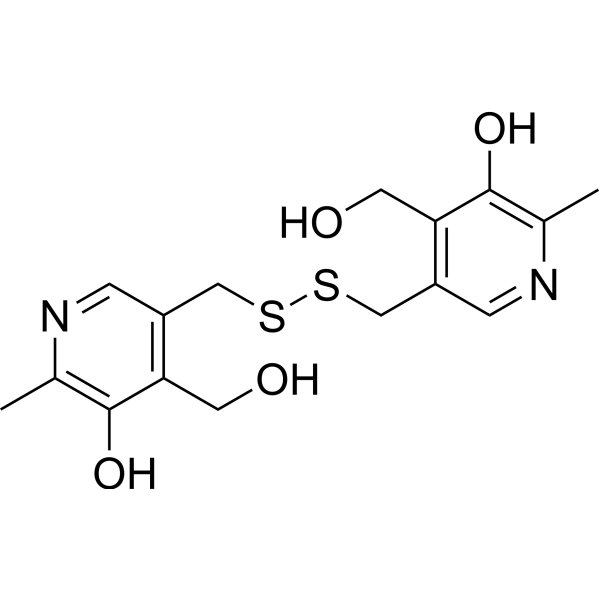
Pyrithioxin (Pyritinol) is an orally active neurodynamic compound. Pyrithioxin can promote the metabolism of glucose and amino acids, increase carotid blood flow and improve cerebral blood flow. Pyrithioxin exhibits anti-inflammation, anti-tumor and neuroprotective effect. Pyrithioxin can be used for the researches of cancer, inflammation, immunology, metabolic and neurological disease such as cerebral infarct, epilepsy, fibrosarcomas and rheumatoid polyarthritis.
For research use only. We do not sell to patients.
- CAS No.: 1098-97-1
- Formula: C16H20N2O4S2
- Molecular Weight:368.47
-
Storage:Powder -20°C, 3 years , 4°C, 2 years ; In solvent -80°C, 6 months , -20°C, 1 month

To place orders, for customer services and technical support, please contact: MedChemExpress USA
Tel: 609-228-6898 E-mail: [email protected] [email protected]


-
 Biological Activity
-
Chemical Information
- Protocols
- Purity & Documentation
- References
-
 Help & FAQs


Publications Citing Use of MedChemExpress (MCE) Pyrithioxin
More

Biological Activity
Description
In Vitro
Pyrithioxin (dihydrochloride) (0.5-3 μg/mL) increases D-arabitol production from Candida parapsilosis by regulating glucose-6-phosphate dehydrogenase[5].
MedChemExpress (MCE) has not independently confirmed the accuracy of these methods. They are for reference only.
In Vivo
Pyrithioxin (200 and 600 mg/kg diet, added to the feed for free consumption, 6 weeks) elevates acetylcholine levels and enhances memory behavior in rats[4].
Pyrithioxin (50-200 mg/kg, p.o.) reduces flinching behavior in Streptozocin (HY-13753)-induced diabetic rats[7].
MedChemExpress (MCE) has not independently confirmed the accuracy of these methods. They are for reference only.
-
Animal Model:WISTAR rats with 3-MC-induced subcutaneous fibrosarcomas[2]
-
Dosage:20 mg/kg
-
Administration:Orally gavage, five times a week after tumor appearance or after tumor resection
-
Result:Showed remission rate 11%-12%.
Partial recurrence control was achieved in remitted rats with small tumors (0.7-1 cm in diameter) under continuous administration.
Clinical Trial
| NCT Number | Sponsor | Condition | Start Date |
Phase

|
|---|---|---|---|---|
| NCT01329991 | Plexxikon| | 2011-05 | PHASE1 |


Chemical Information
-
CAS No. 1098-97-1
-
Appearance Solid
-
Molecular Weight 368.47
-
Formula C16H20N2O4S2
-
Color Off-white to light yellow
-
SMILES
OCC1=C(CSSCC2=C(CO)C(O)=C(C)N=C2)C=NC(C)=C1O
-
Synonyms
Pyritinol; Pyridoxine disulfide; Vitamin B6 disulfide
-
Shipping
Room temperature in continental US; may vary elsewhere.
-
Storage
Powder -20°C 3 years 4°C 2 years In solvent -80°C 6 months -20°C 1 month


Publications (2)
-
Journal Impact Factor
-
Most Recent
-
Nat Commun
INSIG1/2 succination mediated by the moonlighting function of ADSL promotes lipogenesis and liver tumorigenesis. [Abstract]2026 Mar 15;17(1):4002. PMID: 41833955 -
Int J Biol Macromol
Unveiling the mechanistic link between peroxiredoxin inhibition and ferroptosis-like cell death induced by Dinaciclib in Entamoeba histolytica. [Abstract]2026 Mar:350:150992. PMID: 41713546


Purity & Documentation
-
Data Sheet (284 KB)
-
SDS (396 KB)
- English - EN (396 KB)
- Français - FR (396 KB)
- Deutsch - DE (396 KB)
- Norwegian - NO (396 KB)
- Español - ES (396 KB)
- Swedish - SV (396 KB)
- Italian - IT (396 KB)
- Korean - KR (396 KB)
- Portuguese - PT (396 KB)
-
Handling Instructions (2659 KB)
References
[1]. Stoica E, et al. Facilitation through hyperventilation of therapeutic effect of pyrithioxin in cerebral infarct patients. Eur Neurol. 1975;13(4):285-303. [Content Brief]
[2]. von Metzler A. et al. [Antineoplastic activity of drugs affecting the central nervous system against chemically induced tumors in the rat (author's transl)]. J Cancer Res Clin Oncol. 1979 Sep;95(1):11-8. German. [Content Brief]
[3]. Crouzet J, et al. Pyrithioxine et polyarthrite rhumatoïde [Pyrithioxin and rheumatoid polyarthritis]. Rev Rhum Mal Osteoartic. 1986 Jan;53(1):45-8. [Content Brief]
[4]. Marston HM, et al. Effects of the chronic administration of pyrithioxin on behaviour and cholinergic function in young and aged rats. J Psychopharmacol. 1987 Jan;1(4):237-43. [Content Brief]
[5]. Zheng S, et al. Combined mutagenesis and metabolic regulation to enhance D-arabitol production from Candida parapsilosis. J Ind Microbiol Biotechnol. 2020 May;47(4-5):425-435. [Content Brief]
[6]. Martínez-Lage JM, et al. Asociación de piritioxina y difenilhidantoina, en el tratamiento de los síndromes epilépticos orgánicos [Association of pyrithioxin and diphenylhydantoin in the treatment of organic epileptic syndromes]. Med Clin (Barc). 1965 Sep;45(3):204-5. [Content Brief]
[7]. Jiménez-Andrade GY, et al. Pyritinol reduces nociception and oxidative stress in diabetic rats. Eur J Pharmacol. 2008 Aug 20;590(1-3):170-6. [Content Brief]

Calculators
Concentration (start) × Volume (start) = Concentration (final) × Volume (final)


Pyrithioxin Related Classifications
HY-B0910 Related Classifications
 Powered by Bioz