232 Results for "

glaucoma

" in MedChemExpress (MCE) Product Catalog:
Products (232)

232 Results for "glaucoma" in MCE Product Catalog:

Cat. No.: HY-183283
CAII-IN-15 is a potent carbonic anhydrase II (CA II) inhibitor with a hCA II IC50 of 10 nM. CAII-IN-15 elevates cGMP levels, releases nitric oxide, reduces oxidative stress, and exhibits neuroprotective activity in vitro. CAII-IN-15 inhibits NLRP3 inflammasome activation, reduces neuronal apoptosis. CAII-IN-15 reduces Intraocular pressure (IOP) in rabbits. CAII-IN-15 can be used for the research of glaucoma .
loading...
    loading...
Cat. No.: HY-184351
CAS No.: 143508-76-3
Target:  

5-HT Receptor

Research Areas:  

Neurological Disease

CP 132484 is a rat 5-HT2A receptor agonist with a Ki of 1.1 nM and an IC50 of 2.8 nM, and it exhibits over 40-fold selectivity over rat 5-HT1A receptors and bovine 5-HT1D receptors. CP 132484 stimulates phosphoinositide hydrolysis and intracellular calcium mobilization. CP 132484 can be used for research into diseases such as glaucoma .
loading...
    loading...
Cat. No.: HY-B0191AS
Synonyms: 5,6-trans-AGN 192024-d5
5,6-trans-Bimatoprost-d5 (5,6-trans-AGN 192024-d5) is the deuterium labeled 5,6-trans-Bimatoprost (HY-B0191A). 5,6-trans-Bimatoprost is the isomer of Bimatoprost (HY-B0191), and can be used as an experimental control. Bimatoprost is a prostaglandin analogue that can be used in studies of ocular hypertension and glaucoma and also has anti-fat formation effects.
loading...
    loading...
Cat. No.: HY-175972
Target:  

Carbonic Anhydrase

Research Areas:  

Neurological Disease Cancer

CAI/II-IN-12 is a potent and hCAI (IC50 = 7.12 μM, Ki = 9.26 μM) and hCAII (IC50 = 10.62 μM, Ki = 11.72 μM) dual inhibitor. CAI/II-IN-12 has a strong affinity for the active sites of CYP17A1, hCAI, and hCAII enzymes. Compound CAI/II-IN-12 exhibits rapid conformational stabilization, particularly in the CYP17A1 complex. CAI/II-IN-12 can be used for the study of prostate cancer therapy and glaucoma .
loading...
    loading...
Cat. No.: HY-33549R
CAS No.: 658-48-0
Synonyms: α-Methyl-p-tyrosine (Standard)
α-Methyl-p-tyrosine (Standard) is the analytical standard of α-Methyl-p-tyrosine. This product is intended for research and analytical applications. α-Methyl-p-tyrosine is a competitive inhibitor of tyrosine hydroxylase, which converts tyrosine into DOPA. α-Methyl-p-tyrosine is also an orally active inhibitor of catecholamine synthesis, inhibiting the hydroxylation of tyrosine into DOPA. α-Methyl-p-tyrosine can be used in research related to epilepsy, glaucoma, cancer, and other related diseases .
loading...
    loading...
Cat. No.: HY-W074975
CAS No.: 14949-00-9
Synonyms: 5-Amino-1,3,4-thiadiazole-2-sulfonamide
Target:  

Carbonic Anhydrase

Research Areas:  

Cancer

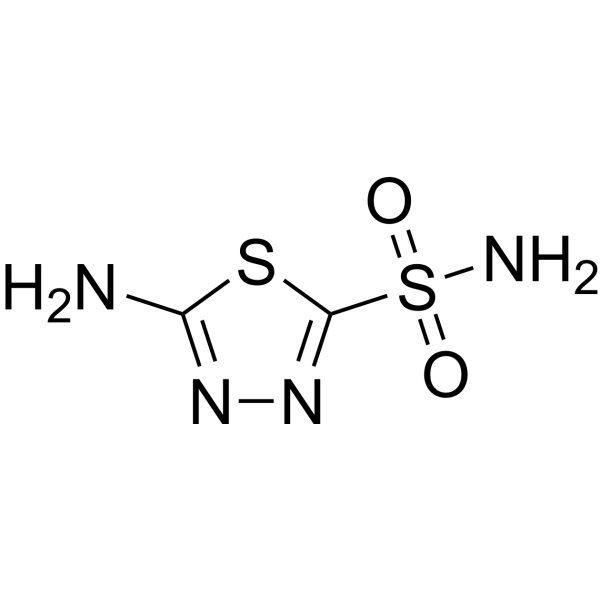
CL 5343 (5-Amino-1,3,4-thiadiazole-2-sulfonamide) is a selective inhibitor of carbonic anhydrase B (HCA-B) and isoforms I, II, IV, and VII. CL 5343 has a Ki of 7.9 nM for hCA II. CL 5343 acts as a CA9 ligand to achieve targeted delivery of maytansine to the cell membrane of SKRC52 renal cancer cells. CL 5343 is useful in the development of therapeutics for diseases associated with CA overactivity, such as glaucoma, epilepsy, and cancer .
loading...
    loading...
Cat. No.: HY-182473
CAS No.: 170552-18-8
Research Areas:  

Neurological Disease

AL-6556 is a full agonist of the DP receptor and a partial agonist of the EP2 receptor. AL-6556 has an EC50 of 799 nM for bovine DP, a Ki of 3200 nM for human DP, and an EC50 of 1180 nM for human EP2, with selectivity over EP3, FP, IP, TP and 19 non-prostaglandin receptors. AL-6556 stimulates cAMP production via receptor activation and reduces intraocular pressure through aqueous humor inflow and outflow mechanisms. AL-6556 can be used in research related to ocular hypertension and glaucoma .
loading...
    loading...
Cat. No.: HY-118652
CAS No.: 68324-95-8
Synonyms: ω-3 6-keto PGF2α
Research Areas:  

Metabolic Disease

Δ17-6-keto Prostaglandin F1α (Δ17-6-keto PGF1α) is a cyclooxygenase (COX) product of eicosapentaenoic acid (EPA) in various tissues such as seminal vesicles, lung, Polymorphonuclear leukocytes, and ocular tissues. Δ17-6-keto PGF1α and other 3-series COX products from EPA, such as PGF3α, PGE3, and thromboxane B3, may be involved in the reduced incidence of glaucoma in patients on a marine-rich (EPA-rich) diet.
loading...
    loading...
Cat. No.: HY-125627
CAS No.: 305822-63-3
CP-394531 is an efficient and highly selective non-steroidal glucocorticoid receptor (GR) antagonist, with a Ki value of 0.1 nM. CP-394531 has a weak binding to androgen receptor (AR) (Ki = 130 nM), and has almost no effect on progesterone receptor (PR) and estrogen receptors (ERα, ERβ). CP-394531 completely blocks the half-maximal agonistic effect induced by Dexamethasone (HY-14648G), with a Kif of 4.1 nM. CP-394531 can be used to study various diseases such as diabetes, obesity, depression, neurodegenerative diseases, glaucoma and Cushing's disease .
loading...
    loading...
Cat. No.: HY-142778
CAS No.: 2756855-45-3
Target:  

Phospholipase

Lp-PLA2-IN-10 is a potent inhibitor of lipoprotein-associated phospholipase A2 (Lp-PLA2). Lp-PLA2 previously known as platelet- activating factor acetylhydrolase (PAF-AH), is a phospholipase A2 enzyme involved in hydrolysis of lipoprotein lipids or phospholipids. Lp-PLA2-IN-10 has the potential for the research of neurodegenerative-related diseases such as Alzheimer's disease (AD), glaucoma, age-related macular degeneration (AMD), or cardiovascular diseases including atherosclerosis (extracted from patent WO2022001881A1, compound 4) .
loading...
    loading...
Cat. No.: HY-158821A
Target:  

TGF-beta/Smad

Research Areas:  

Neurological Disease

ISTH0036 sodium is a phosphorothioate LNA-modified antisense oligonucleotide gapmer that selectively targets and downregulates TGF-β2 mRNA. ISTH0036 sodium suppresses TGF-β2 expression, reduces choroidal neovascularization and vascular leakage, inhibits fibrosis, blocks epithelial-to-mesenchymal transition, and inhibits angiogenesis while promoting bleb survival. ISTH0036 sodium exhibits long-lasting, dose-dependent ocular tissue distribution and target engagement in rabbit and non-human primate eyes. ISTH0036 sodium can be used for the study of various ocular disorders, such as glaucoma and neovascular retinal diseases .
loading...
    loading...
Cat. No.: HY-139420
CAS No.: 1185851-52-8
Purity:  99.56%
Target:  

Drug Derivative

Research Areas:  

Others

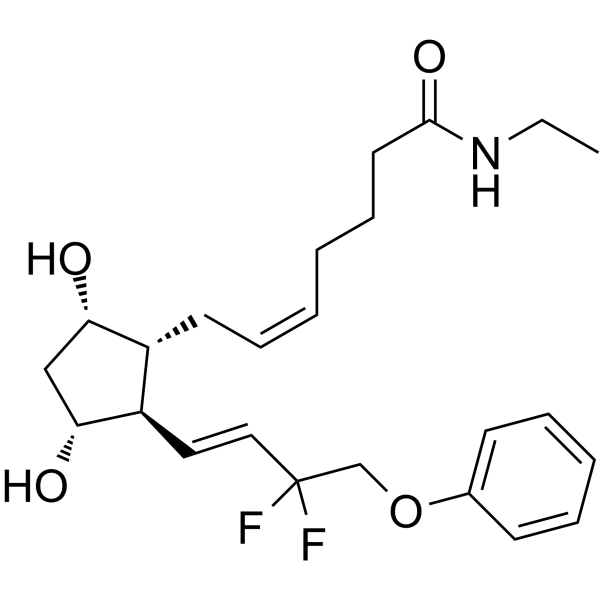
Tafluprost ethyl amide is a derivative of Tafluprost (HY-B0600). Tafluprost ethyl amide is commonly used in studies related to eyelash hypotrichosis, and it can also be applied in research related to the cosmetic field .
loading...
    loading...
Cat. No.: HY-160928
CAS No.: 1825371-51-4
Target:  

E1/E2/E3 Enzyme

Research Areas:  

Cardiovascular Disease

Smurf1 modulator-1 (Compound 20) is a selective inhibitor for Smad ubiquitination regulatory factor 1 (Smurf1), with IC50 of 180 nM .
loading...
    loading...
Cat. No.: HY-180916
CAII-IN-11 (Compound A1) is a dual-target compound that contains a hCA II inhibitor (IC₅₀ = 2 nM) portion and a NO donor portion. CAII-IN-11 also has inhibitory activity against hCA IX, hCA XII, and hCA I, with IC50 values of 6, 3, and 152 nM respectively. CAII-IN-11 significantly increases the intracellular cGMP level in human trabecular meshwork cells. CAII-IN-11 reduces the apoptosis of retinal ganglion cells by reducing oxidative stress (ROS levels), inhibiting astrocytes and the NLRP3 inflammasome activation. CAII-IN-11 has hypotensive activity in rabbit models and can be used for the study of glaucoma .
loading...
    loading...
Cat. No.: HY-19518R
CAS No.: 860005-21-6
Synonyms: NCX116 (Standard); LBN (Standard)
Latanoprostene bunod (NCX116; LBN) (Standard) is the analytical standard of Latanoprostene bunod. This product is intended for research and analytical applications. Latanoprostene bunod is a nitric oxide-releasing prostaglandin F2α analog. Latanoprostene bunod is a prodrug that, upon instillation into the eye, is hydrolyzed by corneal esterases into two active metabolites: Latanoprost (HY-B0577) and NO. Latanoprost activates the prostaglandin FP receptor to increase the outflow of aqueous humor through the uveoscleral pathway. NO increases aqueous humor drainage through the trabecular meshwork pathway, achieving synergistic enhancement targeting the dual pathways of aqueous humor outflow. Latanoprostene bunod can be used in research related to open-angle glaucoma and ocular hypertension.
loading...
    loading...
Cat. No.: HY-116679
CAS No.: 221246-34-0
Synonyms: 17-Trifluoromethylphenyl trinor PGF2α
Research Areas:  

Endocrinology

A number of 17-phenyl trinor prostaglandin F2α (17-phenyl trinor PGF2α) derivatives have been approved for glaucoma. Of these, the unsubstituted or meta-substituted aromatic derivatives are the most potent FP receptor agonists.4 17-trifluoromethylphenyl trinor PGF2α bears an aromatic ring which is reminiscent of the trifluoromethyl-phenoxy ring of travoprost ((+)-fluprostenol isopropyl ester). As an ocular hypotensive agent, it would be expected that 17-trifluoromethylphenyl trinor PGF2α would act very much like the free acid of travoprost. 17-phenyl trinor PGF2α is a potent luteolytic, with a potency equal to or greater than fluprostenol and cloprostenol.
loading...
    loading...
Cat. No.: HY-15195R
CAS No.: 290815-26-8
Synonyms: Ro 67-0565 (Standard); SPP-301 (Standard)
Avosentan (Standard) is the analytical standard of Avosentan (HY-15195). This product is intended for research and analytical applications. Avosentan is an orally active endothelin (ETA) receptor antagonist. Avosentan can block the ETA receptor, thereby reducing vascular contraction, and exerting a renal protective effect. Avosentan inhibits vascular contraction caused by ET-1 and alleviates the reduction in retinal and optic nerve head blood flow induced by it, lowering intraocular pressure in the glaucoma monkey model. Avosentan non-specifically blocks ETB receptors at high doses, inhibiting ETB-mediated diuresis and natriuresis, and may cause fluid retention. Avosentan can be used to reduce proteinuria with diabetic nephropathy, but induces significant fluid overload and congestive heart failure.
loading...
    loading...
Cat. No.: HY-158821B
Target:  

TGF-beta/Smad

Research Areas:  

Neurological Disease

ISTH0036 sodium scrambled negative control is the sequence scrambled negative control of ISTH0036 sodium (HY-158821A). ISTH0036 sodium is a phosphorothioate LNA-modified antisense oligonucleotide gapmer that selectively targets and downregulates TGF-β2 mRNA. ISTH0036 sodium suppresses TGF-β2 expression, reduces choroidal neovascularization and vascular leakage, inhibits fibrosis, blocks epithelial-to-mesenchymal transition, and inhibits angiogenesis while promoting bleb survival. ISTH0036 sodium exhibits long-lasting, dose-dependent ocular tissue distribution and target engagement in rabbit and non-human primate eyes. ISTH0036 sodium can be used for the study of various ocular disorders, such as glaucoma and neovascular retinal diseases.
loading...
    loading...
Cat. No.: HY-158821C
Research Areas:  

Neurological Disease

FAM labled ISTH0036 sodiumis a FAM labled ISTH0036 sodium (HY-158821A). ISTH0036 sodium is a phosphorothioate LNA-modified antisense oligonucleotide gapmer that selectively targets and downregulates TGF-β2 mRNA. ISTH0036 sodium suppresses TGF-β2 expression, reduces choroidal neovascularization and vascular leakage, inhibits fibrosis, blocks epithelial-to-mesenchymal transition, and inhibits angiogenesis while promoting bleb survival. ISTH0036 sodium exhibits long-lasting, dose-dependent ocular tissue distribution and target engagement in rabbit and non-human primate eyes. ISTH0036 sodium can be used for the study of various ocular disorders, such as glaucoma and neovascular retinal diseases.
loading...
    loading...
Cat. No.: HY-158821D
Research Areas:  

Neurological Disease

Cy3 labled ISTH0036 sodium is a Cy3 labled ISTH0036 sodium (HY-158821A). ISTH0036 sodium is a phosphorothioate LNA-modified antisense oligonucleotide gapmer that selectively targets and downregulates TGF-β2 mRNA. ISTH0036 sodium suppresses TGF-β2 expression, reduces choroidal neovascularization and vascular leakage, inhibits fibrosis, blocks epithelial-to-mesenchymal transition, and inhibits angiogenesis while promoting bleb survival. ISTH0036 sodium exhibits long-lasting, dose-dependent ocular tissue distribution and target engagement in rabbit and non-human primate eyes. ISTH0036 sodium can be used for the study of various ocular disorders, such as glaucoma and neovascular retinal diseases.
loading...
    loading...

