



CL 5343

Based on 1 Customer Validation
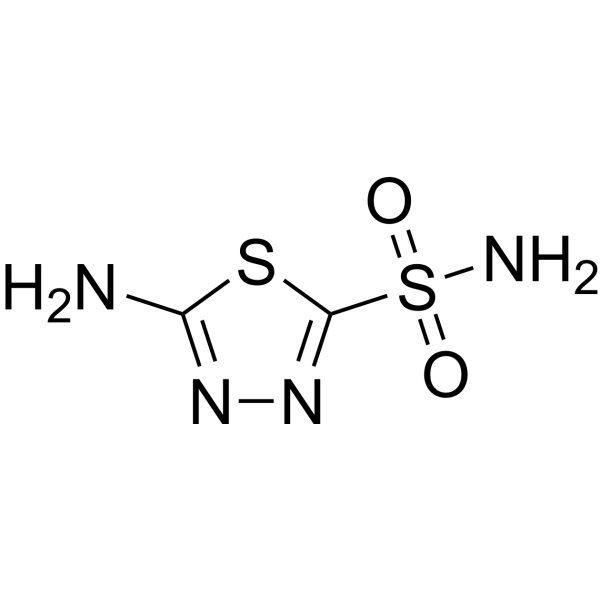
CL 5343 (5-Amino-1,3,4-thiadiazole-2-sulfonamide) is a selective inhibitor of carbonic anhydrase B (HCA-B) and isoforms I, II, IV, and VII. CL 5343 has a Ki of 7.9 nM for hCA II. CL 5343 acts as a CA9 ligand to achieve targeted delivery of maytansine to the cell membrane of SKRC52 renal cancer cells. CL 5343 is useful in the development of therapeutics for diseases associated with CA overactivity, such as glaucoma, epilepsy, and cancer.
For research use only. We do not sell to patients.
- Purity : 99.91%
- CAS No.: 14949-00-9
- Formula: C2H4N4O2S2
- Molecular Weight:180.21
-
Storage:
4°C, protect from light
* In solvent : -80°C, 6 months; -20°C, 1 month (protect from light)

To place orders, for customer services and technical support, please contact: MedChemExpress USA
Tel: 609-228-6898 E-mail: [email protected] [email protected]


-
 Biological Activity
-
Chemical Information
-
Solvent & Solubility
- Purity & Documentation
- References
-
 Help & FAQs





Biological Activity
Description
In Vitro
Gold nanoparticles conjugated with CL 5343 (5-Amino-1,3,4-thiadiazole-2-sulfonamide) enhances cellular uptake and induced apoptosis in MCF-7 cells, resulting in a 75% decrease in cell viability[3].
MedChemExpress (MCE) has not independently confirmed the accuracy of these methods. They are for reference only.
-
Cell Line:MCF-7 breast cancer cells
-
Concentration:1 μM
-
Incubation Time:48 hours
-
Result:The 5-Amino-1,3,4-thiadiazole-2-sulfonamide-conjugated gold nanoparticles enhanced cellular uptake and induced apoptosis in MCF-7 cells, leading to a 75% reduction in cell viability.
In Vivo
MedChemExpress (MCE) has not independently confirmed the accuracy of these methods. They are for reference only.
-
Animal Model:Female nude mice (body weight 20-25g, 6 weeks old) with SKRC52 renal cancer subcutaneous xenograft model[2]
-
Dosage:70 nmol
-
Administration:Intravenous injection, single dose, 1 hour
-
Result:The conjugate of 5-Amino-1,3,4-thiadiazole-2-sulfonamide with maytansinoid showed efficient tumor accumulation (13.4% ID/g) and potent antitumor activity, significantly reducing tumor volume without obvious systemic toxicity.


Chemical Information
-
CAS No. 14949-00-9
-
Appearance Solid
-
Molecular Weight 180.21
-
Formula C2H4N4O2S2
-
Color White to off-white
-
SMILES
O=S(C1=NN=C(N)S1)(N)=O
-
Synonyms
5-Amino-1,3,4-thiadiazole-2-sulfonamide
-
Shipping
Room temperature in continental US; may vary elsewhere.
-
Storage
4°C, protect from light
* In solvent : -80°C, 6 months; -20°C, 1 month (protect from light)


Solvent & Solubility
In Vitro:
DMSO : 100 mg/mL (554.91 mM; Need ultrasonic; Hygroscopic DMSO has a significant impact on the solubility of product, please use newly opened DMSO)
Please refer to the solubility information to select the appropriate solvent. Once prepared, please aliquot and store the solution to prevent product inactivation from repeated freeze-thaw cycles.
Storage method and period of stock solution: -80°C, 6 months; -20°C, 1 month (protect from light). When stored at -80°C, please use it within 6 months. When stored at -20°C, please use it within 1 month.
Please refer to the solubility information to select the appropriate solvent. Once prepared, please aliquot and store the solution to prevent product inactivation from repeated freeze-thaw cycles.
Storage method and period of stock solution: -80°C, 6 months; -20°C, 1 month (protect from light). When stored at -80°C, please use it within 6 months. When stored at -20°C, please use it within 1 month.
Concentration (start) × Volume (start) = Concentration (final) × Volume (final)
In Vivo:
Select the appropriate dissolution method based on your experimental animal and administration route.
- For the following dissolution methods, please ensure to first prepare a clear stock solution using an In Vitro approach and then sequentially add co-solvents:
- To ensure reliable experimental results, the clarified stock solution can be appropriately stored based on storage conditions. As for the working solution for In Vivo experiments, it is recommended to prepare freshly and use it on the same day.
- The percentages shown for the solvents indicate their volumetric ratio in the final prepared solution. If precipitation or phase separation occurs during preparation, heat and/or sonication can be used to aid dissolution.
Add each solvent one by one: 10% DMSO 40% PEG300 5% Tween-80 45% Saline
Solubility: ≥ 5 mg/mL (27.75 mM); Clear solution
This protocol yields a clear solution of ≥ 5 mg/mL (saturation unknown).
Taking 1 mL working solution as an example, add 100 μL DMSO stock solution (50.0 mg/mL) to 400 μL PEG300, and mix evenly; then add 50 μL Tween-80 and mix evenly; then add 450 μL Saline to adjust the volume to 1 mL.
Preparation of Saline: Dissolve 0.9 g sodium chloride in ddH₂O and dilute to 100 mL to obtain a clear Saline solution.
Add each solvent one by one: 10% DMSO 90% (20% SBE-β-CD in Saline)
Solubility: ≥ 5 mg/mL (27.75 mM); Clear solution
This protocol yields a clear solution of ≥ 5 mg/mL (saturation unknown).
Taking 1 mL working solution as an example, add 100 μL DMSO stock solution (50.0 mg/mL) to 900 μL 20% SBE-β-CD in Saline, and mix evenly.
Preparation of 20% SBE-β-CD in Saline (4°C, storage for one week): 2 g SBE-β-CD powder is dissolved in 10 mL Saline, completely dissolve until clear.
In Vivo Dissolution Calculator
Please enter the basic information of animal experiments:
-
-
-
-
Recommended: Prepare an additional quantity of animals to account for potential losses during experiments.
Please enter your animal formula composition:
-
%DMSO +
Recommended: Keep the proportion of DMSO in working solution below 2% if your animal is weak.
-
%+
-
+%Tween-80 + +
-
%Saline +
The co-solvents required include: DMSO, . All of co-solvents are available by MedChemExpress (MCE). , Tween 80. All of co-solvents are available by MedChemExpress (MCE).
Working solution concentration: 0.22 mg/mL
Method for preparing stock solution: mg drug dissolved in μL DMSO. Stock solution concentration: mg/mL. * In solvent : -80°C, 6 months; -20°C, 1 month (protect from light)
1. Take μL DMSO stock solution;
2. Add μL .
μL , mix evenly;
3. Then add μL Tween 80, mix evenly;
4. Then add μL
Please ensure that the stock solution in the first step is dissolved to a clear state, and add co-solvents in sequence. You can use ultrasonic heating (ultrasonic cleaner, recommended frequency 20-40 kHz), vortexing, etc. to assist dissolution.


Purity & Documentation
-
Data Sheet (275 KB)
-
SDS (476 KB)
- English - EN (476 KB)
- Français - FR (476 KB)
- Deutsch - DE (476 KB)
- Norwegian - NO (476 KB)
- Español - ES (476 KB)
- Swedish - SV (476 KB)
- Italian - IT (476 KB)
- Korean - KR (476 KB)
- Portuguese - PT (476 KB)
-
Handling Instructions (2659 KB)
References
[1]. Aday B, et al. Synthesis of novel 5-amino-1,3,4-thiadiazole-2-sulfonamide containing acridine sulfonamide/carboxamide compounds and investigation of their inhibition effects on human carbonic anhydrase I, II, IV and VII. Bioorg Chem. 2018 Apr;77:101-105. [Content Brief]
[2]. Pesando JM, et al. Proton magnetic resonance studies of carbonic anhydrase. III. Binding of sulfonamides. Biochemistry. 1975;14(4):689-693. [Content Brief]
[3]. Pérez-Herrero E, et al. The reversed intra-and extracellular pH in tumors as a unified strategy to chemotherapeutic delivery using targeted nanocarriers[J]. Acta Pharmaceutica Sinica B, 2021, 11(8): 2243-2264. [Content Brief]


Complete Stock Solution Preparation Table
Please refer to the solubility information to select the appropriate solvent. Once prepared, please aliquot and store the solution to prevent product inactivation from repeated freeze-thaw cycles.
Storage method and period of stock solution: -80°C, 6 months; -20°C, 1 month (protect from light). When stored at -80°C, please use it within 6 months. When stored at -20°C, please use it within 1 month.
| Optional Solvent | Concentration Solvent Mass | 1 mg | 5 mg | 10 mg | 25 mg |
|---|---|---|---|---|---|
| DMSO | 1 mM | 5.5491 mL | 27.7454 mL | 55.4908 mL | 138.7270 mL |
| 5 mM | 1.1098 mL | 5.5491 mL | 11.0982 mL | 27.7454 mL | |
| 10 mM | 0.5549 mL | 2.7745 mL | 5.5491 mL | 13.8727 mL | |
| 15 mM | 0.3699 mL | 1.8497 mL | 3.6994 mL | 9.2485 mL | |
| 20 mM | 0.2775 mL | 1.3873 mL | 2.7745 mL | 6.9364 mL | |
| 25 mM | 0.2220 mL | 1.1098 mL | 2.2196 mL | 5.5491 mL | |
| 30 mM | 0.1850 mL | 0.9248 mL | 1.8497 mL | 4.6242 mL | |
| 40 mM | 0.1387 mL | 0.6936 mL | 1.3873 mL | 3.4682 mL | |
| 50 mM | 0.1110 mL | 0.5549 mL | 1.1098 mL | 2.7745 mL | |
| 60 mM | 0.0925 mL | 0.4624 mL | 0.9248 mL | 2.3121 mL | |
| 80 mM | 0.0694 mL | 0.3468 mL | 0.6936 mL | 1.7341 mL | |
| 100 mM | 0.0555 mL | 0.2775 mL | 0.5549 mL | 1.3873 mL |


CL 5343 Related Classifications
HY-W074975 Related Classifications
 Powered by Bioz