307 Results for "

Axis

" in MedChemExpress (MCE) Product Catalog:
Products (307)

307 Results for "Axis" in MCE Product Catalog:

Cat. No.: HY-N9932
CAS No.: 125519-47-3
11β,13-Dihydrolactucopicrin is a sesquiterpene lactone and the main bitter component of chicory root. 11β,13-Dihydrolactucopicrin inhibits yeast α-glucosidase activity (IC50 = 27.49 μM) and inhibits Crz1 activation and nuclear accumulation. 1β,13-Dihydrolactucopicrin possesses blood-brain barrier penetration capacity in an in vitro HBMEC blood-brain barrier model and can generate cysteine-conjugated metabolites within brain microvascular endothelial cells. 11β,13-Dihydrolactucopicrin can regulate the lncRNA H19/miR-21-3p signaling axis; it upregulates the expression of ABCG2 and lncRNA H19, downregulates miR-21-3p, inhibits the release of IL-6, TNF-α, and hs-CRP pro-inflammatory mediators, and alleviates urate-induced inflammatory injury in renal epithelial cells. 11β,13-Dihydrolactucopicrin can be used in research on diabetes and renal urate deposition .
loading...
    loading...
Cat. No.: HY-10032A
CAS No.: 1247874-19-6
Target:  

14-3-3 Protein

PF-477736 (hydrochloride) is an ATP-competitive Chk1 inhibitor (Ki 0.49 nM) that also inhibits CK2A1, PKCA, and Akt1, and is a broad-spectrum kinase inhibitor .PF-477736 induces apoptosis via PARP cleavage, caspase-3/7 activation, caspase-independent death, BAX and PUMA upregulation, H2AX phosphorylation, DNA fragmentation, and Chk1 proteasomal degradation, while inhibiting proliferation and preventing mitotic entry .PF-477736 demonstrates selective synthetic lethality in LIMD1-deficient cells, efficacy in subcutaneous xenograft models of LIMD1-deficient tumors, and anti-proliferative activity against leukemia and lymphoma cell lines .PF-477736 induces DNA double-strand breaks and activates the ATM-p53-p21 axis, and sensitizes CHK1i-insensitive neuroblastoma cells to apoptosis with ATM or DNA-PK inhibitors .PF-477736 can be used for the research of non-small cell lung cancer, leukemia, lymphoma, and neuroblastoma .
loading...
    loading...
Cat. No.: HY-P991736
Anti-IL11 Antibody (X203, Mouse IgG) is an antibody targeting IL-11. Anti-IL11 Antibody (X203, Mouse IgG) inhibits IL-11-mediated activation of the ERK-mTORC1 axis, inactivation of LKB1-AMPK, and pro-senescence pathways. Anti-IL11 Antibody (X203, Mouse IgG) alleviates age-related metabolic decline, improves muscle function, reduces tissue fibrosis, decreases the expression of senescence markers, and maintains telomere length and mtDNA copy number. Anti-IL11 Antibody (X203, Mouse IgG) restores browning of white adipose tissue, upregulates thermogenic and mitochondrial biogenesis gene programs, reduces lipid droplet size, and decreases immune cell infiltration in visceral white adipose tissue. Anti-IL11 Antibody (X203, Mouse IgG) extends the median lifespan of mice and reduces the incidence of age-related tumors. Anti-IL11 Antibody (X203, Mouse IgG) can be used in the research of age-related metabolic decline, sarcopenia and age-related cancers .
loading...
    loading...
Cat. No.: HY-182360
Cytisine-Platinum(IV) Prodrug-1 is a Pt(IV) prodrug incorporating the natural compound Cytisine (HY-N0175) with antiproliferative activity against tumor cells. Cytisine-Platinum(IV) Prodrug-1 promotes calcium transfer across the IP3R1-GRP75-VDAC1 axis to drive mitochondrial calcium overload. Cytisine-Platinum(IV) Prodrug-1 initiates unfolded protein response via PERK, eIF2α, ATF4, and CHOP to modulate Bcl-2 and Bax, triggering apoptosis. Cytisine-Platinum(IV) Prodrug-1 induces mitochondrial dysfunction, ROS production, reduced ATP synthesis, DNA damage, and S-phase cell cycle arrest. Cytisine-Platinum(IV) Prodrug-1 activates the cGAS-STING pathway, reduces PD-L1 expression, drives immunogenic cell death. Cytisine-Platinum(IV) Prodrug-1 exhibits high physiological stability, efficient cellular accumulation, and enhanced platinum-DNA binding, and inhibits tumor growth in mouse models with reduced systemic toxicity. Cytisine-Platinum(IV) Prodrug-1 can be used for the research of lung cancer .
loading...
    loading...
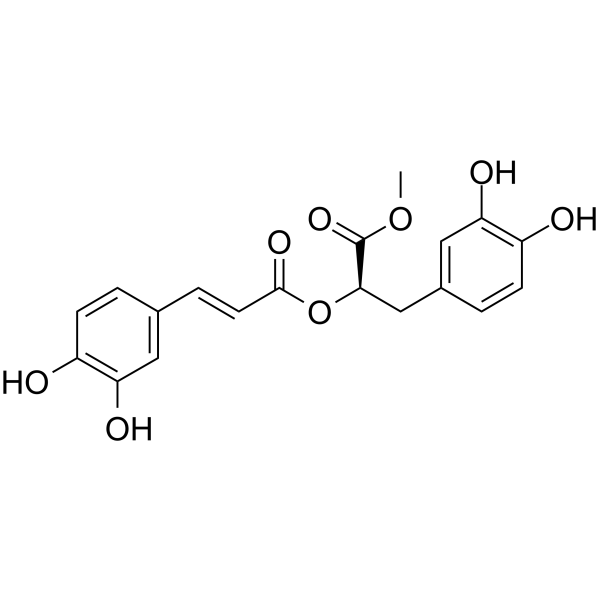
Cat. No.: HY-N3266
CAS No.: 99353-00-1
Methyl rosmarinate is an orally active hydroxycinnamic acid. Methyl rosmarinate exhibits an IC50 of 24.70 μM and a Ki of 15.29 μM against PTP1B, an IC50 of 41.46 μg/mL against BChE, a Ki of 0.61 mM against mushroom tyrosinase, and an IC50 of 2.50 μM against SARS-CoV-2 3CLpro. Methyl rosmarinate downregulates the phosphorylation levels of ERK, JNK, p38, Smad2 and Smad3. Methyl rosmarinate activates erythrocyte BPGM and promotes the production of 2,3-BPG. Methyl rosmarinate induces apoptosis of fibroblasts. Methyl rosmarinate prolongs the survival time of hypoxic mice. Methyl rosmarinate improves insulin sensitivity. Methyl rosmarinate binds to SARS-CoV-2 3CLpro and inhibits viral replication. Methyl rosmarinate induces glioblastoma cell death. Methyl rosmarinate activates the TGR5/AMPK axis and reduces the levels of ROS and MDA. Methyl rosmarinate shows inhibitory activity against MMP-1. Methyl rosmarinate can be used in research related to pulmonary fibrosis, hypoxia-induced injury, type 2 diabetes, Alzheimer's disease, hyperpigmentation disorders, COVID-19, glioblastoma and myocardial ischemia-reperfusion injury .
loading...
    loading...
Cat. No.: HY-L249
6,182 compounds

Protein lactylation, an emerging post-translational modification identified in recent years, plays a critical role in linking cellular metabolic reprogramming, epigenetic regulation, and signaling networks. Based on a systematic framework encompassing lactate metabolism, lactylation, and downstream signaling pathways, this compound library comprehensively targets multiple regulatory layers, including histone modification enzymes (such as p300 and HDACs), key glycolytic enzymes (such as PKM2, LDHA, and GAPDH), transcriptional regulators (such as STAT3, HMGB1, and p53), as well as central signaling pathway nodes including HIF-1α, NF-κB, and PI3K-AKT-mTOR. This integrated design enables a comprehensive representation of the regulatory roles of lactylation across the “metabolism–epigenetics–signaling” axis.

MCE has assembled a collection of 6,182 known bioactive compounds and potential functional molecules, making this library suitable for a wide range of applications, including high-throughput drug screening, inhibitor identification, and mechanistic studies. It can be used to systematically evaluate the functional roles of lactylation in biological processes such as tumor metabolism, immune regulation, and inflammatory responses, and to efficiently identify small-molecule candidates with regulatory potential, thereby facilitating the development of innovative therapeutics targeting the interplay between metabolism and epigenetic regulation.

Cat. No.: HY-P991744

Target:  

CXCR

Research Areas:  

Cancer

Anti-Mouse CXCR4 Antibody is a monoclonal antibody that specifically recognizes murine CXCR4 (C-X-C chemokine receptor 4), also known as fusin or CD184. CXCR4 is a seven-transmembrane G protein–coupled receptor whose principal endogenous ligand is CXCL12 (stromal cell–derived factor-1α, SDF-1α) and is widely expressed in hematopoietic cells, endothelial cells, neurons, as well as embryonic and adult stem cells. The CXCR4–CXCL12 signaling axis activates multiple downstream pathways, including ERK1/2, Ras, p38 MAPK, PLC/MAPK, and SAPK/JNK, thereby regulating cell survival, proliferation, migration, and stemness maintenance. Aberrant overexpression of CXCR4 is closely associated with poor prognosis and metastasis in various cancers, with CXCR4-positive tumor cells preferentially home to CXCL12-rich tissues such as the liver, bone marrow, lung, and lymph nodes. Accordingly, CXCR4 and its CXCL12-related antagonists emerge as attractive targets for experimental anticancer therapy. Anti-Mouse CXCR4 Antibody is generated using a cell-based immunization and screening strategy and exhibits high affinity for both endogenous and exogenous murine CXCR4. Anti-Mouse CXCR4 Antibody can be used for thestudy of chronic lymphocytic leukemia and multiple myeloma .
loading...
    loading...

