


3771 Results for "

fluorescent substrate,BAAA

" in MedChemExpress (MCE) Product Catalog:
Products (3771)

3771 Results for "fluorescent substrate,BAAA" in MCE Product Catalog:

Cat. No.: HY-D3117
CAS No.: 2146114-18-1
Target:  

Fluorescent Dye

Research Areas:  

Others

MBCB is a two-photon Fluorescent probe for dual-detection of mitochondrial SO₂ derivatives and viscosity. For SO₂ derivatives detection, the probe utilizes a Michael addition mechanism: nucleophilic addition of SO₂ derivatives to the C=C bond between the carbazole skeleton and 3-methylbenzothiazolium moiety destroys the strong intramolecular charge transfer (ICT) system between these groups, while enhancing the weak ICT system between the benzothiazole group and carbazole framework; this causes the red emission at 600 nm to decrease and the blue emission at 434 nm to increase, creating a ratiometric response based on the I₄₃₄ₙₘ/I₆₀₀ₙₘ intensity ratio. For viscosity detection, in low-viscosity environments, steric hindrance creates a twisted ICT (TICT) system with weak fluorescence, while in high-viscosity environments, intramolecular rotation is blocked, the TICT state is disrupted, and the strong ICT system is recovered, leading to a strong red emission at 567 nm with negligible change to the short-wavelength emission at 415 nm, creating a ratiometric response based on the I₅₆₇ₙₘ/I₄₁₅ₙₘ intensity ratio that has a logarithmic linear relationship with viscosity. The probe has excitation/emission wavelengths of Ex/Em = 351/434, 600 nm for SO₂ derivatives detection and Ex/Em = 351/567 nm for viscosity detection, with two-photon excitation at 740 nm for bioimaging; it also exhibits good mitochondrial targeting ability with a Pearson's colocalization coefficient of 0.93 when paired with Mito-Tracker Green. The probe shows high sensitivity and selectivity for SO₂ derivatives, has low cell cytotoxicity, and can be applied to detect exogenous/endogenous HSO₃⁻ in living cells and in vivo, as well as visualize mitochondrial viscosity changes induced by nystatin[1].
loading...
    loading...
Cat. No.: HY-D3133
CAS No.: 2410296-16-9
Target:  

Fluorescent Dye

Research Areas:  

Others

HS-CyBz is a Fluorescent probe for H₂S detection, enabling ratiometric optical/photoacoustic dual-modality in/ex vivo imaging. Its detection mechanism relies on nucleophilic substitution of its benzoic ester group by HS⁻, which releases an enolic meso-hydroxyltricarboheptamethine cyanine that then undergoes keto-enol tautomerization to form Cy-ketone; this tautomerization causes distinct shifts in absorption and emission spectra, producing a ratiometric response that reduces interferences from tissue scattering, autofluorescence, and probe concentration. In its initial state, HS-CyBz has an excitation wavelength of 595 nm, with emission bands centered at 805 nm (main) and 630 nm (minor); upon reaction with H₂S, the 805 nm emission band decreases while the 630 nm band drastically increases, and its absorption spectrum shows a sharp band at 775 nm and a shoulder band at 708 nm, which decrease upon H₂S reaction with a minor increase at 850 nm and an isosbestic point at 825 nm. For in vivo optical imaging, excitation at 560 nm is used with emission channels at 620 nm and 790 nm, while in vivo photoacoustic imaging uses excitation at 775 nm and 825 nm. The detection limit of HS-CyBz for H₂S is 0.5 μM, and it shows high selectivity, with only H₂S inducing a distinct enhancement of the emission ratio F₆₃₀/F₈₀₅ and PA ratio PA₈₂₅/PA₇₇₅, while other biochemical species including cations, anions, reactive oxygen species, biothiols, and carboxylesterase trigger only minor changes and do not interfere with H₂S sensing. Tail intravenous injection of HS-CyBz leads to accumulation in the liver of mice, and it can be used to verify endogenous H₂S upregulation triggered by S-adenosyl-L-methionine via ratiometric optical/photoacoustic imaging .
loading...
    loading...
Cat. No.: HY-D0265
CAS No.: 125-20-2
Target:  

Fluorescent Dye

Research Areas:  

Others

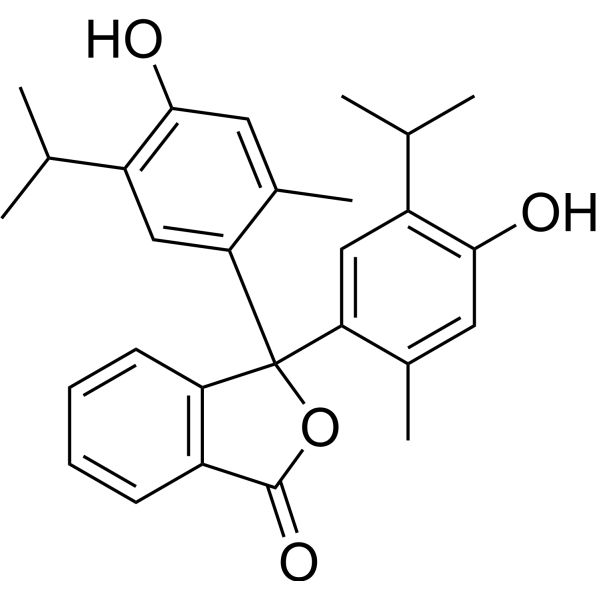
Thymolphthalein is a phthalocyanine dye with electrochemical activity that can serve as an acid-base indicator, appearing colorless under acidic pH conditions and blue under alkaline pH conditions. Thymolphthalein acts as a signal molecule in co-assembled AMP/TP nanoparticles (NPs) for the visual and colorimetric detection of Escherichia coli. Thymolphthalein can form a non-conductive porous polymer coating via electropolymerization .
loading...
    loading...
Cat. No.: HY-D0896AR
CAS No.: 28836-03-5
Synonyms: NSC 1746 ammonium (Standard); Peri acid, phenyl- ammonium (Standard); Phenyl peri acid ammonium (Standard)
ANS (ammonium) (Standard) is the analytical standard of ANS (ammonium). This product is intended for research and analytical applications. ANS ammonium is a potent antibacterial agent and a textile dye. ANS ammonium can be used as fluorescence probe. ANS ammonium blocks the binding of triiodothyronine to thyroxine binding globulin in radioimmunoassay of triiodothyronine .
loading...
    loading...
Cat. No.: HY-D1639A
CAS No.: 111248-72-7
5,5'-Dibromo-BAPTA is a biochemical assay reagent.
loading...
    loading...
Cat. No.: HY-W020030
CAS No.: 79539-35-8
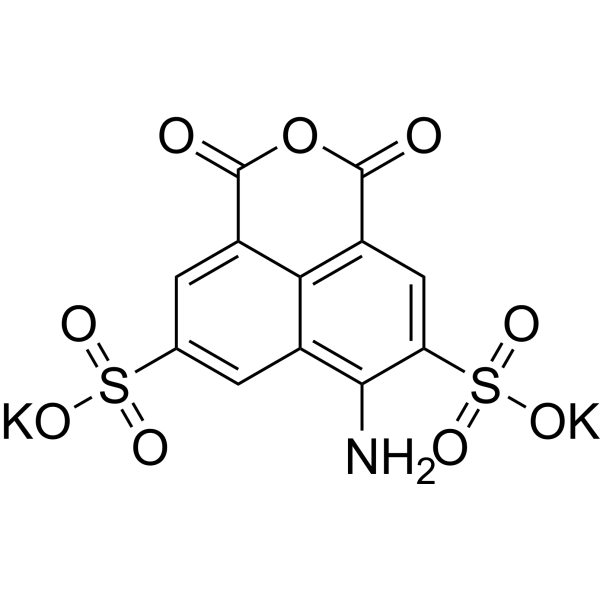
4-Amino-3,6-disulfonaphthalic anhydride dipotassium is a building block that can be used to systhese a useful dye for biological research purposes.
loading...
    loading...
Cat. No.: HY-W345148
CAS No.: 842-15-9
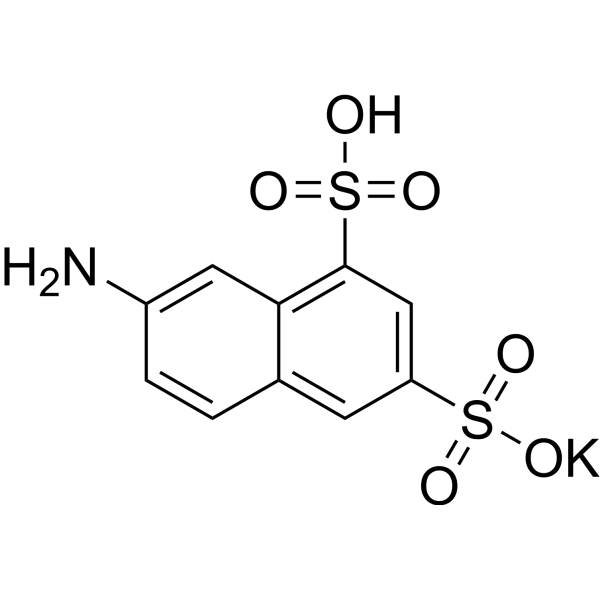
2-Naphthylamine-6,8-disulfonic acid potassium is chemical that can be used for preparing dyestuff, medicine, agricultural chemicals etc .
loading...
    loading...
Cat. No.: HY-W354821
CAS No.: 66185-70-4
Synonyms: 4-MUD
4-Methyl-2-oxo-2H-1-benzopyran-7-yl decanoate is a fluorogenic substrate used to follow the hydrolytic activity of carboxylesterases .
loading...
    loading...
Cat. No.: HY-W357142
CAS No.: 20943-16-2
3-Acetylumbelliferyl β-D-Glucopyranoside is a fluorogenic substrate for β-glucosidase and can be used as a positive control substrates for β-D-glucosidase .
loading...
    loading...
Cat. No.: HY-W440916
CAS No.: 1000788-53-3
Target:  

Liposome

Research Areas:  

Others

DSPE-PEG3400-FITC is a fluorescein attached PEG lipid. It can be used to prepare liposomes as drug carrier in targeted drug delivery. The polymer is modified with fluorescein (green) dye which can be used for staining cells, tissues, biomarkers, or nanoparticles.
loading...
    loading...
Cat. No.: HY-P11236
CAS No.: 2041574-23-4
Synonyms: LS301
Research Areas:  

Others

Cronexitide lanocianine is a diagnostic imaging agent.
loading...
    loading...

