37 Results for "

Repellent activity

" in MedChemExpress (MCE) Product Catalog:
Products (37)

37 Results for "Repellent activity" in MCE Product Catalog:

Cat. No.: HY-N15269
CAS No.: 20084-99-5
Cyperol is a chemical component of the Nagarmotha (Cyperus rotundus). Nagarmotha possesses various pharmacological activities such as diuresis, digestion, menstruation, insect repellent, analgesia and anti-inflammatory .
loading...
    loading...
Cat. No.: HY-N10100
CAS No.: 88728-58-9
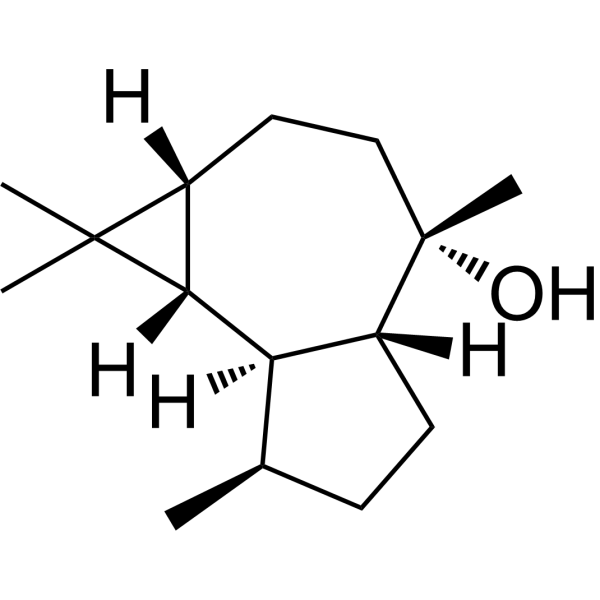
Epiglobulol is a natural product that can be isolated from Atalantia buxifolia. Epiglobulol is a principal components of essential oil which has significant contact toxicity against three stored-product insects .
loading...
    loading...
Cat. No.: HY-W774881
CAS No.: 1262551-89-2
Synonyms: Tiabendazole-d6; 2-(4-Thiazolyl)benzimidazole-d6
Thiabendazole-d6 is a deuterated labeled Thiabendazole (HY-B0263). Thiabendazole is an orally available benzimidazole fungicide with repellent and anticancer activities. Thiabendazole can result in developmental malformations. Thiabendazole can be used for modeling .
loading...
    loading...
Cat. No.: HY-N15444
CAS No.: 493-71-0
Bullatenone is a volatile bioactive compound that can be found in Lophomyrtus bullata. It has insect - repellent, anti - ulcer, anti - UV, and antifungal activities. Bullatenone can inhibit the growth of fungi such as Candida albicans and Cladosporium resinae. Bullatenone can be used in the research of diseases such as inflammation and infections .
loading...
    loading...
Cat. No.: HY-N1500S1
CAS No.: 62385-90-4
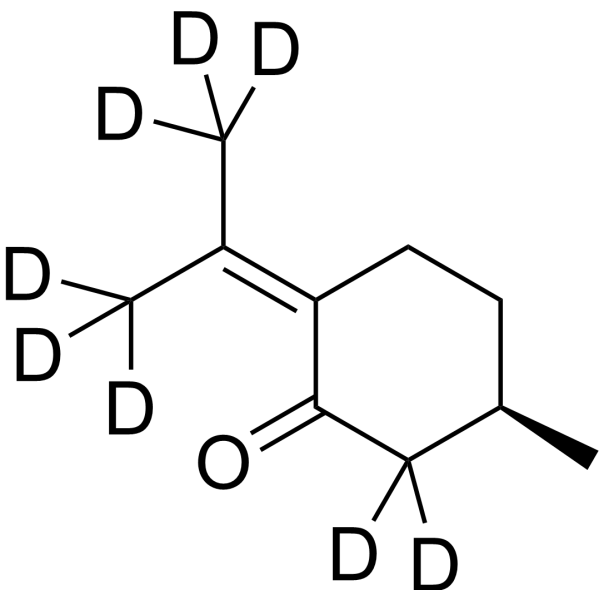
Pulegone-d8 is deuterated labeled Pulegone (HY-N1500). Pulegone is a monoterpene ketone compound widely present in the essential oils of many plants. Pulegone can also be used as a bird repellent. Pulegone has multiple activities such as anti-inflammatory, antibacterial, antifungal, and anti-hyperalgesic effects. Pulegone is particularly effective against bacteria of the Salmonella species .
loading...
    loading...
Cat. No.: HY-N1500R
CAS No.: 89-82-7
Pulegone (Standard) is the analytical standard of Pulegone (HY-N1500). This product is intended for research and analytical applications. Pulegone is a monoterpene ketone compound widely present in the essential oils of many plants. Pulegone can also be used as a bird repellent. Pulegone has multiple activities such as anti-inflammatory, antibacterial, antifungal, and anti-hyperalgesic effects. Pulegone is particularly effective against bacteria of the Salmonella species .
loading...
    loading...
Cat. No.: HY-W004285R
CAS No.: 1731-86-8
Methyl undecanoate (Standard) is the analytical standard of Methyl undecanoate (HY-W004285). This product is intended for research and analytical applications. Methyl undecanoate is a synthetic undecanoic acid ester analog with biting deterrent and repellent activity against Aedes aegypti mosquitoes, with a biting deterrent index (BDI) of 0.88 and minimum effective dose (MED) of 25 µg/cm 2. Methyl undecanoate can be used for the research of mosquito-borne diseases transmitted by Aedes aegypti .
loading...
    loading...
Cat. No.: HY-W738270
CAS No.: 1173022-44-0
Synonyms: 3,4-Dimethoxy[7-13C]-benzaldehyde
Veratraldehyde- 13C (3,4-Dimethoxy[7- 13C]-benzaldehyde) is the 13C-labeled Veratraldehyde (HY-N1096). Veratraldehyde is an orally active aromatic compound and antibacterial agent. Veratraldehyde can be isolated from essential oils of plants such as peppermint and ginger. Veratraldehyde targets the PilY1 protein. Veratraldehyde has antibacterial activity against Pseudomonas aeruginosa. Veratraldehyde has a repellent effect against mosquitoes and ticks. Veratraldehyde can be used as a flavoring agent .
loading...
    loading...
Cat. No.: HY-Y0496R
CAS No.: 106-46-7
Research Areas:  

Others

1,4-Dichlorobenzene (Standard) is the analytical standard of 1,4-Dichlorobenzene. This product is intended for research and analytical applications. 1,4-Dichlorobenzene is a non-genotoxic, orally active mitogenic/tumor-promoting carcinogen that is also widely used as a dye, resin intermediate, and deodorant, moth repellent/insecticide. 1,4-Dichlorobenzene induces liver tumors in mice and promotes the growth of spontaneous precancerous lesions, but shows no liver tumor-inducing activity in F344 rats. 1,4-Dichlorobenzene increases the levels of white blood cell count, serum alanine aminotransferase and blood urea nitrogen in occupationally exposed populations. 1,4-Dichlorobenzene is metabolized to 2,5-dichlorophenol and excreted in urine, and this metabolite can serve as a biomarker for 1,4-Dichlorobenzene exposure. Due to its specific hepatotoxic characteristics, 1,4-Dichlorobenzene is applicable to liver cancer-related research .
loading...
    loading...
Cat. No.: HY-W099647
CAS No.: 14936-66-4
2-Nonyl acetate is an insecticide and also the main component of the essential oil extracted from the aerial parts of Ruta chalepensis. 2-Nonyl acetate exhibits biting repellent activity against Aedes aegypti and Anopheles quadrimaculatus. It can be used in insecticidal research .
loading...
    loading...
Cat. No.: HY-W269352
CAS No.: 6175-49-1
Target:  

Insecticide

Research Areas:  

Infection

2-Dodecanone is an insecticide with repellent activity against specific insect species. 2-Dodecanone exhibits contact toxicity against adult Tribolium castaneum, Lasioderma serricorne and Liposcelis bostrychophila. 2-Dodecanone shows repellent effects against adult Lasioderma serricorne .
loading...
    loading...
Cat. No.: HY-W067479R
CAS No.: 22031-64-7
(E)-Cinnamamide (Standard) is the analytical standard of (E)-Cinnamamide (HY-W067479). This product is intended for research and analytical applications. (E)-Cinnamamide is a non-lethal chemical repellent. (E)-Cinnamamide exists as a trans-cinnamic acid amide metabolite in the culture broth of an unidentified Streptomyces No. 902. (E)-Cinnamamide is used in studies of conditioned taste aversion and repellent activity .
loading...
    loading...
Cat. No.: HY-N21949A
CAS No.: 15592-33-3
Synonyms: Methyl glucosinolate potassium
Glucocapparin (Methyl glucosinolate) potassium is a glucosinolate compound. Glucocapparin potassium can be isolated from plants of the Brassicaceae and Capparaceae families. Glucocapparin potassium possesses phytochemical defense (insect-repellent and antibacterial), hypoglycemic and antioxidant activities, and the isothiocyanate substances produced by its hydrolysis exhibit certain anticancer effects. Glucocapparin potassium can be used in studies related to cancer, inflammation and hyperglycemia .
loading...
    loading...
Cat. No.: HY-184082
CAS No.: 3784-99-4
Target:  

Parasite

Research Areas:  

Infection

Stilbazium iodide is an orally effective pyridinium quaternary ammonium repellent. Stilbazium (iodide) exhibits broad-spectrum activity against a variety of human and animal intestinal parasites. Stilbazium iodide eliminates both mature and immature worms, reduces egg counts, reddens feces, and causes mild gastrointestinal irritation. Stilbazium iodide can be used in research related to intestinal parasitic infections including pinworm, whipworm, and strongyloidiasis .
loading...
    loading...
Cat. No.: HY-W004285S
CAS No.: 1219804-96-2
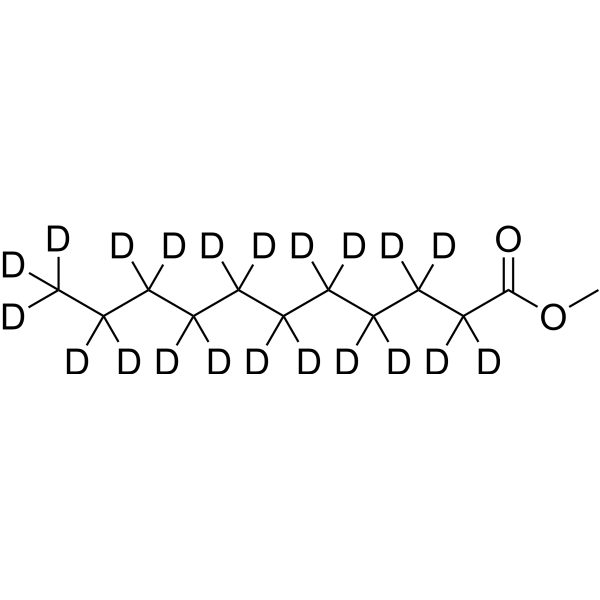
Methyl undecanoate-d21 is the d21-labeled Methyl undecanoate (HY-W004285). Methyl undecanoate is a synthetic undecanoic acid ester analog with biting deterrent and repellent activity against Aedes aegypti mosquitoes, with a biting deterrent index (BDI) of 0.88 and minimum effective dose (MED) of 25 µg/cm 2. Methyl undecanoate can be used for the research of mosquito-borne diseases transmitted by Aedes aegypti .
loading...
    loading...
Cat. No.: HY-W727481
CAS No.: 1253429-01-4
Target:  

Parasite Insecticide

Research Areas:  

Infection

Cyetpyrafen is a pyrazole insecticide/acaricide with broad-spectrum insecticidal activity. Cyetpyrafen binds to DhelOBP4 (Ki = 4.95 μM) and DhelOBP21 (Ki = 5.51 μM) to mediate olfactory recognition in *Cryptolaemus montrouzieri*. Cyetpyrafen induces dose-dependent electroantennogram responses in *Cryptolaemus montrouzieri* and exhibits repellent effects on the species. Cyetpyrafen has bioaccumulative properties, is rapidly and passively absorbed by the roots of lettuce and rice, reaches a steady state within 24 h, preferentially accumulates in roots, and shows limited xylem/phloem translocation .
loading...
    loading...
Cat. No.: HY-W015616R
CAS No.: 2550-26-7
Synonyms: 4-Penylbutan-2-one (Standard)
Benzylacetone (4-Penylbutan-2-one) (Standard) is the analytical standard of Benzylacetone (HY-W015616). This product is intended for research and analytical applications. Benzylacetone is an aromatic compound. Benzylacetone is a mushroom tyrosinase inhibitor with an IC50 of 2.8 mM, a Ki of 1.25 mM for monophenolase and an IC50 of 0.6 mM, a Ki of 0.39 mM for diphenolase. Benzylacetone inhibits free mushroom tyrosinase and enzyme-substrate complex. Benzylacetone acts as an appetite enhancer via olfactory stimulation, reduces spontaneous locomotor activity, induces weight gain. Benzylacetone exhibits repellent, fumigant, and contact toxicity against Tribolium castaneum adults .
loading...
    loading...

