65 Results for "

microfluidic procedure

" in MedChemExpress (MCE) Product Catalog:
Products (65)

65 Results for "microfluidic procedure" in MCE Product Catalog:

Cat. No.: HY-139579A
CAS No.: 1628858-03-6
Synonyms: OTL 38 tetrasodium
Target:  

Fluorescent Dye

Research Areas:  

Cancer

Pafolacianine tetrasodium (OTL 38 tetrasodium) is a fluorescent imaging agent made of near-infrared dye used in detecting tumor lesions during surgical procedures. Pafolacianine tetrasodium excites at 774 to 775 nm and emits at 794 to 796 nm .
loading...
    loading...
Cat. No.: HY-P2769A
CAS No.: 37288-57-6
Research Areas:  

Others

Thermostable β-Agarase is a hydrolase that can hydrolyze the β-1,4 linkages in agarose to produce neoagaro-oligosaccharides, and it can be used to extract DNA and RNA from gels. Compared to conventional β-Agarase, Thermostable β-Agarase exhibits higher heat resistance and stronger hydrolytic activity. The thermostable properties of Thermostable β-Agarase simplify experimental procedures and make it suitable for the rapid purification of intact large DNA molecules .
loading...
    loading...
Cat. No.: HY-14536R
CAS No.: 61-73-4
Synonyms: Basic Blue 9 (Standard); CI-52015 (Standard); Methylthioninium chloride (Standard)
Methylene Blue (Standard) is the analytical standard of Methylene Blue. This product is intended for research and analytical applications. Methylene blue (Basic Blue 9) is a guanylyl cyclase (sGC), monoamine oxidase A (MAO-A) and NO synthase (NOS) inhibitor. Methylene blue is a vasopressor and is often used as a dye in several medical procedures. Methylene blue through the nitric oxide syntase/guanylate cyclase signalling pathway to reduce prepulse inhibition. Methylene blue is a REDOX cycling compound and able to cross the blood-brain barrier. Methylene blue is a Tau aggregation inhibitor. Methylene blue reduces cerebral edema, attenuated microglial activation and reduced neuroinflammation .
loading...
    loading...
Cat. No.: HY-W011777R
CAS No.: 886-86-2
Synonyms: MS-222 (Standard)
Tricaine (methanesulfonate) (Standard) is the analytical standard of Tricaine (methanesulfonate). This product is intended for research and analytical applications. Tricaine methanesulfonate (MS-222) is common used to immobilize fish for marking or transport and to suppress sensory systems during invasive procedures .
loading...
    loading...
Cat. No.: HY-151637
CAS No.: 1009362-00-8
Research Areas:  

Others

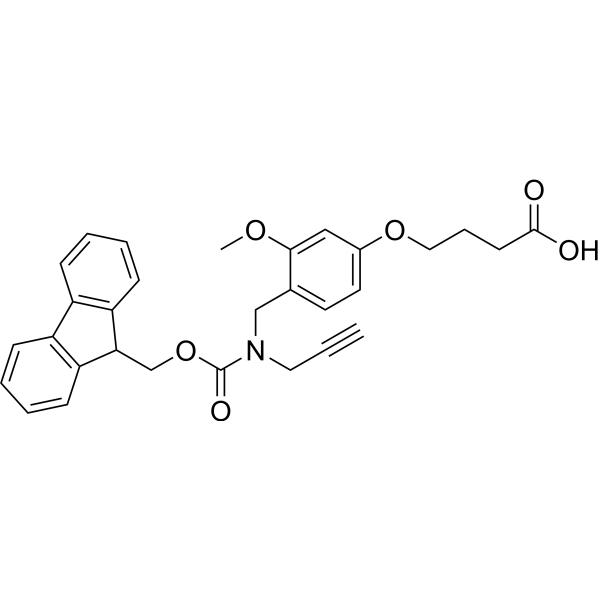
Fmoc-N-propargyl-MPBA is a propargyl-substituted MPBA linker derived from 4-hydroxy-3-methoxybenzaldehyde. Fmoc-N-propargyl-MPBA can be elongated using standard Fmoc-based solid phase chemistry and linked to supports by standard coupling procedures . Fmoc-N-propargyl-MPBA is a click chemistry reagent, it contains an Alkyne group and can undergo copper-catalyzed azide-alkyne cycloaddition (CuAAc) with molecules containing Azide groups.
loading...
    loading...
Cat. No.: HY-16505
CAS No.: 7246-20-0
Target:  

Endogenous Metabolite

Research Areas:  

Neurological Disease

Triclofos sodium is a drug used to suppress insomnia and for sedation and has sedative activity. Triclofos sodium is used in children for sedation during painless medical procedures, particularly in children with neurocognitive disorders. Triclofos sodium has similar physiological and pharmacological properties to chloral and therefore can be used as a substitute when necessary. The safety and efficacy of Triclofos sodium have been demonstrated in pediatric populations with high rates of neurocognitive disorders .
loading...
    loading...
Cat. No.: HY-D0958R
CAS No.: 122965-43-9
Synonyms: Basic Blue 9 hydrate (Standard); CI-52015 hydrate (Standard); Methylthioninium chloride hydrate (Standard)
Methylene blue (hydrate) (Standard) is the analytical standard of Methylene blue (hydrate). This product is intended for research and analytical applications. Methylene blue (Basic Blue 9) hydrate is a guanylyl cyclase (sGC), monoamine oxidase A (MAO-A) and NO synthase (NOS) inhibitor. Methylene blue is a vasopressor and is often used as a dye in several medical procedures. Methylene blue hydrate through the nitric oxide syntase/guanylate cyclase signalling pathway to reduce prepulse inhibition. Methylene blue hydrate is a REDOX cycling compound and able to cross the blood-brain barrier. Methylene blue hydrate is a Tau aggregation inhibitor. Methylene blue hydrate reduces cerebral edema, attenuated microglial activation and reduced neuroinflammation .
loading...
    loading...
Cat. No.: HY-W250129
CAS No.: 94695-48-4
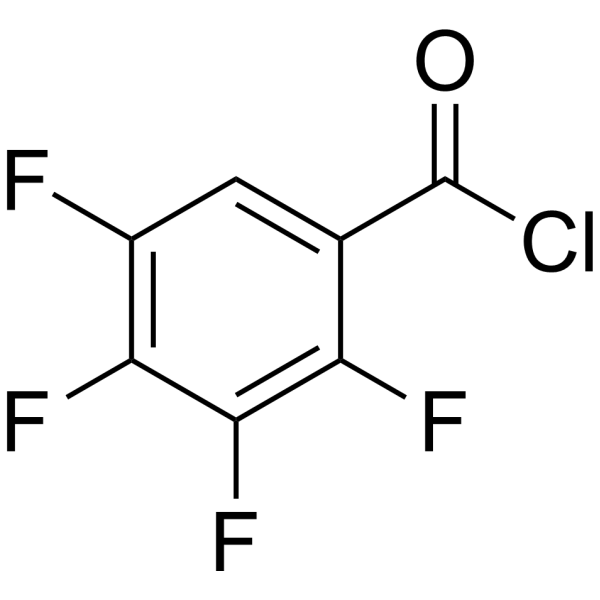
2,3,4,5-Tetrafluorobenzoyl chloride is a fluorinated organic compound that belongs to the class of benzoyl chlorides. It is a colorless liquid with a pungent smell and is mainly used as an intermediate in the synthesis of various pharmaceutical and pesticide compounds. 2,3,4,5-Tetrafluorobenzoyl chloride is an acylating agent that can react with a variety of nucleophiles, including amines, alcohols, and thiols, to form amides, esters, or thioesters, respectively. Its unique fluorine-containing structure can impart desired properties to target molecules, such as increased lipophilicity or increased stability against metabolic degradation. However, due to its high reactivity and potential health hazards, proper safety measures and handling procedures must be followed when using this compound.
loading...
    loading...
Cat. No.: HY-163863
CAS No.: 85252-22-8
Fast Red RC salt, 97% is used in plant science to detect aminotransferase activity and as a marker for phosphatase activity in diagnostic procedures.
loading...
    loading...
Cat. No.: HY-169314
CAS No.: 3059122-56-1
Target:  

JNK

JNK-IN-19 (Compound Q8) is a c-Jun N-terminal kinase inhibitor that is used for treating and/or preventing an injury before, during, or after a surgical procedure .
loading...
    loading...
Cat. No.: HY-A0182R
CAS No.: 56-59-7
Synonyms: PLV-2 (Standard)
Felypressin (Standard) is the analytical standard of Felypressin. This product is intended for research and analytical applications. Felypressin (PLV-2) is a non-catecholamine vasoconstrictor and a vasopressin 1 agonist. Felypressin is widely used in dental procedures .
loading...
    loading...
Cat. No.: HY-121886
CAS No.: 316-15-4
Target:  

Endogenous Metabolite

Research Areas:  

Neurological Disease

Bucricaine is an anesthetic compound with analgesic activity. Bucricaine is used in clinical anesthesia to reduce pain during surgery. The mechanism of action of Bucricaine involves inhibition of nerve signaling. Bucricaine's applications include local anesthesia and dental anesthesia. Bucricaine is widely used during surgery and other medical procedures to improve patient comfort .
loading...
    loading...
Cat. No.: HY-B0962AR
CAS No.: 82-98-4
Research Areas:  

Neurological Disease

Piperidolate (Standard) is the analytical standard of Piperidolate. This product is intended for research and analytical applications. Piperidolate is a cholinergic antagonist. Piperidolate prevents ventricular fibrillation during hypothermic cardiac manipulations to support cardiac procedures post-preoperative defibrillation. Piperidolate causes dose-dependent cardiac depression. Piperidolate can be used for the research of ventricular fibrillation .
loading...
    loading...
Cat. No.: HY-10313
CAS No.: 185836-64-0
Target:  

Integrin

Research Areas:  

Cardiovascular Disease

ZD 2486 is a glycoprotein IIb/IIIa (GP IIb/IIIa) antagonist. ZD 2486 inhibits platelet aggregation by blocking the binding of fibrinogen to the GP IIb/IIIa receptor on platelets. ZD 2486 can be used for the study of conditions related to unwanted platelet aggregation, such as acute coronary syndrome, unstable angina pectoris, acute myocardial infarction, and complications from cardiovascular interventional procedures [1]
loading...
    loading...
Cat. No.: HY-Y0316BR
CAS No.: 151-21-3
Synonyms: Sodium lauryl sulfate (Standard); Laurylsulfuric acid sodium (Standard)
Sodium dodecyl sulfate (Standard) is the analytical standard of Sodium dodecyl sulfate. This product is intended for research and analytical applications. Sodium dodecyl sulfate is a high purity sodium dodecyl sulfate (SDS) with a minimum purity of 98.5%. It is an anionic detergent commonly used in electrophoretic procedures to denature and impart a negative charge to proteins, allowing separation based on size and charge. Sodium dodecyl sulfate has unique chemical properties that make it an effective ingredient in many laboratory applications, helping to improve the resolution and sensitivity of protein analysis.
loading...
    loading...
Cat. No.: HY-179669K
Research Areas:  

Others

0.5M Tris-HCl Buffer, pH 8.0 is a 0.5 M Tris-HCl buffer solution with a pH of 8.0, used for enzyme-related experimental procedures .
loading...
    loading...
Cat. No.: HY-D3252
IR 650 maleimide is a near-infrared fluorescent dye. It should be noted that IR 650 maleimide‘s fluorescence stability is poor, with less than 16% of the fluorescence signal retained after the expansion microscopy experimental procedure .
loading...
    loading...
Cat. No.: HY-K3050

MCE Pyrogen-Free Water is sterile-filtered ultrapure water with a bacterial endotoxin level of ≤0.005 EU/mL. It is free of nucleases, proteases, and other interfering substances. It is suitable for procedures sensitive to endotoxin contamination, including the dilution of working standards and test samples for bacterial endotoxin testing and the preparation of cell culture media and buffers.

loading...
    loading...
Cat. No.: HY-116765
CAS No.: 1619884-75-1
Target:  

Endogenous Metabolite

Research Areas:  

Neurological Disease

MAO-B-IN-35 is a potent, selective, reversible monoamine oxidase B (MAO-B) inhibitor with high inhibitory activity. MAO-B-IN-35 can exhibit high selectivity and potency at a small molecule scale. MAO-B-IN-35 is designed and synthesized so that it can be efficiently obtained during standard synthesis procedures and has superior physical and chemical properties .
loading...
    loading...
Cat. No.: HY-KD1113
The Biotinylation Rapid Labelling Kit enables biotinylation of proteins. Based on NHS ester chemistry, the NHS ester-activated fluorescent dye reacts with primary amines in the antibody/protein to be labelled within a pH 7-9 solution, forming stable amide bonds to achieve conjugation with the antibody/protein. Typically, a single IgG molecule can bind 2-8 molecules of biotin. The entire procedure can be completed within two hours.
loading...
    loading...

