40 Results for "

spinal block

" in MedChemExpress (MCE) Product Catalog:
Products (40)

40 Results for "spinal block" in MCE Product Catalog:

Cat. No.: HY-17417AS
CAS No.: 1261079-38-2
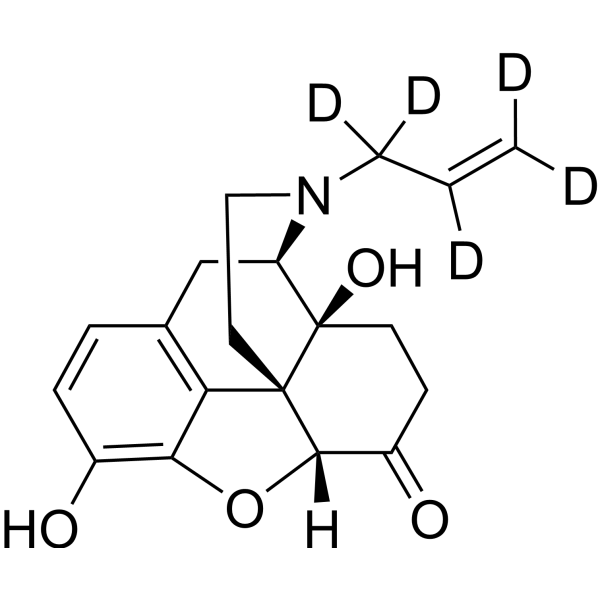
Naloxone-d5 is the deuterated-labeled Naloxone (HY-17417A). Naloxone is an orally active opioid receptor antagonist. Naloxone attenuates spinal cord stimulation‑associated anti‑hyperalgesic effects, antagonizes physiologic effects of endogenous opioid peptides linked to central nervous system injury sequelae, functions as a pressor agent to induce modest elevations in mean arterial blood pressure, exerts neuroprotective effects to improve post‑traumatic neurologic motor function, blocks opioid receptor‑mediated amnesic pathways, enhances memory consolidation, reverses Adrenocorticotropic hormone (ACTH) (HY-106373)‑ and epinephrine‑induced amnesia, and potentiates the memory‑facilitatory effects of ACTH and epinephrine .
loading...
    loading...
Cat. No.: HY-107944R
CAS No.: 886-74-8
Synonyms: Maolate (Standard); U 19646 (Standard)
Research Areas:  

Neurological Disease

Chlorphenesin carbamate (Standard) is the analytical standard of Chlorphenesin carbamate. This product is intended for research and analytical applications. Chlorphenesin carbamate is a centrally acting skeletal muscle relaxant. Chlorphenesin carbamate can be used for the research of pain and discomfort related to skeletal muscle trauma and inflammation . Chlorphenesin carbamate is a selective blocker of polysynaptic pathways at the spinal and supra-spinal levels . Antinociceptive effect .
loading...
    loading...
Cat. No.: HY-107605
CAS No.: 745055-86-1
Target:  

iGluR

Research Areas:  

Neurological Disease

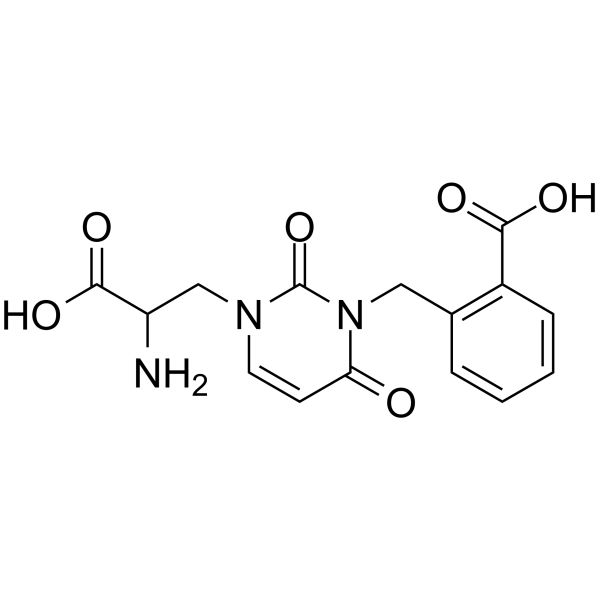
UBP296 is a potent and selective antagonist of GLUK5-containing kainate receptor in the spinal cord. UBP296 reversibly blocks ATPA-induced depressions of synaptic transmission, and affects AMPA receptor-mediated synaptic transmission directly in rat hippocampal slices .
loading...
    loading...
Cat. No.: HY-B1301R
CAS No.: 6138-79-0
Triprolidine (hydrochloride monohydrate) (Standard) is the analytical standard of Triprolidine (hydrochloride monohydrate). This product is intended for research and analytical applications. Triprolidine hydrochloride monohydrate, a first-generation antihistamine, is an oral active histamine H1 antagonist. Triprolidine hydrochloride monohydrate can be used for the research of allergic rhinitis. Triprolidine hydrochloride monohydrate exhibits spinal motor and sensory block in rats .
loading...
    loading...
Cat. No.: HY-P0193
CAS No.: 208253-85-4
Nocistatin (Bovine) is a nociceptin precursor contains another biologically active peptide. Nocistatin (Bovine) blocks nociception-induced allodynia and hyperalgesia. Nocistatin (Bovine) also attenuates pain evoked by prostaglandin E2. Nocistatin (Bovine) can bind to the membrane of mouse brain and spinal cord with high affinity. Nocistatin (Bovine) can be studied in research on pain transmission .
loading...
    loading...
Cat. No.: HY-127004
CAS No.: 140944-30-5
Synonyms: RGH-5002
Target:  

Sodium Channel

Research Areas:  

Others

Silperisone hydrochloride is an organosilicone compound similar to tolperisone that has centrally acting muscle relaxant properties. Silperisone (hydrochloride) is a sodium channel protein type 2 alpha channel blocker that blocks sodium and calcium channels in cells, reduces muscle cell excitability and contraction, reduces peripheral tone, and acts as a muscle relaxant and peripheral vascular dilator. Silperisone (hydrochloride) is used to study recurrent painful myoclonus due to spinal cord injury, abnormal hypertonia due to cerebrovascular disease, myotonia symptoms, pyramidal tonia syndrome, multiple sclerosis myospasm, and myelitis .
loading...
    loading...
Cat. No.: HY-P991310
CAS No.: 1253114-37-2
Synonyms: LT3015; LT-3000

Target:  

LPL Receptor

Research Areas:  

Neurological Disease Cancer

Lpathomab (LT3015; LT-3000) is a human IgG1 monoclonal antibody (mAb) targeting LPA. Lpathomab reduces the release of IL-8 and IL-6 cytokines in SKOV3 cells and blocks LPA-triggered tumor cell migration. Lpathomab reduces neovascularization in Matrigel plug and CNV models. Lpathomab inhibits brain injury in the CCI mouse model. Lpathomab can be used in the study of brain injury, ovarian cancer, diabetic neuropathy, and spinal cord injury. Recommended isotype control: Human IgG1 kappa, Isotype Control (HY-P99001) .
loading...
    loading...
Cat. No.: HY-17417AR
CAS No.: 465-65-6
Naloxone Standard is the analytical standard of Naloxone (HY-17417A). This product is intended for research and analytical applications. Naloxone is an opioid receptor antagonist. Naloxone attenuates spinal cord stimulation‑associated anti‑hyperalgesic effects, antagonizes physiologic effects of endogenous opioid peptides linked to central nervous system injury sequelae, functions as a pressor agent to induce modest elevations in mean arterial blood pressure, exerts neuroprotective effects to improve post‑traumatic neurologic motor function, blocks opioid receptor‑mediated amnesic pathways, enhances memory consolidation, reverses Adrenocorticotropic hormone (ACTH) (HY-106373)‑ and epinephrine‑induced amnesia, and potentiates the memory‑facilitatory effects of ACTH and epinephrine .
loading...
    loading...
Cat. No.: HY-118030
CAS No.: 1257116-00-9
Target:  

Calcium Channel

Research Areas:  

Neurological Disease

RQ-00311651 is a T-type calcium channel blocker that specifically targets the Cav3.2 isoform with a role in neuropathic and visceral pain. RQ-00311651 significantly inhibits T currents in HEK293 cells expressing human Cav3.1 or Cav3.2. RQ-00311651 also inhibited high potassium-induced calcium signaling. RQ-00311651 also inhibits antiallergic properties in rats and mice with neuropathic pain induced by spinal nerve injury or Paclitaxel (HY-B0015). Oral and intraperitoneal injection (10-20 mg/kg) inhibits Cerulein (HY-A0190)-induced acute pancreatitis and cyclophosphamide-induced cystitis in mice .
loading...
    loading...
Cat. No.: HY-B0971AR
CAS No.: 86-21-5
Synonyms: Prophenpyridamine (Standard); Tripoton (Standard); Pheniramine solution (Standard)
Pheniramine (Standard) is the analytical standard of Pheniramine. This product is intended for research and analytical applications. Pheniramine (Prophenpyridamine;Tripoton) is a first-generation histamine H1 receptor antagonist, acts on the central nervous system (CNS) with sedative and hypnotic effect. Pheniramine displays antitumor effect and induces leukemia cells apoptosis. Pheniramine is also a safe and effective local agent that can suppress or relieve pain, with antipruritic effects .
loading...
    loading...
Cat. No.: HY-B0971R
CAS No.: 132-20-7
Synonyms: Prophenpyridamine maleate (Standard); Tripoton maleate (Standard); Pheniramine maleate (Standard)
Pheniramine (maleate) (Standard) is the analytical standard of Pheniramine (maleate). This product is intended for research and analytical applications. Pheniramine (Prophenpyridamine; Tripoton) maleate is a first-generation histamine H1 receptor antagonist, acts on the central nervous system (CNS) with sedative and hypnotic effect. Pheniramine maleate displays antitumor effect and induces leukemia cells apoptosis. Pheniramine maleate is also a safe and effective local agent that can suppress or relieve pain, with antipruritic effects .
loading...
    loading...
Cat. No.: HY-P992422

Research Areas:  

Neurological Disease

NG004 is a fully human monoclonal antibody targeting Nogo-A. NG004 reduces retinal Nogo-A levels, blocks the binding of the Nogo-A-receptor complex, and neutralizes the Nogo-A protein. NG004 can be used in studies related to diabetic retinopathy, stroke and acute spinal cord injury .
loading...
    loading...
Cat. No.: HY-108459
CAS No.: 859171-97-4
Target:  

TRP Channel

Research Areas:  

Neurological Disease

6-Iodonordihydrocapsaicin is a TRPV1 antagonist. 6-Iodonordihydrocapsaicin functionally blocks TRPV1-mediated responses, including capsaicin-induced ion currents in dorsal root ganglion neurons and distension-induced firing of jejunal spinal afferent fibers in mice. 6-Iodonordihydrocapsaicin can be used in the research of visceral pain and anxiety disorders .
loading...
    loading...
Cat. No.: HY-N6609B
CAS No.: 75413-87-5
Magnocurarine chloride is a neuromuscular junction blocker that inhibits muscle contraction by functionally blocking signal transmission without directly damaging nerve or muscle tissues. In frog, mouse and rabbit models, Magnocurarine chloride exerts a dose-dependent paralytic effect, which progresses gradually from limb weakness and loss of righting reflex to respiratory depression and even cardiac arrest. Although high doses cause complete cessation of movement, Magnocurarine chloride does not affect the spinal multineuronal reflex in frogs. Magnocurarine chloride exhibits biological activity similar to that of tubocurarine (HY-125901) in various animal models .
loading...
    loading...
Cat. No.: HY-183144
CAS No.: 141575-50-0
Target:  

mAChR

Vedaclidine is an orally active muscarinic acetylcholine receptor (mAChR) modulator with mixed receptor activity, which activates muscarinic M2 and M4 receptors and blocks muscarinic M1, M3 and M5 receptors. Vedaclidine exerts its activity through interaction with spinal M4 muscarinic receptors, and does not induce hypothermia or excessive salivation. Vedaclidine can be used in research related to pain, neuropathic pain and inflammatory pain states .
loading...
    loading...
Cat. No.: HY-A0254A
CAS No.: 532-76-3
Synonyms: Cyclain hydrochloride
Research Areas:  

Others

Hexylcaine hydrochloride (Cyclain hydrochloride) is a local anesthetic characterized by rapid onset and long-lasting anesthetic effects. Hexylcaine hydrochloride produces spinal, regional, infiltration and surface anesthesia. Hexylcaine hydrochloride is used in research related to local anesthesia, regional anesthesia and spinal anesthesia .
loading...
    loading...
Cat. No.: HY-17417B
CAS No.: 51481-60-8
Target:  

Opioid Receptor

Research Areas:  

Neurological Disease

Naloxone hydrochloride is an orally active opioid receptor antagonist. Naloxone hydrochloride attenuates spinal cord stimulation‑associated anti‑hyperalgesic effects, antagonizes physiologic effects of endogenous opioid peptides linked to central nervous system injury sequelae, functions as a pressor agent to induce modest elevations in mean arterial blood pressure, exerts neuroprotective effects to improve post‑traumatic neurologic motor function, blocks opioid receptor‑mediated amnesic pathways, enhances memory consolidation, reverses Adrenocorticotropic hormone (ACTH) (HY-106373)‑ and epinephrine‑induced amnesia, and potentiates the memory‑facilitatory effects of ACTH and epinephrine .
loading...
    loading...
Cat. No.: HY-110268
CAS No.: 1029521-30-9
Target:  

CXCR

Research Areas:  

Inflammation/Immunology

NVP CXCR2 20 is a selective CXCR2 inhibitor with analgesic and antinociceptive activities. NVP CXCR2 20 selectively blocks CXCR2 signaling and attenuates mechanical and thermal hypersensitivity in rat chronic constriction injury (CCI) models. NVP CXCR2 20 inhibits CXCL3-induced hypersensitivity in naive mice and reduces elevated CXCL3 protein levels in the spinal cord and dorsal root ganglia (DRG) of CCI-exposed rats. NVP CXCR2 20 can be used for the research of neuropathic pain and chronic obstructive pulmonary disease (COPD) .
loading...
    loading...
Cat. No.: HY-183244
CAS No.: 121412-39-3
Research Areas:  

Neurological Disease

CGS 21595 is an orally active 5-lipoxygenase inhibitor that blocks the synthesis of 5-hydroxyeicosatetraenoic acid and leukotriene B4. CGS 21595 acts as a prodrug and metabolizes into CGS 19213. CGS 21595 induces lesions in the spinal nerve roots and sciatic nerves of rats, causing mild functional impairments including reduced grip strength, increased spread of the landing feet, and decreased motor activity. CGS 21595 exhibits dose-dependent neurotoxicity in rats, and induces reversible cytoplasmic hyaline droplets in the proximal renal tubules of both male and female rats. CGS 21595 can be used in studies of peripheral toxic neuropathy .
loading...
    loading...
Cat. No.: HY-66012A
CAS No.: 499-67-2
Synonyms: Proxymetacaine
Target:  

Sodium Channel

Research Areas:  

Neurological Disease

Proparacaine (Proxymetacaine) is a local anesthetic. Proparacaine blocks voltage-gated sodium channels on neuronal cell membranes, thereby inhibiting signal conduction and nociceptive signal transmission. Proparacaine blocks nociceptive signals in the eye and induces ocular muscle relaxation to reduce eye movement during surgery. Proparacaine is used in research related to cataracts .
loading...
    loading...

