55 Results for "

Hyperpigmentation

" in MedChemExpress (MCE) Product Catalog:
Products (55)

55 Results for "Hyperpigmentation" in MCE Product Catalog:

Cat. No.: HY-149207
CAS No.: 240797-64-2
Purity:  98.12%
Target:  

Tyrosinase

Research Areas:  

Metabolic Disease

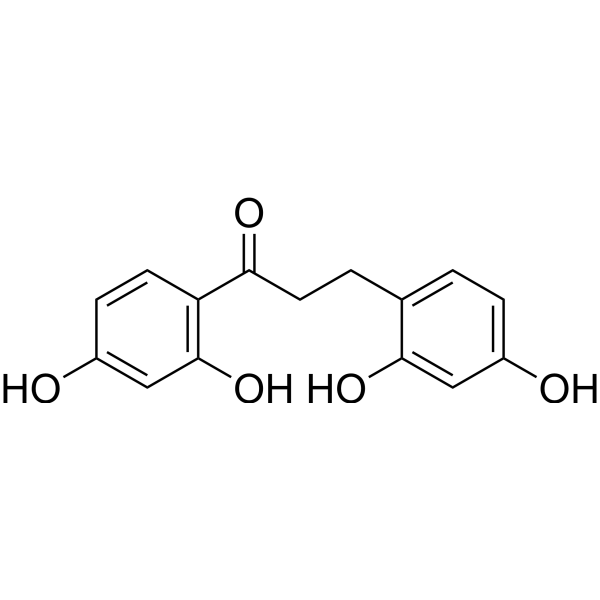
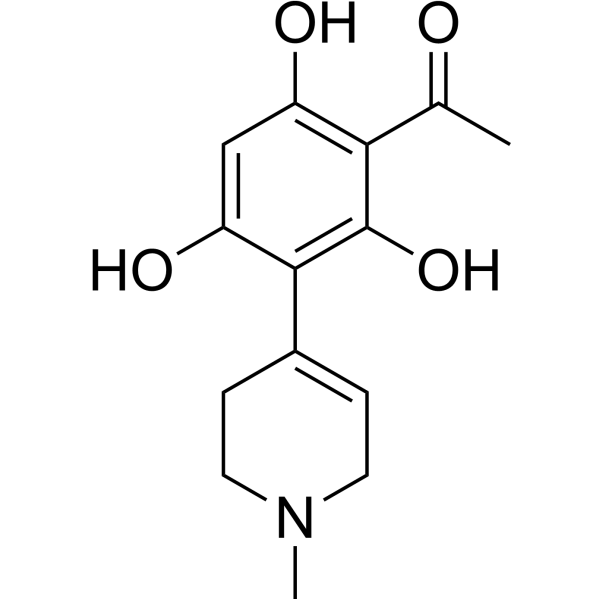
Tyrosinase-IN-11 is a potent tyrosinase inhibitor with IC50s of 50 nM and 64 nM for L-tyrosinase and L-dopa, respectively. Tyrosinase-IN-11 has significant antioxidant activity and low cytotoxicity. Tyrosinase-IN-11 has the potential for skin hyperpigmentation research .
loading...
    loading...
Cat. No.: HY-139430
CAS No.: 2138-43-4
Purity:  98.03%
Synonyms: 4-IPC
Target:  

Tyrosinase

Research Areas:  

Inflammation/Immunology

4-Isopropylcatechol is a potent and irreversible cutaneous depigmenting agent. 4-Isopropylcatechol significantly inhibits protein biosynthesis in mouse melanoma cells containing high levels of tyrosinase. 4-Isopropylcatechol can be use to study hyperpigmentation of skins .
loading...
    loading...
Cat. No.: HY-W000873
CAS No.: 146631-00-7
Target:  

Drug Intermediate

Research Areas:  

Metabolic Disease

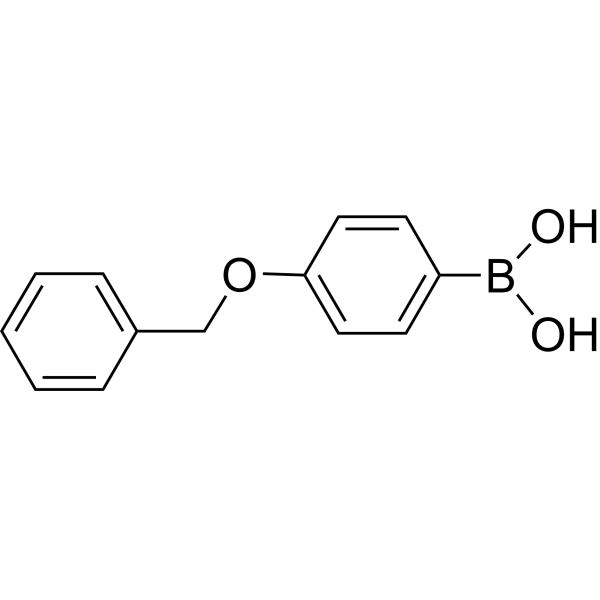
4-Benzyloxyphenylboronic acid is an arylboronic acid reagent that generates Monobenzone (HY-30272), a compound that inhibits melanin production in the skin, via electrochemical deboronation hydroxylation. 4-Benzyloxyphenylboronic acid serves as a coupling partner in Pd (0)-catalyzed Suzuki-Miyaura cross-coupling reactions for the synthesis of bent-core liquid crystals and liquid crystalline amphiphiles. 4-Benzyloxyphenylboronic acid is used in the study of hyperpigmentation .
loading...
    loading...
Cat. No.: HY-W012092
CAS No.: 6178-44-5
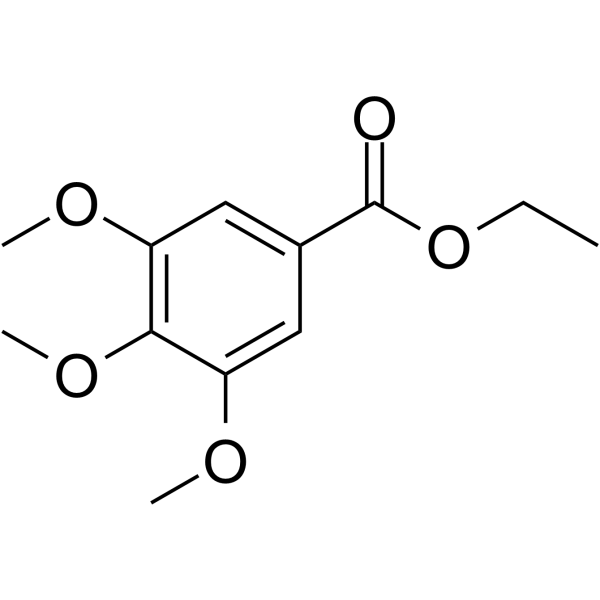
Ethyl 3,4,5-trimethoxybenzoate is a melanogenesis inhibitor. Ethyl 3,4,5-trimethoxybenzoate does not directly target tyrosinase activity, but inhibits melanin synthesis in a dose-dependent manner by downregulating α-MSH (HY-P0252)-induced tyrosinase protein expression and scavenging ROS. Ethyl 3,4,5-trimethoxybenzoate scavenges DPPH free radicals. Ethyl 3,4,5-trimethoxybenzoate can be used in the research of hyperpigmentation .
loading...
    loading...
Cat. No.: HY-149471
CAS No.: 1625821-37-5
Purity:  99.06%
Target:  

Tyrosinase

Research Areas:  

Cancer

hTYR/AbTYR-IN-1 (Compound 7) is a hTYR/AbTYR dual inhibitor, with IC50s of 5.4 μM and 3.52 μM for hTYR and AbTYR respectively .
loading...
    loading...
Cat. No.: HY-155189
CAS No.: 1128053-62-2
Target:  

Melanocortin Receptor

Research Areas:  

Others

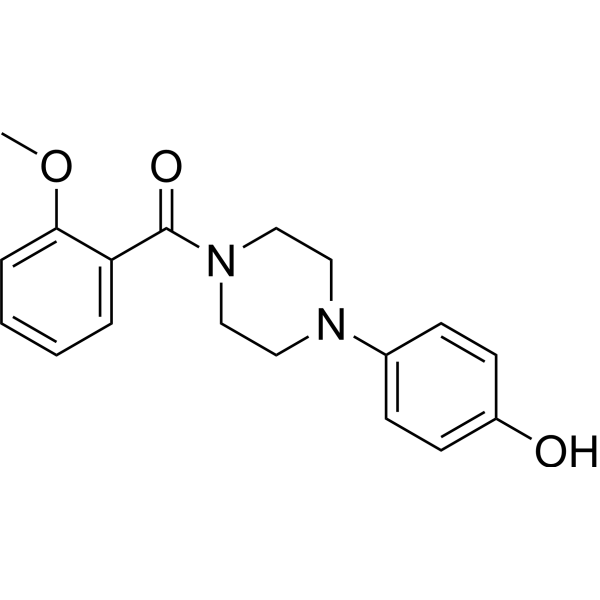
IIIM-8 is a melanogenesis inhibitor. IIIM-8 inhibits pigment production both in vitro and in vivo without incurring any cytotoxicity in Human Adult Epidermal Melanocytes (HAEM). IIIM-8 can be used for hyperpigmentation disorders research .
loading...
    loading...
Cat. No.: HY-175349
Target:  

Tyrosinase

Research Areas:  

Metabolic Disease

Tyrosinase-IN-43 (Compound 12j) is a competitive Tyrosinase inhibitor with an IC50 of 10.49 ?μM for tyrosinase. Tyrosinase-IN-43 has significant antioxidant activity. Tyrosinase-IN-43 can be used for hyperpigmentation-related complications such as melasma, freckles, age spots and post-inflammatory hyperpigmentation research .
loading...
    loading...
Cat. No.: HY-157010
CAS No.: 1365531-21-0
Target:  

Tyrosinase PKA

Research Areas:  

Others

AP736 is a potent tyrosinase inhibitor (IC50 = 0.9 μM) with anti-melanogenesis activity in normal human melanocytes (IC50 = 0.11 μM). AP736 suppresses the expression of tyrosinase and TRP-1/2 by inhibiting the cAMP-PKA-CREB signalling axis, leading to reduced microphthalmia-associated transcription factor (MITF) transcripts and proteins. AP736 can be used for melanogenesis and hyperpigmentation research .
loading...
    loading...
Cat. No.: HY-W552702
CAS No.: 408335-66-0
Target:  

Tyrosinase

Research Areas:  

Metabolic Disease

Tyrosinase-IN-29 (compound 5c) is a potent inhibitor of tyrosinase abTYR (IC50: 6.11 μM). Tyrosinase-IN-29 can be used to further study the inhibition of skin hyperpigmentation .
loading...
    loading...
Cat. No.: HY-162524
Target:  

Tyrosinase

Research Areas:  

Others

Tyrosinase-IN-28 (Compound 4l) is an inhibitor for tyrosinase with IC50 of 72.55 μM, by affecting both substrate binding and enzyme catalysis .
loading...
    loading...
Cat. No.: HY-168436
Target:  

Tyrosinase

Research Areas:  

Endocrinology

Tyrosinase-IN-40 (Compound 9r) is a competitive-type tyrosinase inhibitor, with an IC50 value of 17.02  µM, a Ki value of 14.87 µM. Tyrosinase-IN-40 displays antioxidant activity. Tyrosinase-IN-40 can be used in melanin-related studies .
loading...
    loading...
Cat. No.: HY-N6829R
CAS No.: 1245-15-4
Synonyms: Quercetin-​3,​3',​4',​7-​tetramethylether (Standard)
Retusin (Quercetin-3,3',4',7-tetramethylether) (Standard) is the analytical standard of Retusin. This product is intended for research and analytical applications. Retusin is a tyrosinase inhibitor, with IC50 values of 50.9 μM and 51.8 μM against mushroom and intracellular tyrosinase, respectively. Retusin also acts as a free radical scavenger, melanogenesis inhibitor, anti-apoptosis agent, neuroprotective agent, antiemetic, antifungal agent, and antiviral agent. Retusin scavenges ABTS• + and DPPH• free radicals. Retusin can be used in studies related to hyperpigmentation, vomiting, Aspergillus niger infection, and COVID-19 infection.
loading...
    loading...
Cat. No.: HY-182989
CAS No.: 3081328-14-2
Tyrosinase-IN-50 (Compound 14) is a Tyrosinase inhibitor (IC50 is 0.06 μM or 0.16 μM). Tyrosinase-IN-50 inhibits melanogenesis in multiple cell types. Tyrosinase-IN-50 can be used for the research of hyperpigmentation-related diseases and inflammatory diseases .
loading...
    loading...
Cat. No.: HY-184909
Target:  

Tyrosinase

Research Areas:  

Metabolic Disease

AI10-a2 is a tyrosinase (tyrosinase) inhibitor, with IC50 values of 0.92 μM against mushroom tyrosinase using L-DOPA (HY-N0304) as the substrate and 0.68 μM using L-Tyrosine (HY-N0473) as the substrate. AI10-a2 inhibits intracellular melanin (melanin) production and reduces head pigmentation in zebrafish embryos. AI10-a2 can be used for the research of hyperpigmentation disorders .
loading...
    loading...
Cat. No.: HY-P79111
Purity:  ≥ 95%, as determined by reducing SDS-PAGE.
Synonyms: KITLG; SLF; Prev. MGF; Familial Progressive Hyperpigmentation 2; SCF; Steel Factor; Mast Cell Growth Factor; C-Kit Ligand; Stem Cell Factor; Kit Ligand; DFNA69; SHEP7; Kitl; DCUA; KL-1; FPHH; FPH2; WS2F; KIT Ligand; SF
Species:  
Canine
Source:  
E. coli
loading...
    loading...
Cat. No.: HY-P7064
Purity:  ≥ 95%, as determined by reducing SDS-PAGE.
Synonyms: KITLG; SLF; Prev. MGF; Familial Progressive Hyperpigmentation 2; SCF; Steel Factor; Mast Cell Growth Factor; C-Kit Ligand; Stem Cell Factor; Kit Ligand; DFNA69; SHEP7; Kitl; DCUA; KL-1; FPHH; FPH2; WS2F; KIT Ligand; SF
Species:  
Mouse
Source:  
P. pastoris
loading...
    loading...
Cat. No.: HY-P7056
Purity:  ≥ 95%, as determined by reducing SDS-PAGE.
Synonyms: KITLG; SLF; Prev. MGF; Familial Progressive Hyperpigmentation 2; SCF; Steel Factor; Mast Cell Growth Factor; C-Kit Ligand; Stem Cell Factor; Kit Ligand; DFNA69; SHEP7; Kitl; DCUA; KL-1; FPHH; FPH2; WS2F; KIT Ligand; SF
Species:  
Human
Source:  
P. pastoris
loading...
    loading...
Cat. No.: HY-P7107
Purity:  ≥ 95%, as determined by reducing SDS-PAGE.
Synonyms: KITLG; SLF; Prev. MGF; Familial Progressive Hyperpigmentation 2; SCF; Steel Factor; Mast Cell Growth Factor; C-Kit Ligand; Stem Cell Factor; Kit Ligand; DFNA69; SHEP7; Kitl; DCUA; KL-1; FPHH; FPH2; WS2F; KIT Ligand; SF
Species:  
Rat
Source:  
P. pastoris
loading...
    loading...
Cat. No.: HY-P7107A
Purity:  ≥ 95%, as determined by reducing SDS-PAGE.
Synonyms: KITLG; SLF; Prev. MGF; Familial Progressive Hyperpigmentation 2; SCF; Steel Factor; Mast Cell Growth Factor; C-Kit Ligand; Stem Cell Factor; Kit Ligand; DFNA69; SHEP7; Kitl; DCUA; KL-1; FPHH; FPH2; WS2F; KIT Ligand; SF
Species:  
Rat
Source:  
HEK293
loading...
    loading...
Cat. No.: HY-P72480
Purity:  ≥ 95%, as determined by reducing SDS-PAGE.
Synonyms: KITLG; SLF; Prev. MGF; Familial Progressive Hyperpigmentation 2; SCF; Steel Factor; Mast Cell Growth Factor; C-Kit Ligand; Stem Cell Factor; Kit Ligand; DFNA69; SHEP7; Kitl; DCUA; KL-1; FPHH; FPH2; WS2F; KIT Ligand; SF
Species:  
Rat
Source:  
E. coli
loading...
    loading...

