



Tyrosinase-IN-11

Based on 1 Customer Validation
Tyrosinase-IN-11 is a potent tyrosinase inhibitor with IC50s of 50 nM and 64 nM for L-tyrosinase and L-dopa, respectively. Tyrosinase-IN-11 has significant antioxidant activity and low cytotoxicity. Tyrosinase-IN-11 has the potential for skin hyperpigmentation research.
For research use only. We do not sell to patients.
- Purity : 98.12%
- CAS No.: 240797-64-2
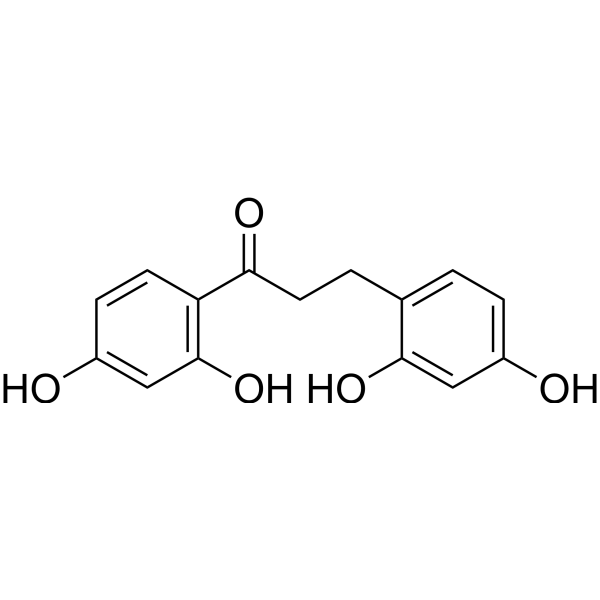
- Formula: C15H14O5
- Molecular Weight:274.27
-
Storage:Powder -20°C, 3 years ; In solvent -80°C, 6 months , -20°C, 1 month

To place orders, for customer services and technical support, please contact: MedChemExpress USA
Tel: 609-228-6898 E-mail: [email protected] [email protected]


-
 Biological Activity
-
Chemical Information
-
Solvent & Solubility
- Protocols
- Purity & Documentation
- References
-
 Help & FAQs




Biological Activity
Description
In Vitro
Tyrosinase-IN-11 (compound 11c; 0.1-2 μM; 72 h) decreases the protein levels of both TYR and MiTF in a dose-dependent manner[1].
Tyrosinase-IN-11 (50 μM) is slightly cytotoxic in the human malignant melanoma cells A375 and B16F10 cells[1].
MedChemExpress (MCE) has not independently confirmed the accuracy of these methods. They are for reference only. Further protocols information, click here.
-
Cell Line:B16F10 cells
-
Concentration:0.1, 0.5, 1, 2 μM
-
Incubation Time:72 hours
-
Result:Decreased the protein levels of both TYR and MiTF in a dose-dependent manner.
In Vivo
MedChemExpress (MCE) has not independently confirmed the accuracy of these methods. They are for reference only.
-
Animal Model:Female guinea pigs (10 weeks old, 350-500 g) received ultraviolet exposure from a UV lamp[1]
-
Dosage:0.5, 1 mM
-
Administration:Topical administration before UV radiation every day for 2 weeks or after exposure to UV lamp for 5 days/week for two consecutive weeks
-
Result:Inhibited the production of melanin in a dose-dependent manner.


Chemical Information
-
CAS No. 240797-64-2
-
Appearance Solid
-
Molecular Weight 274.27
-
Formula C15H14O5
-
Color Pink to orange
-
SMILES
O=C(C1=C(C=C(C=C1)O)O)CCC2=CC=C(C=C2O)O
-
Shipping
Room temperature in continental US; may vary elsewhere.
-
Storage
Powder -20°C 3 years In solvent -80°C 6 months -20°C 1 month


Solvent & Solubility
In Vitro:
DMSO : 125 mg/mL (455.76 mM; Need ultrasonic; Hygroscopic DMSO has a significant impact on the solubility of product, please use newly opened DMSO)
Please refer to the solubility information to select the appropriate solvent. Once prepared, please aliquot and store the solution to prevent product inactivation from repeated freeze-thaw cycles.
Storage method and period of stock solution: -80°C, 6 months; -20°C, 1 month. When stored at -80°C, please use it within 6 months. When stored at -20°C, please use it within 1 month.
Please refer to the solubility information to select the appropriate solvent. Once prepared, please aliquot and store the solution to prevent product inactivation from repeated freeze-thaw cycles.
Storage method and period of stock solution: -80°C, 6 months; -20°C, 1 month. When stored at -80°C, please use it within 6 months. When stored at -20°C, please use it within 1 month.
Concentration (start) × Volume (start) = Concentration (final) × Volume (final)

Protocols
-
Cell Cytotoxicity Assay
Cytotoxicity assays are usually based on the assessment of cell membrane damage, which can also be indirectly detected by measuring cell viability. Detection methods include MTT assay, CKK-8 assay, LDH assay and ATP assay, etc.
-
Mammalian live/dead viability and cytotoxicity staining
Live/dead viability and cytotoxicity staining assays are based on the simultaneous detection of intracellular esterase activity in metabolically active (viable) cells and membrane integrity loss in non-viable cells. In commonly used dual-staining approaches, membrane-permeant fluorogenic substrates are converted by intracellular esterases into fluorescent products in live cells, while impermeant DNA-binding dyes selectively enter cells with compromised plasma membranes and label nucleic acids in dead or dying cells, enabling discrimination between viable and non-viable populations by fluorescence microscopy or flow cytometry.
-
Cell Viability Determination by MTT Colorimetric Assay
The following protocol uses the MTT colorimetric assay as a classic literature-established method for assessing cell viability/metabolic activity in cultured mammalian cells. MTT[3-(4,5-dimethylthiazol-2-yl)-2,5-diphenyltetrazolium bromide] is reduced by metabolically active cells to a colored formazan product; the amount of formazan is quantified spectrophotometrically and provides an indirect measure of metabolically active viable cells. Importantly, MTT reduction reflects cellular oxidoreductase/metabolic activity rather than an absolute direct count of living cells, so changes in cellular metabolism can alter the signal independently of cell number.


Purity & Documentation
-
Data Sheet (271 KB)
-
SDS (393 KB)
- English - EN (393 KB)
- Français - FR (393 KB)
- Deutsch - DE (393 KB)
- Norwegian - NO (393 KB)
- Español - ES (393 KB)
- Swedish - SV (393 KB)
- Italian - IT (393 KB)
- Korean - KR (393 KB)
- Portuguese - PT (393 KB)
-
Handling Instructions (2659 KB)
References


Complete Stock Solution Preparation Table
Please refer to the solubility information to select the appropriate solvent. Once prepared, please aliquot and store the solution to prevent product inactivation from repeated freeze-thaw cycles.
Storage method and period of stock solution: -80°C, 6 months; -20°C, 1 month. When stored at -80°C, please use it within 6 months. When stored at -20°C, please use it within 1 month.
| Optional Solvent | Concentration Solvent Mass | 1 mg | 5 mg | 10 mg | 25 mg |
|---|---|---|---|---|---|
| DMSO | 1 mM | 3.6460 mL | 18.2302 mL | 36.4604 mL | 91.1511 mL |
| 5 mM | 0.7292 mL | 3.6460 mL | 7.2921 mL | 18.2302 mL | |
| 10 mM | 0.3646 mL | 1.8230 mL | 3.6460 mL | 9.1151 mL | |
| 15 mM | 0.2431 mL | 1.2153 mL | 2.4307 mL | 6.0767 mL | |
| 20 mM | 0.1823 mL | 0.9115 mL | 1.8230 mL | 4.5576 mL | |
| 25 mM | 0.1458 mL | 0.7292 mL | 1.4584 mL | 3.6460 mL | |
| 30 mM | 0.1215 mL | 0.6077 mL | 1.2153 mL | 3.0384 mL | |
| 40 mM | 0.0912 mL | 0.4558 mL | 0.9115 mL | 2.2788 mL | |
| 50 mM | 0.0729 mL | 0.3646 mL | 0.7292 mL | 1.8230 mL | |
| 60 mM | 0.0608 mL | 0.3038 mL | 0.6077 mL | 1.5192 mL | |
| 80 mM | 0.0456 mL | 0.2279 mL | 0.4558 mL | 1.1394 mL | |
| 100 mM | 0.0365 mL | 0.1823 mL | 0.3646 mL | 0.9115 mL |


Tyrosinase-IN-11 Related Classifications
HY-149207 Related Classifications
 Powered by Bioz