
391 Results for "

Delivery systems

" in MedChemExpress (MCE) Product Catalog:
Products (391)

391 Results for "Delivery systems" in MCE Product Catalog:

Cat. No.: HY-W250120
CAS No.: 37220-17-0
Konjac glucomannan (Viscosity≥15000mPa.s) is an orally active acetylated (1-4)-β-D-glucomannan with multiple biological activities including anti-diabetic, anti-obesity, anti-inflammatory effects, as well as film-forming and gelling properties. Konjac glucomannan (Viscosity≥15000mPa.s) forms a defensive coating on the intestinal surface, reducing levels of blood glucose, cholesterol, triglycerides and blood pressure; it is specifically degraded by colonic β-mannanase produced by human colonic bacteria. Konjac glucomannan (Viscosity≥15000mPa.s) can be used as a food additive, dietary supplement and excipient for oral colon-targeted drug delivery systems. Konjac glucomannan (Viscosity≥15000mPa.s) is applicable to research related to various diseases such as type 2 diabetes, obesity, atopic dermatitis and metabolic syndrome, as well as research in fields including biotechnology, pharmaceuticals and tissue engineering .
loading...
    loading...
Cat. No.: HY-W250172
CAS No.: 92046-34-9
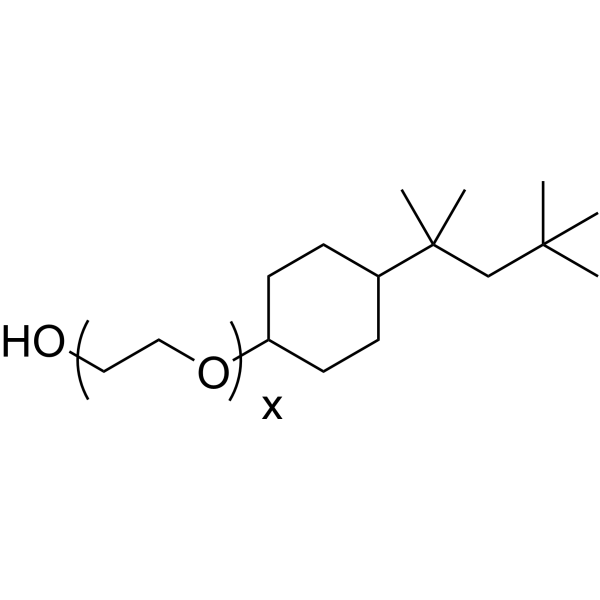
Polyethylene glycol tert-octylphenyl ether X-405 (70% in H2O) is a nonionic surfactant commonly used in a variety of industrial and research applications. Polyethylene glycol tert-octylphenyl ether X-405 (70% in H2O) belongs to the family of polyethylene glycol (PEG) ethers with a hydrophilic head and lipophilic tail and is suitable for use in emulsions, detergents and solubilizers. Polyethylene glycol tert-octylphenyl ether X-405 (70% in H2O) is particularly useful in the study of membrane proteins, where it is used to solubilize and stabilize proteins for structural analysis techniques. It is also used in a variety of other applications, including drug delivery systems, nanotechnology, and diagnostic analysis. Additionally, Polyethylene glycol tert-octylphenyl ether X-405 (70% in H2O) is used in the production of microemulsions, salves and lotions due to its emulsifying and solubilizing properties. However, it can be toxic if ingested or inhaled, so proper handling and safety precautions are required.
loading...
    loading...
Cat. No.: HY-100138R
CAS No.: 173308-19-5
2-Aminoethyl-mono-amide-DOTA-tris(tBu ester) (Standard) is the analytical standard of 2-Aminoethyl-mono-amide-DOTA-tris(tBu ester) (HY-100138). This product is intended for research and analytical applications. 2-Aminoethyl-mono-amide-DOTA-tris(tBu ester) is a metal chelator precursor containing a DOTA macrocyclic structure. DOTA can form highly stable complexes with metal ions (such as 68Ga, 177Lu) through four nitrogen atoms and four carboxylic acid groups to mediate targeted delivery of radionuclides. The tert-butyl ester group (tBu ester) of 2-Aminoethyl-mono-amide-DOTA-tris(tBu ester) also protects the carboxylic acid group during synthesis, and forms a free carboxyl group after deprotection reaction for coupling with targeting molecules (such as antibodies, peptides). 2-Aminoethyl-mono-amide-DOTA-tris(tBu ester) may be combined with tumor pre-targeting systems through bioorthogonal reactions (such as reverse electron demand Diels-Alder reaction) to study radioactive imaging or therapy of tumor tissues, and is mainly used in tumor pre-targeting research in the field of nuclear medicine .
loading...
    loading...
Cat. No.: HY-187396
Research Areas:  

Cancer

FD1-C10-CB is a PROTAC degrader targeting the BRD4 protein. FD1-C10-CB binds to FEM1B to form a ternary complex with BRD4, achieving FEM1B-dependent degradation of BRD4 via the ubiquitin-proteasome system. FD1-C10-CB binds to CD36 to mediate endocytic cellular delivery, thereby enhancing its degrading activity. FD1-C10-CB mediates protein degradation through the Cullin-dependent ubiquitin-proteasome pathway, rather than the lysosomal autophagy pathway. FD1-C10-CB induces a decrease in BRD4 protein levels, and its degrading activity is competitively inhibited by FL47 or JQ1. FD1-C10-CB can be used in the research of breast cancer and osteosarcoma .
loading...
    loading...
Cat. No.: HY-120991
CAS No.: 26662-95-3
Purity:  ≥98.0%
Synonyms: 1-Palmitoyl-2-linoleoyl PE; (1-Palmitoyl, 2-linoleoyl)-phosphatidylethanolamine; (1-Palmitoyl, 2-linoleoyl)-phosphoethanolamine
Target:  

Liposome

Research Areas:  

Others

1-Palmitoyl-2-linoleoyl-sn-glycero-3-PE (1-Palmitoyl-2-linoleoyl PE; (1-Palmitoyl, 2-linoleoyl)-phosphatidylethanolamine; (1-Palmitoyl, 2-linoleoyl)-phosphoethanolamine) is a phosphatidylethanolamine phospholipid with a palmitoyl chain at sn-1 and a linoleoyl chain at sn-2, and an oxidation-prone substrate. 1-Palmitoyl-2-linoleoyl-sn-glycero-3-PE undergoes glycation and subsequent oxidation via Fenton system, forming long-chain and short-chain products at C-7, C-8, C-9, C-12 of its sn-2 acyl chain and glycated polar head. 1-Palmitoyl-2-linoleoyl-sn-glycero-3-PE’s glycated form oxidizes more quickly than non-glycated phosphatidylethanolamines and contributes to increased oxidative stress modifications. 1-Palmitoyl-2-linoleoyl-sn-glycero-3-PE can be used for the research of drug delivery .
loading...
    loading...
Cat. No.: HY-178736S
Synonyms: DLPE-d46; 1,2-Dilauroyl-sn-glycero-3-PE-d46
1,2-Dilauroyl-sn-glycero-3-phosphoethanolamine-d46 (DLPE-d46; 1,2-Dilauroyl-sn-glycero-3-PE-d46) is the deuterium labeled 1,2-Dilauroyl-sn-glycero-3-phosphoethanolamine. 1,2-Dilauroyl-sn-glycero-3-phosphoethanolamine (DLPE; 1,2-Dilauroyl-sn-glycero-3-PE) is an anionic phospholipid. 1,2-Dilauroyl-sn-glycero-3-phosphoethanolamine promotes the endocytosis of liposome-DNA complexes into target cells, and subsequently mediates membrane fusion between liposome carriers and endosomes to deliver DNA into the nucleus. 1,2-Dilauroyl-sn-glycero-3-phosphoethanolamine is a component of anionic artificial viral envelope liposomes, which deliver plasmid DNA to hepatoma cells without serum inhibition. 1,2-Dilauroyl-sn-glycero-3-phosphoethanolamine enables the construction of biocompatible non-viral gene delivery vector systems. 1,2-Dilauroyl-sn-glycero-3-phosphoethanolamine is applicable for liposome synthesis .
loading...
    loading...
Cat. No.: HY-W585442
CAS No.: 105528-25-4
5,9,14,18,23,27,32,36-Octabutoxy-2,3-naphthalocyanine is a photosensitive material with excellent light absorption and electron conduction activity. 5,9,14,18,23,27,32,36-Octabutoxy-2,3-naphthalocyanine is widely used in optoelectronic devices and is considered to be an effective photocatalyst. 5,9,14,18,23,27,32,36-Octabutoxy-2,3-naphthalocyanine can be used to improve the performance of solar cells and increase the photoelectric conversion efficiency. 5,9,14,18,23,27,32,36-Octabutoxy-2,3-naphthalocyanine also has potential anti-tumor activity and can inhibit the proliferation of certain cancer cells. 5,9,14,18,23,27,32,36-Octabutoxy-2,3-naphthalocyanine exhibits excellent fluorescence properties in medical imaging, which helps to improve the clarity and accuracy of imaging. 5,9,14,18,23,27,32,36-Octabutoxy-2,3-naphthalocyanine is studied as a component of a novel compound delivery system to improve the targeting and release effect of the compound.
loading...
    loading...
Cat. No.: HY-141613S
Synonyms: (2S,8R,19Z)DOPS-d3 ammonium
(2S,8R,19Z)1,2-Dioleoyl-sn-glycero-3-phospho-L-serine-d3 ammonium ((2S,8R,19Z)DOPS-d3 ammonium) is the deuterium labeled (2S,8R,19Z)1,2-Dioleoyl-sn-glycero-3-phospho-L-serine ammonium (HY-141613). 1,2-Dioleoyl-sn-glycero-3-phospho-L-serine sodium (DOPS-NA) is a ubstitute for Phosphoserine/phosphatidylserine. 1,2-Dioleoyl-sn-glycero-3-phospho-L-serine sodium can be used together with DOPC and DOPE in lipid mixtures for the synthesis of liposomes. 1,2-Dioleoyl-sn-glycero-3-phospho-L-serine sodium can self-assemble into single-layer or double-layer membrane structures, similar to cell membranes, and possesses high membrane fluidity and flexibility. 1,2-Dioleoyl-sn-glycero-3-phospho-L-serine is widely applied in membrane biology, cell membrane research, lipid preparation, and drug delivery systems .
loading...
    loading...
Cat. No.: HY-B0633D
CAS No.: 9067-32-7
Hyaluronic acid sodium (MW 200-1560) is a biopolymer composed of repeating disaccharide units, with a molecular weight of 200-1560. Hyaluronic acid sodium is a major component of the extracellular matrix (ECM). It is synthesized on the plasma membrane. Hyaluronic acid sodium exerts its effects by binding to receptors CD44 and RHAMM. Hyaluronic acid sodium activates PI3K-Akt signaling. Hyaluronic acid sodium also enhances cell invasion and angiogenesis by promoting or stimulating the binding of proteolytic MMP-9 to the cell surface. Elevated hyaluronic acid levels are associated with tumor cell growth, adhesion, migration, invasion, and angiogenesis in digestive system cancers. Hyaluronic acid sodium is involved in tissue remodeling and rapid cell proliferation in several physiological processes, including embryonic morphogenesis and wound healing. Hyaluronic acid sodium can be used as a regulator of cancer-associated lymphangiogenesis. Hyaluronic acid sodium can be used as a drug delivery carrier for sodium butyrate, enhancing its anti-proliferative activity against breast cancer cell lines. Hyaluronic acid sodium can lubricate the corneal endothelium. Hyaluronic acid sodium can improve tissue hydration and enhance the resistance of cells to mechanical damage. Hyaluronic acid sodium has been conjugated with antibodies to ensure that the active compound continues to exert its effects at the site of inflammation. Hyaluronic acid sodium can be used in research in the fields of osteoarthritis, ophthalmology, cosmetic dermatology, oncology, and liver diseases .
loading...
    loading...
Cat. No.: HY-B0633E
CAS No.: 9004-61-9
Synonyms: Hyaluronan, low endotoxin; Hyaluronate, low endotoxin
Hyaluronic acid, low endotoxin (Hyaluronan, low endotoxin) is a biopolymer composed of repeating disaccharide units containing low levels of endotoxin. Hyaluronic acid is a major component of the extracellular matrix (ECM). It is synthesized on the plasma membrane. Hyaluronic acid exerts its effects by binding to receptors CD44 and RHAMM. Hyaluronic acid activates PI3K-Akt signaling. Hyaluronic acid also enhances cell invasion and angiogenesis by promoting or stimulating the binding of proteolytic MMP-9 to the cell surface. Elevated hyaluronic acid levels are associated with tumor cell growth, adhesion, migration, invasion, and angiogenesis in digestive system cancers. Hyaluronic acid is involved in tissue remodeling and rapid cell proliferation in several physiological processes, including embryonic morphogenesis and wound healing. Hyaluronic acid can be used as a regulator of cancer-associated lymphangiogenesis. Hyaluronic acid can be used as a drug delivery carrier for sodium butyrate, enhancing its anti-proliferative activity against breast cancer cell lines. Hyaluronic acid can lubricate the corneal endothelium. Hyaluronic acid can improve tissue hydration and enhance the resistance of cells to mechanical damage. Hyaluronic acid has been conjugated with antibodies to ensure that the active compound continues to exert its effects at the site of inflammation. Hyaluronic acid can be used in research in the fields of osteoarthritis, ophthalmology, cosmetic dermatology, oncology, and liver diseases .
loading...
    loading...
Cat. No.: HY-W020780
CAS No.: 724722-89-8
Synonyms: mPEG5000-Maleimide
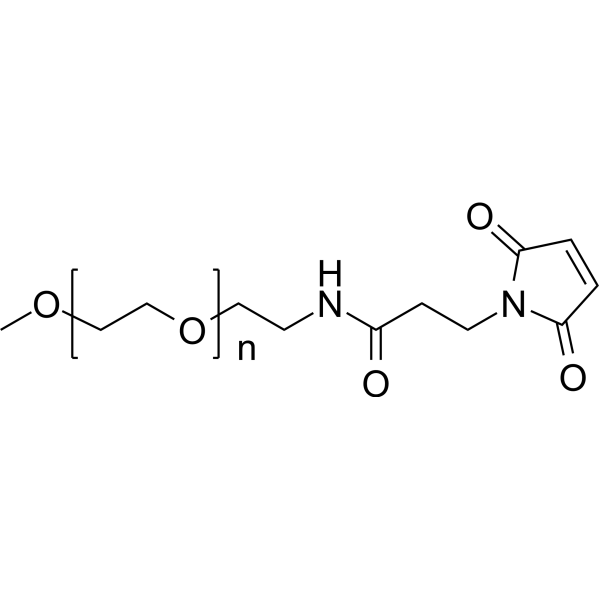
mPEG5000-Mal (mPEG5000-Maleimide) is a PEG-derived selective covalent binding agent for sulfhydryl groups (RSGs), which can form irreversible thioether bonds with sulfhydryl groups under near-neutral conditions via the maleimide group. The mechanism of action of mPEG5000-Mal can be divided into two categories: firstly, as an enzyme modifier, it binds to target proteins through hydrophobic interactions, hydrogen bonds, and van der Waals forces, altering the protein's secondary structure; secondly, as a nanoparticle surface modifier, it covalently binds to sulfhydryl groups on the surface of red blood cells, changing the surface properties and morphology of the red blood cells, leading to their phagocytosis by macrophages of the reticuloendothelial system. mPEG5000-Mal can react with free cysteine in proteins, increasing the apparent molecular weight of the modified protein by 10-15 kDa for detection purposes. mPEG5000-Mal can enhance the thermal stability and catalytic activity of enzymes, and improve the macrophage targeting of nanoparticles, enabling targeted drug delivery. mPEG5000-Mal can be applied in enzyme engineering research in the food industry and in oncology, assisting radiotherapy by inhibiting tumor-associated macrophage infiltration and enhancing anti-tumor immune responses .
loading...
    loading...

