536 Results for "

Kit

" in MedChemExpress (MCE) Product Catalog:
Products (536)

536 Results for "Kit" in MCE Product Catalog:

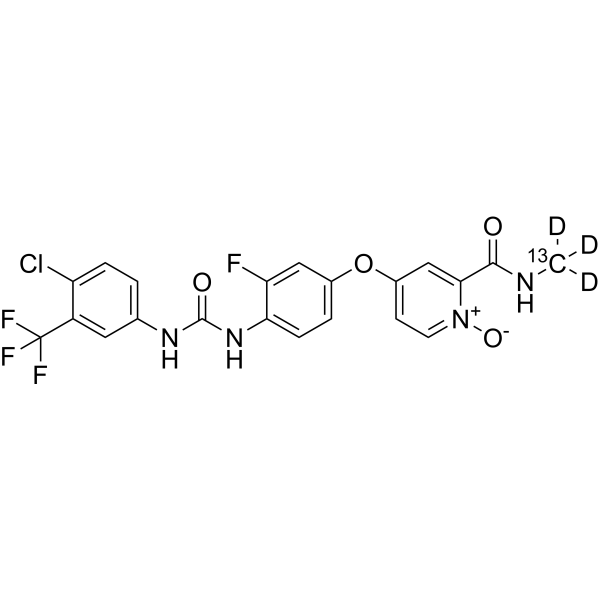
Cat. No.: HY-I0678S1
CAS No.: 2140317-01-5
Regorafénib N-oxyde (M2)- 13C,d3 is the 13C- and deuterium labeled Regorafénib N-oxyde (M2). Regorafénib N-oxyde M2 is an active metabolite of Regorafenib. Regorafenib is a multi-target inhibitor for VEGFR1/2/3, PDGFRβ, Kit, RET and Raf-1 with IC50s of 13/4.2/46, 22, 7, 1.5 and 2.5 nM, respectively.
loading...
    loading...
Cat. No.: HY-KD1101
Green Fluorescent Rapid Labelling Kit (FITC) enables green fluorescent labelling of proteins. Maximum excitation/ emission wavelengths: 488/515 nm. Based on NHS-ester chemistry, the NHS-ester-activated fluorescent dye reacts with primary amines in pH 7-9 solutions to form stable amide bonds, thereby achieving conjugation with antibodies/proteins. Typically, one IgG molecule can bind 2-8 molecules of FITC. The entire procedure can be completed within two hours.
loading...
    loading...
Cat. No.: HY-KD1106
Red Fluorescent Rapid Labelling Kit (AF647) enables red fluorescent labelling of proteins. Maximum excitation/ Emission Wavelength: 647/665 nm. Based on NHS ester chemistry, the NHS ester-activated fluorescent dye reacts with primary amines in the antibody/protein to be labelled at pH 7-9, forming stable amide bonds to achieve conjugation. Typically, one IgG molecule can bind 2-8 molecules of AF647. The entire procedure can be completed within two hours.
loading...
    loading...
Cat. No.: HY-KD1112
TheBlue Fluorescence Rapid Labelling Kit (AF350) enables red fluorescent labelling of proteins. Maximum excitation/ emission wavelengths: 346/442 nm. Based on NHS ester chemistry, the NHS ester-activated fluorescent dye reacts with primary amines in the antibody/protein to be labelled at pH 7-9, forming stable amide bonds to achieve conjugation. Typically, one IgG molecule can bind 2-8 molecules of AF350. The entire procedure can be completed within two hours.
loading...
    loading...
Cat. No.: HY-K0324

MCE MCE Total Superoxide Dismutase (SOD) Activity Colorimetric Assay Kit (Xanthine Oxidase-NBT Method) is based on the xanthine oxidase–NBT chromogenic system and quantitatively determines total SOD activity in various biological samples by measuring the inhibition of NBT reduction to formazan in the xanthine/xanthine oxidase–generated superoxide system at 560 nm. It is suitable for the determination of SOD activity in cell or tissue homogenate supernatants, whole blood, erythrocyte extracts, serum, and other biological samples.

loading...
    loading...
Cat. No.: HY-K0605

MCE AB—PAS Staining Kit for Glycogen and Mucopolysaccharides combines Alcian Blue staining and PAS staining, allowing the simultaneous detection and differentiation of different types of mucins within the same tissue section. In this method, acidic mucins are typically stained blue, neutral mucins appear red or magenta, and mucins containing both acidic and neutral components may appear purple or bluish-purple. This technique is widely used in histological and pathological studies for the identification and distribution analysis of mucin types within tissues.

loading...
    loading...
Cat. No.: HY-K0357

MCE Mouse Mature B Cell Negative Selection Kit enables the efficient isolation of mature B cells from single-cell suspensions prepared from mouse spleen, lymph nodes, or bone marrow. The principle involves using biotin-labeled monoclonal antibodies to label non-target cells (non-B cells), followed by the removal of these non-target cells through streptavidin-labeled magnetic beads, achieving the selective isolation of mouse mature B cells.

loading...
    loading...
Cat. No.: HY-13894R
CAS No.: 146535-11-7
Synonyms: AG1296 (Standard)
Tyrphostin AG1296 (Standard) is the analytical standard of Tyrphostin AG1296. This product is intended for research and analytical applications. Tyrphostin AG1296 is a potent and selective inhibitor of platelet-derived growth factor receptor (PDGFR), with an IC50 of 0.8 μM. Tyrphostin AG1296 inhibits signaling of human PDGF α- and β-receptors as well as of the related stem cell factor receptor (c-Kit). Tyrphostin AG1296 is also a potent inhibitor of FLT3, with an IC50 in the micromolar range .
loading...
    loading...
Cat. No.: HY-15463R
CAS No.: 152459-95-5
Synonyms: STI571 (Standard); CGP-57148B (Standard)
Research Areas:  

Cancer

Imatinib (Standard) is the analytical standard of Imatinib. This product is intended for research and analytical applications. Imatinib (STI571) is an orally bioavailable tyrosine kinases inhibitor that selectively inhibits BCR/ABL, v-Abl, PDGFR and c-kit kinase activity. Imatinib (STI571) works by binding close to the ATP binding site, locking it in a closed or self-inhibited conformation, therefore inhibiting the enzyme activity of the protein semicompetitively . Imatinib also is an inhibitor of SARS-CoV and MERS-CoV .
loading...
    loading...
Cat. No.: HY-18187
CAS No.: 516523-31-2
Target:  

Apoptosis

Research Areas:  

Cancer

Ki 23057 is a competitive, orally active inhibitor for tyrosine kinase, which inhibits the phosphorylation of K-samII/FGF-R2, VEGF-R1, VEGF-R2, PDGF-Rβ and c-Kit, with IC50s of 88, 69, 83, 100 and 480 nM. Ki 23057 inhibits the proliferation of sclerogastric cancer cells OCUM-2MD3 and OCUM-8, and induces apoptosis. Ki 23057 exhibits antitumor efficacy in mouse models .
loading...
    loading...
Cat. No.: HY-184327
Research Areas:  

Inflammation/Immunology

Anti-inflammatory agent 117 is an orally active anti-inflammatory agent and c-Kit kinase inhibitor with an IC50 of 15.2 μM. Anti-inflammatory agent 117 blocks the NF-κB signaling pathway and inhibits the release of IL-6. Anti-inflammatory agent 117 exhibits anti-inflammatory effects in mouse models of acute lung injury, sepsis and ulcerative colitis. Anti-inflammatory agent 117 can be used in research related to acute lung injury, sepsis and ulcerative colitis .
loading...
    loading...
Cat. No.: HY-18949
CAS No.: 856436-16-3
Target:  

FLT3 JAK c-Kit

Research Areas:  

Cancer

JI6 is a potent, selective and orally active FLT3 inhibitor, with IC50s of ~40, 8, and 4 nM for FLT3-WT, FLT3-D835Y, and FLT3-D835H, respectively. JI6 also inhibits JAK3 and c-Kit, with IC50s of ~250 and ~500 nM, respectively. JI6 can be used for the research of acute myeloid leukemia .
loading...
    loading...
Cat. No.: HY-KD1103
Red Fluorescent Rapid Labelling Kit (CY3) enables red fluorescent labelling of proteins. Maximum excitation/ Emission Wavelength: 550/570 nm. Based on NHS ester chemistry, the NHS ester-activated fluorescent dye reacts with primary amines in the antibody/protein to be labelled at pH 7-9, forming stable amide bonds to achieve conjugation with the antibody/protein. Typically, one IgG molecule can bind 2–8 molecules of CY3. The entire experiment can be completed within 2 hours.
loading...
    loading...
Cat. No.: HY-KD1104
Red Fluorescent Rapid Labelling Kit (AF555) enables red fluorescent labelling of proteins. Maximum excitation/ Emission Wavelength: 555/565 nm. Based on NHS ester chemistry, the NHS ester-activated fluorescent dye reacts with primary amines in pH 7-9 solutions to form stable amide bonds with the target antibody/protein, achieving conjugation. Typically, one IgG molecule can bind 2-8 molecules of AF555. The entire procedure can be completed within two hours.
loading...
    loading...
Cat. No.: HY-KD1107
Deep Red Fluorescent Rapid Labelling Kit (CY5) enables red fluorescent labelling of proteins. Maximum excitation/ emission wavelengths: 649/667 nm. Based on NHS ester chemistry, the NHS ester-activated fluorescent dye reacts with primary amines in the antibody/protein to be labelled at pH 7-9, forming stable amide bonds to achieve conjugation. Typically, one IgG molecule can bind 2–8 molecules of CY5. The entire experiment can be completed within 2 hours.
loading...
    loading...
Cat. No.: HY-KD1109
Near-infrared Fluorescent Rapid Labelling Kit (CY7) enables red fluorescent labelling of proteins. Maximum excitation/ emission wavelengths: 750/773 nm. Based on NHS ester chemistry, the NHS ester-activated fluorescent dye reacts with primary amines in the antibody/protein to be labelled at pH 7-9, forming stable amide bonds to achieve conjugation. Typically, one IgG molecule can bind 2–8 molecules of CY7. The entire experiment can be completed within 2 hours.
loading...
    loading...
Cat. No.: HY-KD1111
Near-infrared Fluorescent Rapid Labelling Kit (AF750) enables red fluorescent labelling of proteins. Maximum excitation/ Emission Wavelength: 750/775 nm. Based on NHS ester chemistry, the NHS ester-activated fluorescent dye reacts with primary amines in pH 7-9 solutions to form stable amide bonds, thereby achieving conjugation with antibodies/proteins. Typically, one IgG molecule can bind 2-8 molecules of AF750. The entire procedure can be completed within two hours.
loading...
    loading...
Cat. No.: HY-KD1102
Green Fluorescent Rapid Labelling Kit (AF488) enables green fluorescent labelling of proteins. Maximum excitation/ emission wavelengths: 480/525 nm. Based on NHS ester chemistry, the NHS ester-activated fluorescent dye reacts with primary amines in pH 7-9 solutions to form stable amide bonds, thereby achieving conjugation with antibodies/proteins. Typically, one IgG molecule can bind 2-8 molecules of AF488. The entire procedure can be completed within two hours.
loading...
    loading...
Cat. No.: HY-KD1105
Red Fluorescent Rapid Labelling Kit (AF594) enables red fluorescent labelling of proteins. Maximum excitation/ Emission Wavelength: 594/617 nm. Based on NHS ester chemistry, the NHS ester-activated fluorescent dye reacts with primary amines in pH 7-9 solutions to form stable amide bonds, thereby achieving conjugation with antibodies/proteins. Typically, one IgG molecule can bind 2-8 molecules of AF594. The entire procedure can be completed within two hours.
loading...
    loading...
Cat. No.: HY-K2034

MCE OptiLNP Antibody-ctLNP pDNA Transfection Reagent (Jurkat Cells) utilizes antibody-conjugated cell-targeted lipid nanoparticle (Cell-targeted Lipid Nanoparticle, ctLNP) technology and is specifically optimized for human primary T cells. It enables efficient and targeted RNA delivery, improving transfection efficiency in difficult-to-transfect primary T cells. The kit is ideally suited for applications including CAR-T and TCR-T cell engineering, cancer immunology research, immune cell engineering, and in vitro T cell functional studies.

loading...
    loading...

