5506 Results for "

Multivariate statistical analysis

" in MedChemExpress (MCE) Product Catalog:
Products (5506)

5506 Results for "Multivariate statistical analysis" in MCE Product Catalog:

Cat. No.: HY-D2188
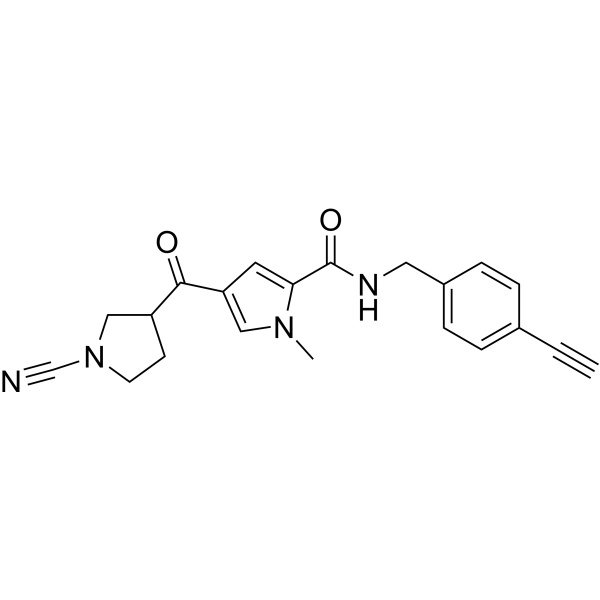
IMP-2373 is a low-toxicity activity-based probe targeting covalent pan-deubiquitinase (DUB), which modulates and monitors DUB activity via covalent binding to the catalytic cysteine and active site of DUB. IMP-2373 enables real-time tracking of dynamic intracellular DUB activity in physiologically relevant living cell systems, and quantitative analysis of activity changes induced by pharmacological inhibition or MYC dysregulation. IMP-2373 can be used for research on related diseases such as B-cell lymphoma .
loading...
    loading...
Cat. No.: HY-D3347
CAS No.: 1123684-41-2
DUPA-FITC is a fluorescent reagent targeting PSMA, which specifically binds to prostate cancer cells expressing PSMA without non-specific binding to normal blood cells. DUPA-FITC can label PSMA-expressing prostate cancer cells in whole blood, followed by internalization and trafficking to acidic intracellular endosomes, during which the fluorescence is quenched. When combined with flow cytometry and density gradient centrifugation enrichment, DUPA-FITC enables quantitative analysis of circulating tumor cells in peripheral blood samples from prostate cancer patients .
loading...
    loading...
Cat. No.: HY-NP186
Helix pomatia Agglutinin is a N-acetylgalactosamine (GalNAc) binding lectin, found in the reproductive gland of a Roman snail. Helix pomatia Agglutinin binds with high affinity (kD = 1.9-2.4 μM) steroid hormones: testosterone and progesterone. Helix pomatia Agglutinin interacts with adenine (kD = 5.4 μM) and arylaminonaphthalene sulfonate TNS (kD = 12 μM). Helix pomatia Agglutinin is commonly used for characterizing, imaging, or targeting glycoconjugates, and is also a very useful tool for glycomics analysis . Helix pomatia Agglutinin can be used for cancer prognosis study .
loading...
    loading...
Cat. No.: HY-W127711
CAS No.: 14263-94-6
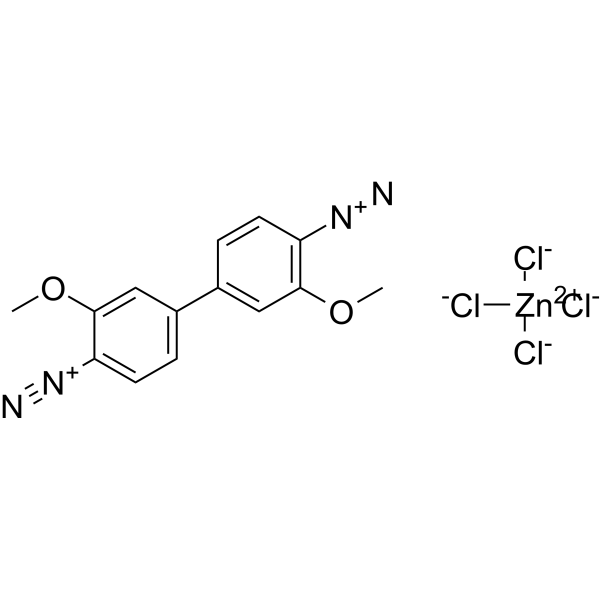
Fast Blue B Salt, Dye content ~95% is a diazo dye, primarily used as a chromogenic substrate in biochemical analysis. Fast Blue B Salt, Dye content ~95% is the coupling agent for the histochemical demonstration of proteases. Fast Blue B Salt, Dye content ~95% can be used for the detection of acid phosphatase in Clostridium perfringens, and also for the determination of lipase activity. Fast Blue B Salt, Dye content ~95% reacts directly with the active hydroxyl groups in phenolic compounds to determine the content of phenolic substances .
loading...
    loading...
Cat. No.: HY-W250176
CAS No.: 60828-78-6
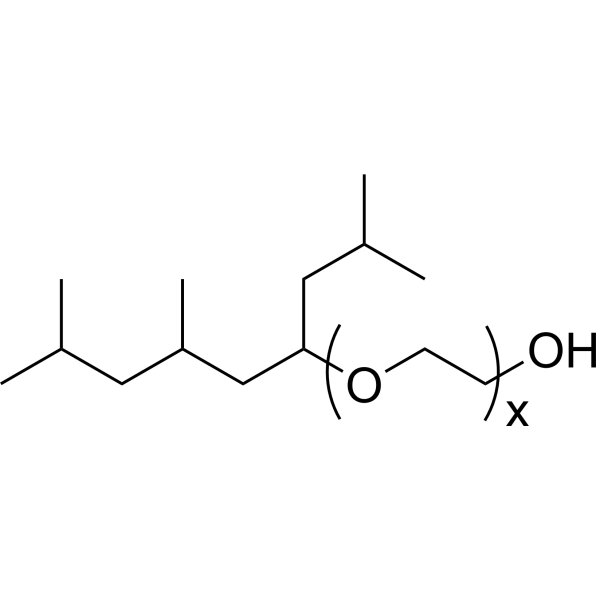
Polyethylene glycol trimethylnonyl ether, is a nonionic surfactant commonly used in various industrial and research applications. It belongs to the family of polyethylene glycol (PEG) ethers with a hydrophilic head and lipophilic tail and is suitable for use in lotions, detergents and solubilizers. Polyethylene glycol trimethylnonyl ether is particularly useful in protein chemistry, where it is used to solubilize and stabilize proteins, such as membrane proteins, for structural analysis techniques. In addition, Polyethylene glycol trimethylnonyl ether has potential applications in drug delivery and other medical fields due to its ability to interact with and penetrate cell membranes.
loading...
    loading...
Cat. No.: HY-W250178
CAS No.: 24233-81-6
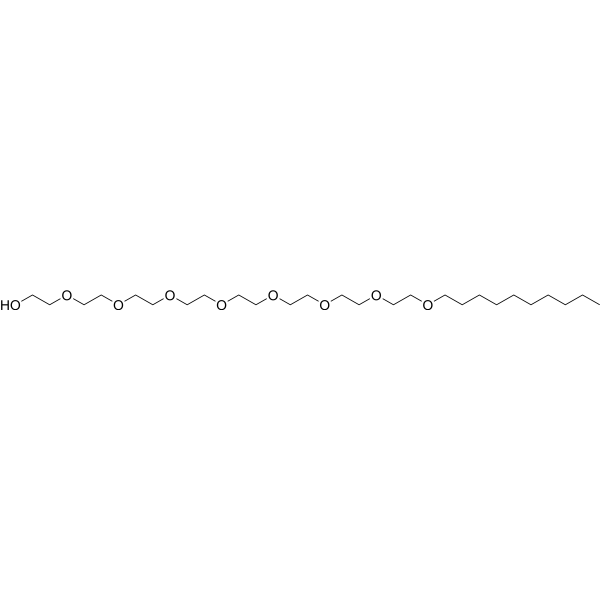
Octaethylene glycol monodecyl ether, is a nonionic surfactant commonly used in various industrial and research applications. It belongs to the family of polyethylene glycol (PEG) ethers with a hydrophilic head and lipophilic tail and is suitable for use in lotions, detergents and solubilizers. Octaethylene glycol monodecyl ether is particularly useful in the study of membrane proteins, where it is used to solubilize and stabilize proteins for structural analysis techniques. In addition, Octaethylene glycol monodecyl ether has the ability to interact with and penetrate cell membranes, so it has potential applications in drug delivery and other medical fields.
loading...
    loading...
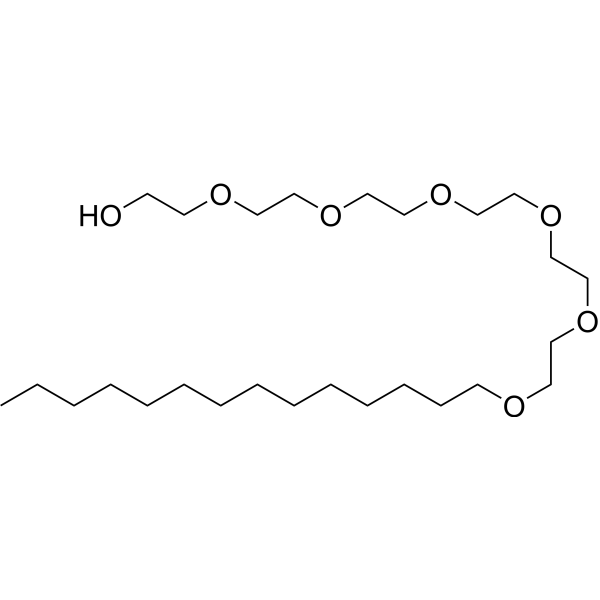
Cat. No.: HY-W250195
CAS No.: 5157-04-0
Hexaethylene glycol monotetradecyl ether is a kind of nonionic surfactant with hydrophilic head and lipophilic tail. It belongs to the class of polyethylene glycol (PEG) ethers and is widely used in different industrial and research applications. Due to its unique properties, Hexaethylene glycol monotetradecyl ether is commonly used in lotions, detergents and solubilizers. It is particularly useful in the study of membrane proteins and can be used to stabilize and solubilize proteins for use in structural analysis techniques. Due to its moisturizing and emulsifying properties, Hexaethylene glycol monotetradecyl ether is also used in personal care and cosmetics.
loading...
    loading...
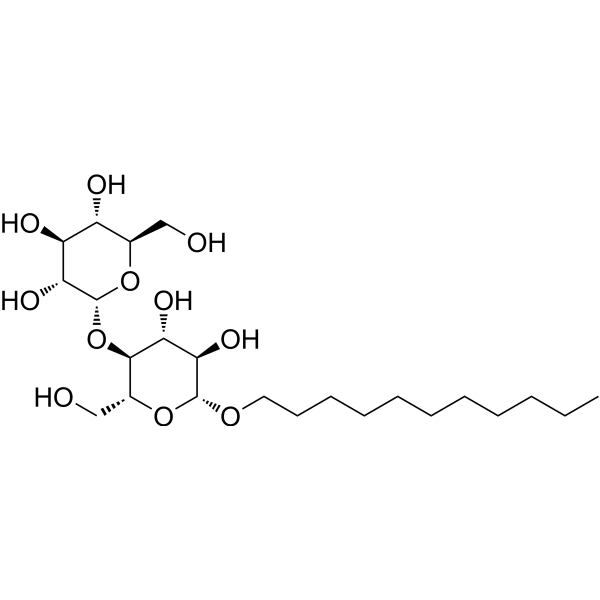
Cat. No.: HY-W283166
CAS No.: 253678-67-0
n-Undecyl β-D-maltopyranoside is an n-alkyl β-D-maltopyranoside detergent that can be used for solubilization and structural determination of membrane proteins. n-Undecyl β-D-maltopyranoside effectively solubilizes CST from Golgi-enriched fractions of Pichia pastoris, but fails to maintain the functional activity of CST during subsequent partial purification and reconstitution into proteoliposomes. n-Undecyl β-D-maltopyranoside is more suitable for structural analysis studies of membrane proteins rather than functional reconstitution experiments .
loading...
    loading...
Cat. No.: HY-Y0699R
CAS No.: 493-52-7
Methyl red (Standard) is the analytical standard of Methyl red (HY-Y0699). This product is intended for research and analytical applications. Methyl red is a pH-sensitive acid-base indicator and colorimetric reagent with a pKa of 5.1. Methyl red achieves visual judgment of the titration endpoint through reversible structural changes of protonation (red, pH < 4.4) and deprotonation (yellow, pH > 6.2). Methyl red is widely used in acid-base titration in chemical analysis and buffer pH monitoring in biochemistry .
loading...
    loading...
Cat. No.: HY-K0609

MCE Modified Masson Staining Kit employs Celestine Blue hematoxylin for light nuclear staining, offering shorter differentiation time compared to conventional methods. It features low toxicity, environmental friendliness, simple operation, and stable performance. The staining results show clear coloration and high contrast. The stained sections can be stored for long periods with minimal fading, facilitating long-term preservation and image analysis. This kit is widely used in studies of connective tissue, muscle tissue, and collagen fibers, and is suitable for histological observation and related pathological analyses.

loading...
    loading...
Cat. No.: HY-K3122

MCE Dry Plant-Derived Extracellular Vesicle Isolation and Purification Kit is specifically optimized for dried plant samples. It facilitates the efficient release of vesicles from plant tissues and employs an optimized extraction and purification system to remove non-vesicular components such as polysaccharides and phenolic compounds, thereby enabling the efficient extraction and purification of plant-derived vesicles. The isolated plant-derived vesicles can be used for downstream applications including transmission electron microscopy (TEM), nanoparticle tracking analysis (NTA), Western blotting, qPCR, cell-based studies, and animal experiments.

loading...
    loading...
Cat. No.: HY-K3123

MCE Succulent Plant -Derived Extracellular Vesicle Isolation and Purification Kit is specifically optimized for succulent plant samples. It facilitates the efficient release of vesicles from plant tissues and employs an optimized extraction and purification system to remove non-vesicular components such as polysaccharides and phenolic compounds, thereby enabling the efficient extraction and purification of plant-derived vesicles. The isolated plant-derived vesicles can be used for downstream applications including transmission electron microscopy (TEM), nanoparticle tracking analysis (NTA), Western blotting, qPCR, cell-based studies, and animal experiments.

loading...
    loading...
Cat. No.: HY-120963
CAS No.: 52514-04-2
Purity:  98%
Target:  

Endogenous Metabolite

Research Areas:  

Metabolic Disease

Several different arachidonoyl amino acids, including N-arachidonoyl dopamine and N-arachidonoyl serine, have been isolated and characterized from bovine brain.1 During mass spectral lipidomics analysis of rat brain, a series of fatty acyl amides of a third amino acid, taurine, were discovered.2 This novel class of compounds is present in kidney and activates members of the transient receptor potential (TRP) family of calcium channels.3 N-Oleoyl taurine is an amino-acyl endocannabinoid isolated from rat brain that may activate TRPV1 and TRPV4.
loading...
    loading...
Cat. No.: HY-120964
CAS No.: 63155-80-6
Purity:  99.00%
Target:  

Endogenous Metabolite

Research Areas:  

Metabolic Disease

Several different arachidonoyl amino acids, including N-arachidonoyl dopamine (NADA) and N-arachidonoyl serine (ARA-S), have been isolated and characterized from bovine brain.1 During mass spectral lipidomic analysis of rat brain, a series of fatty acyl amides of a third amino acid, taurine, is discovered.2 This novel class of compounds is present in kidney and activates members of the transient receptor potential (TRP) family of calcium channels.3 N-Stearoyl taurine is a prominent amino-acyl endocannabinoid isolated from rat brain during lipidomics profiling.
loading...
    loading...
Cat. No.: HY-177058
Research Areas:  

Inflammation/Immunology

DSP30 is a phosphorothioate cpG-oligodeoxynucleotide and a TLR9 agonist. DSP30 can activate immune system cells, including B cells and dendritic cells, by inducing proliferation and cytokine production.DSP30 can enhance the immunosuppressive function of bone marrow-multipotent mesenchymal stromal cells (BM-MSC). DSP30 combined with interleukin 2 (IL2) is an effective mitotic stimulant in B-cell disorders. DSP30 can be used for the genetic characteristic research and analysis of chronic lymphocytic leukemia (CLL) .
loading...
    loading...
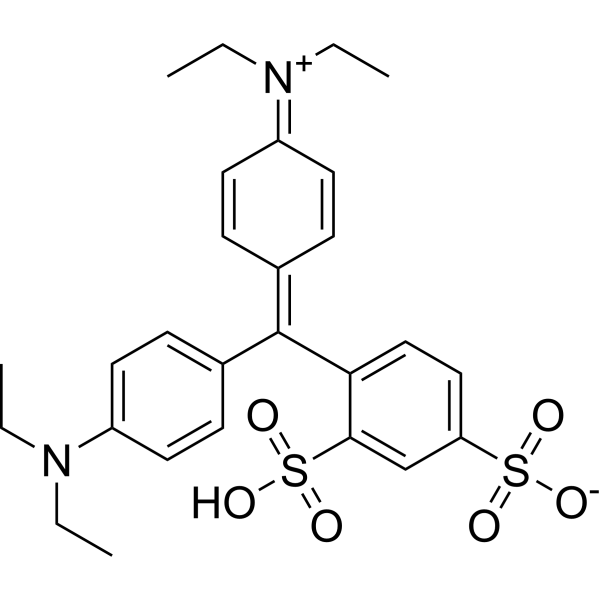
Cat. No.: HY-D0293
CAS No.: 116-95-0
Synonyms: Xylene blue free acid; C.I. Acid blue 1 free acid
Acid blue 1 free acid (Patent Blue V) is a novel biological dye that can be used as an intraocular dye for retinectomy. Retinectomy refers to the removal of the translucent inner limiting membrane (ILM). The application of appropriate dyes in vitreoretinal surgery can achieve the purpose of complete removal. Acid blue 1 free acid can be used to stain retinal premembranous structures. Spectral analysis shows that Acid blue 1 free acid has strong absorption below 450 nm and above 600 nm, showing a blue-green color. Acid blue 1 free acid is also used as a marker in lymphangiography for resection of neoplastic lymph nodes .
loading...
    loading...
Cat. No.: HY-DY1034
CAS No.: 76204-02-9
4-MUNANA (solution) is a substrate of influenza virus neuraminidase (NA) with high selectivity and irreversible reaction. In the enzymatic reaction, 4-MUNANA is hydrolyzed by NA to generate fluorescent 4-methylumbelliferone (4-MU). By detecting the fluorescence intensity of 4-MU, quantitative analysis of NA activity can be achieved. 4-MUNANA can be used in influenza-related research, such as screening NA inhibitors, developing new anti-influenza drugs, and studying the infection mechanism of influenza viruses .
Solvent and Concentration: Sterile water: 10 mM
loading...
    loading...
Cat. No.: HY-P11934
Research Areas:  

Others

TPE-GGH is a water-soluble aggregation-induced emission (AIE)-active fluorescent probe composed of tetraphenylethylene (TPE)-modified tripeptide (Gly-Gly-His-NH2). TPE-GGH detects Cu 2+ with high selectivity and sensitivity, with a limit of detection of 28.5 nM. TPE-GGH exhibits low toxicity and favorable membrane permeability, and can be used for Cu 2+ imaging in living cells (LLC) and zebrafish, as well as for Cu 2+ detection in environmental water samples and semi-quantitative analysis via portable test strips/smartphone RGB technology .
loading...
    loading...
Cat. No.: HY-W008425
CAS No.: 10160-24-4
Synonyms: 7-Bromoheptan-1-ol
Research Areas:  

Cancer

7-Bromo-1-heptanol (7-Bromoheptan-1-ol) acts as a HaloTag-GPSM2 inhibitor and an organic synthesis intermediate. It forms a covalent irreversible bond with HaloTag-GPSM2, thereby blocking the subsequent labeling effect of fluorescent HaloTag ligands and enabling pulse-chase analysis of protein turnover. 7-Bromo-1-heptanol can be used to synthesize PROTAC BET degraders and multivalent glycoporphyrin antiviral compounds. It is applicable to cancer-related research .
loading...
    loading...
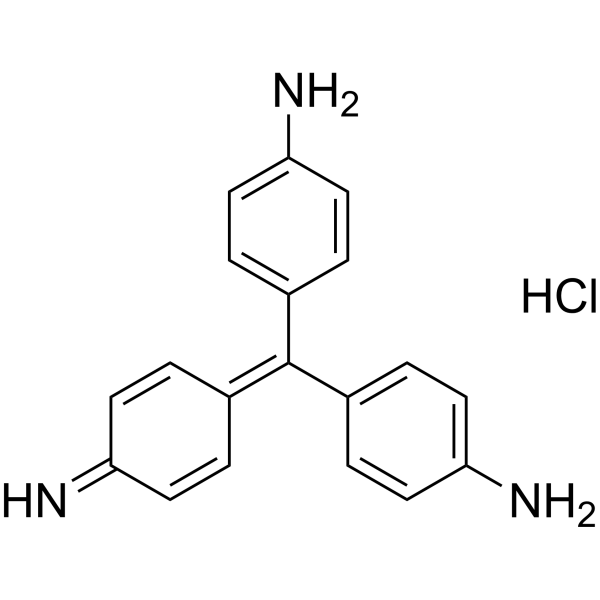
Cat. No.: HY-W127770
CAS No.: 569-61-9
Synonyms: Basic red 9
Target:  

Fluorescent Dye

Research Areas:  

Infection

Pararosaniline hydrochloride (Basic red 9) is a pH-responsive basic dye, as a biological stain to track certain proteins. The pH of the acidified Pararosaniline hydrochloride reagent has a significant effect on the color and the maximum absorption wavelength (λmax) of the reaction system, with its optimum pH 0.48 and a λmax at 549 nm. Pararosaniline hydrochloride is also a strong modifier of RNA splicing. Pararosaniline hydrochloride has been used in the analysis of SO2 and formaldehyde and staining of bacteria or other organisms. Pararosaniline hydrochloride is extensively used in industries like textile, printing, paper, cosmetic, and leather .
loading...
    loading...

