577 Results for "

buffer

" in MedChemExpress (MCE) Product Catalog:
Products (577)

577 Results for "buffer" in MCE Product Catalog:

Cat. No.: HY-P11816
Research Areas:  

Cancer

DOTA-cTMTP1 is a cyclic tumor-homing peptide precursor molecule. DOTA-cTMTP1 selectively binds to XPNPEP2 on highly metastatic tumor cells, accumulates and retains in hepatocellular carcinoma tumors, and maintains a high tumor-to-liver contrast over time in small animal models. After radiolabeling with 68Ga, DOTA-cTMTP1 forms a PET probe for positron emission tomography (PET) imaging of hepatocellular carcinoma (HCC).
loading...
    loading...
Cat. No.: HY-P11842
Target:  

DNA/RNA Synthesis

Research Areas:  

Cancer

Ac-HFKLYWPPFLGS-NH2 is a RMI1/2 heterodimer inhibitor with an IC50 of 99 nM and antiproliferative activity. Ac-HFKLYWPPFLGS-NH2 binds competitively at the FANCM-RMI interaction interface, mimics native FANCM MM2 domain hydrophobic interactions, and adopts a unique binding pose with additional protein interactions. Ac-HFKLYWPPFLGS-NH2 induces antiproliferative effects in ALT-positive osteosarcoma cells. Ac-HFKLYWPPFLGS-NH2 shows limited stability toward α-chymotrypsin-mediated enzymatic degradation in vitro. Ac-HFKLYWPPFLGS-NH2 lacks inherent cell permeability, requiring conjugation to a cell-penetrating peptide for intracellular delivery. Ac-HFKLYWPPFLGS-NH2 can be used for the research of ALT-positive osteosarcoma .
loading...
    loading...
Cat. No.: HY-D3119
CAS No.: 2246946-49-4
Research Areas:  

Others

MitoAIE1 is a Fluorescent probe for mitochondrial viscosity detection. MitoAIE1 contains a pyridinium structural unit, which endows it with mitochondria-targeting specificity. The detection mechanism of this probe is based on aggregation-induced emission (AIE): in low-viscosity media such as PBS buffer, intramolecular rotation leads to non-radiative energy dissipation, resulting in only weak fluorescence; however, in high-viscosity environments such as the mitochondrial matrix or the vicinity of the inner mitochondrial membrane, such intramolecular motion is restricted, thereby significantly enhancing its fluorescent signal; in addition, this probe is not interfered by changes in microenvironment polarity and pH. Its emission wavelength is 625 nm, with absorption peaks at 325 nm and 450 nm; when transferred from low-viscosity PBS to high-viscosity 99% glycerol, its fluorescence intensity at 625 nm can be increased by 38-fold. It can be used to monitor changes in mitochondrial viscosity during processes such as Stauroporine (HY-15141)-induced apoptosis and starvation-induced mitophagy in live cells, and has good biocompatibility .
loading...
    loading...
Cat. No.: HY-151686
CAS No.: 1454558-58-7
Purity:  95.02%
Research Areas:  

Others

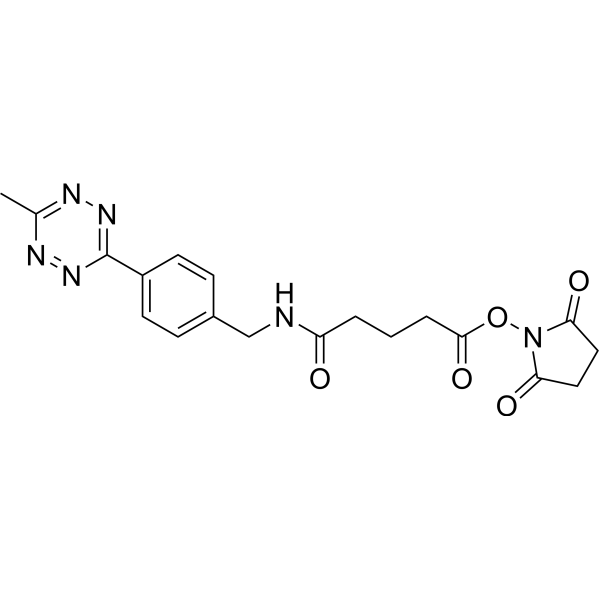
Bz-(Me)Tz-NHS is a methyltetrazine carboxylic acid NHS ester that enables conjugation of the tetrazine moiety to the 5' end of oligonucleotides via amide coupling reaction, and it is used in oligonucleotide template-mediated fluorescent bioorthogonal cycloaddition reactions. Bz-(Me) Tz-NHS is applicable to click chemistry-related studies .
loading...
    loading...
Cat. No.: HY-D1314
CAS No.: 1386385-76-7
Synonyms: 6-FAM azide
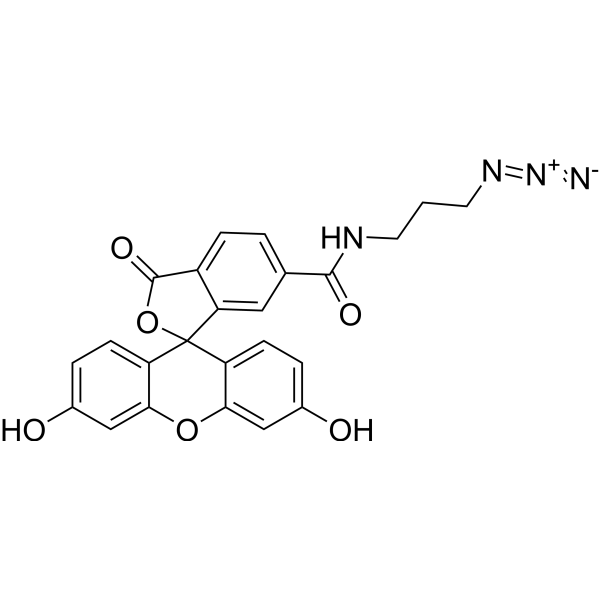
FAM azide, 6-isomer (6-FAM azide) is a 6-carboxyfluorescein derivative with an azide functional group and coupling partner in copper-catalyzed azide-alkyne cycloaddition. FAM azide, 6-isomer participates in synthesis of fluorescently tagged disparlure enantiomers for pheromone-binding protein binding assays. FAM azide, 6-isomer is widely used for labeling oligonucleotides (Ex/Em = 493/517 nm) .
loading...
    loading...
Cat. No.: HY-D1509
CAS No.: 10510-77-7
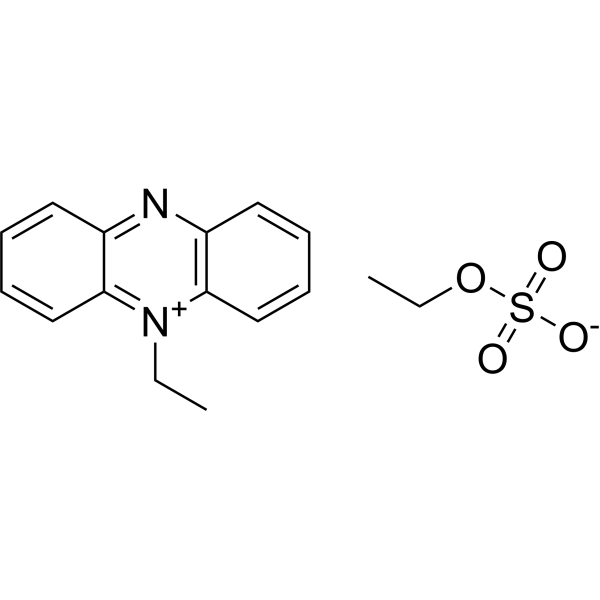
Phenazine ethosulfate is a cationic dye (Ex=390 nm, Em=530 nm) and electron acceptor that can be used in dye-linked enzyme assays . Phenazine ethosulfate exhibits weak, pH-dependent fluorescence properties and serves as an oxidative substrate. Phenazine ethosulfate promotes the reduction of equine heart metmyoglobin to ferrohemoglobin. As an intermediate, Phenazine ethosulfate can be used in combination with ascorbic acid for the detection of nitric oxide reductase activity .
loading...
    loading...
Cat. No.: HY-D3125
Target:  

Fluorescent Dye

Research Areas:  

Others

NtHzBtd is a fluorescent probe for detecting Fe 3+. NtHzBtd is applicable to the selective fluorescent detection of Fe 3+ ions and live cell imaging studies. NtHzBtd can selectively coordinate with Fe 3+ to form a 1:1 complex, triggering chelation enhanced quenching (CHEQ) and intramolecular charge transfer (ICT) processes, which result in fluorescence turn-off, thereby enabling sensitive detection of Fe 3+ and live cell fluorescence imaging. After binding to Fe 3+, NtHzBtd reduces fluorescence intensity, exhibits a rapid response property, with a limit of detection of 0.036 μM and a response time of approximately 55 s. The detection wavelengths are Ex/Em = 334/401 nm (solution system) .
loading...
    loading...
Cat. No.: HY-Y0131
CAS No.: 19847-12-2
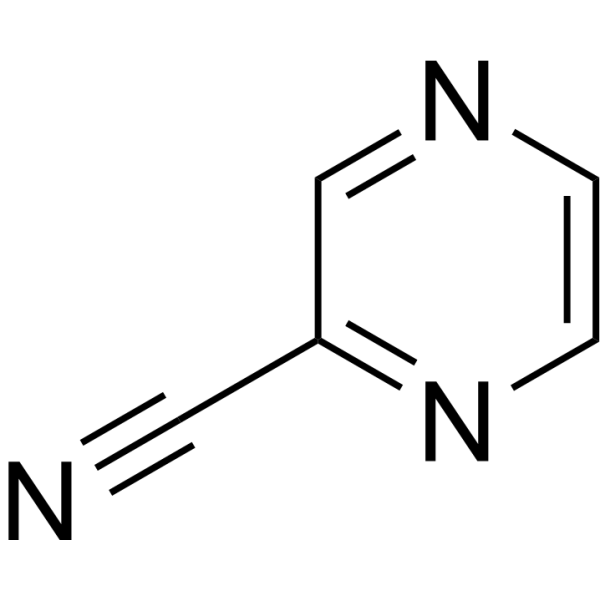
Pyrazine-2-carbonitrile is a biochemical reagent that can be used as a biological material or organic compound for life science related research .
loading...
    loading...
Cat. No.: HY-141667
CAS No.: 33984-50-8
Purity:  98.93%
Synonyms: 7-(p-Methoxybenzylamino)-4-nitrobenz-2,1,3-oxadiazole
Target:  

Fluorescent Dye

Research Areas:  

Others

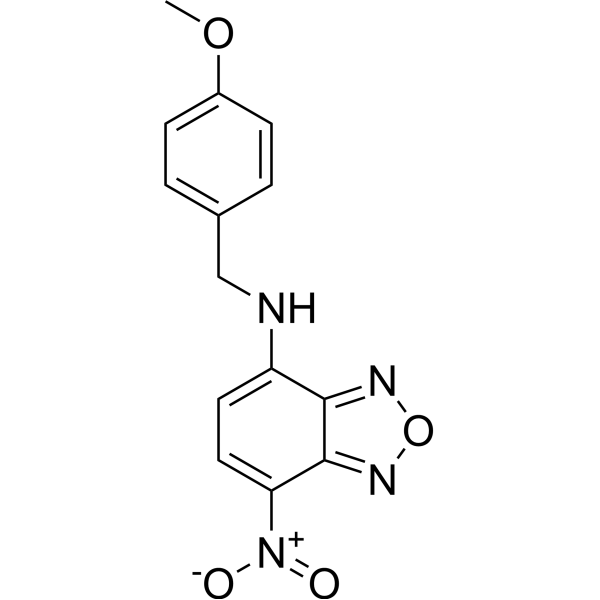
MBD (7-(p-Methoxybenzylamino)-4-nitrobenz-2,1,3-oxadiazole) is a hydrophobic fluorescent probe that is used to detect conformational changes of the complement subcomponent C1r during its autoactivation process. MBD acts by selectively binding to exposed hydrophobic regions on the C1r macromolecule. The detection wavelength of MBD in the free unbound state is Ex/Em = 490/560 nm, whereas the maximum emission wavelength of MBD upon binding to C1r exhibits a blue shift of approximately 20 nm relative to 560 nm .
loading...
    loading...
Cat. No.: HY-151759
CAS No.: 2129525-69-3
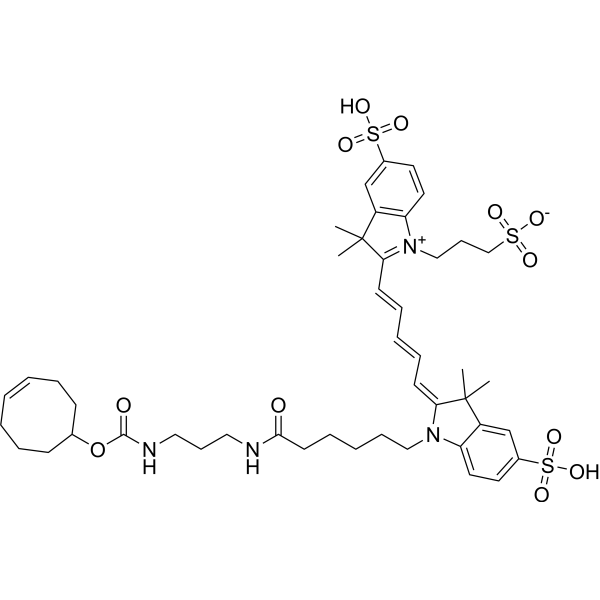
Sulfo-Cy5-TCO is a water-soluble sulfonated Cy5 fluorescent reagent containing trans-cyclooctene (TCO). Sulfo-Cy5-TCO undergoes an inverse electron demand Diels‑Alder reaction with tetrazine-labeled fixed breast cancer cells to achieve cell labeling. Sulfo-Cy5-TCO is used for fluorescent labeling and imaging of biological samples such as proteins and cells .
loading...
    loading...
Cat. No.: HY-D3435
Research Areas:  

Others

Biotin-X-DHPE is a biotin-labeled phospholipid analog that can be used for semi-automated cell panning in antibody discovery. Biotin-X-DHPE enables stable immobilization of live cells on magnetic beads without damaging the cells or altering their surface protein expression levels, while ensuring that the selected antibodies recognize natural, functional epitopes on the cell surface .
loading...
    loading...
Cat. No.: HY-172754
ICAAc is a solvatochromic fluorophore with reduced basicity. ICAAc demonstrates significant solvatochromic behavior across solvents of varying polarity, with a large dipole moment difference and low quantum yield in water, making it a tunable solvatochromic fluorophore. ICAAc enables pH sensing via UV-vis/fluorescence detection and in microenvironments including sodium lauryl sulfate micelle Stern layers. ICAAc acts as a supravital cell stain for epifluorescence imaging of live cancer cells .
loading...
    loading...
Cat. No.: HY-185759
CAS No.: 2940240-84-4
Target:  

Liposome

Research Areas:  

Inflammation/Immunology

IR-19-Py is an ionizable lipid suitable for aerosolized mRNA delivery. When formulated into lipid nanoparticles, IR-19-Py delivers mRNA to nasal tissues in mice, achieving sustained nasal protein expression and dose-dependent pulmonary protein expression. IR-19-Py can be used in cystic fibrosis research .
loading...
    loading...
Cat. No.: HY-W020249
CAS No.: 97600-39-0
Research Areas:  

Others

Sodium ionophore X is a neutral ionophore that binds highly selectively to sodium ions (Na +) to form stable complexes. Sodium ionophore X can be used to construct ion-selective chemical sensors (including optical sensors and electrochemical sensors) .
loading...
    loading...
Cat. No.: HY-134096
CAS No.: 78323-98-5
Synonyms: DNS-M
Target:  

Fluorescent Dye

Research Areas:  

Others

Dansyl-morpholine (DNS-M) is a Fluorescent probe for lipid droplet imaging, cancer cell discrimination, and real-time tracking of lipid droplet dynamics. As a solvatochromic probe with a donor-π-acceptor structure, it relies on hydrophobic interaction for its mechanism of action: its good lipophilicity, confirmed by an oil-water partition coefficient LogP = 2.35, allows it to rapidly penetrate cell membranes, and it specifically localizes to the hydrophobic core of lipid droplets; its fluorescence is strongly enhanced in the nonpolar environment of lipid droplets, while it emits very weak fluorescence in polar environments like PBS buffer, and it exhibits a bathochromic shift in emission wavelength with increasing solvent polarity. It has negligible cytotoxicity, with cell viability remaining over 95% after 24-hour incubation with 100 μM of the probe, and it possesses excellent photostability, retaining over 97% of initial fluorescence intensity after 60 continuous laser scans. For cell imaging applications, its excitation/emission wavelengths for lipid droplet labeling are Ex/Em = 405/480−540 nm, and in a simulative lipid environment O/W emulsion, it has an excitation wavelength of ~346 nm and emission wavelength of ~500 nm, giving a Stokes shift of 154 nm[1].
loading...
    loading...
Cat. No.: HY-D3231
Ratio-Coppersensor-1 is a selective ratiometric copper ion Fluorescent reporter (excitation wavelength: 480 nm; emission peak central wavelengths at 505 nm and 570 nm, respectively). Ratio-Coppersensor-1 exhibits extremely high selectivity for Cu + at cellular concentrations, outperforming other competing metal ions, and shows an approximately 20-fold change in fluorescence ratio upon Cu + binding. Ratio-Coppersensor-1 is capable of reflecting changes in Cu levels .
loading...
    loading...
Cat. No.: HY-D0186R
CAS No.: 951-78-0
2'-Deoxyuridine (Standard) is the analytical standard of 2'-Deoxyuridine. This product is intended for research and analytical applications. 2’-deoxyuridine is a brain-penetrant pyrimidines nucleotide that is associated with nervous system diseases. 2'-Deoxyuridine could increase chromosome breakage and results in a decreased thymidylate synthetase activity. 2'-Deoxyuridine is a precursor in the synthesis of Edoxudine (HY-B1011) and also an analogue of 5-ethynyl-2'-deoxyuridine, EdU (HY-118411). 2’-deoxyuridine reduces microglial activation and improve oxidative stress damage by modulating glycolytic metabolism on the Aβ25-35-induced brain injury, which is promising for research of Alzheimer’s disease (AD) . In Vitro:The interaction between the 2-deoxyuridine and the column increases the duration of retention of 2-deoxyuridine .
Gradient elution with sodium acetate buffer-ACN eluent on two ZIC-HILIC homemade columns separates 2-deoxyuridine in under 9 min .
In Vivo:2'-Deoxyuridine (34.42 ng/mL, gavage, 15 min) passes the blood-brain barrier (BBB) to enter the hippocampus of mice brain .
2'-Deoxyuridine (20 mg/kg, gavage, daily for 4 weeks) improves cognition and memory loss and attenuates the damage to the hippocampus in Aβ25-35-induced mice model .
loading...
    loading...

