577 Results for "

buffer

" in MedChemExpress (MCE) Product Catalog:
Products (577)

577 Results for "buffer" in MCE Product Catalog:

Cat. No.: HY-Y1913
CAS No.: 12045-78-2
Synonyms: Potassium biborate tetrahydrate, 99.5%
Potassium tetraborate tetrahydrate, 99.5% has antibacterial activity against Pectobacterium carotovorum. Potassium tetraborate tetrahydrate, 99.5% can be used as a biological material or organic compound for life science related research .
loading...
    loading...
Cat. No.: HY-Y1918
CAS No.: 7320-34-5
Synonyms: tetra-Potassium pyrophosphate
Potassium diphosphate (tetra-Potassium pyrophosphate) is a kind of biological materials or organic compounds that are widely used in life science research .
loading...
    loading...
Cat. No.: HY-Y1939A
CAS No.: 37267-86-0
Synonyms: Glacial phosphoric acid, 33.5-36.5%
Metaphosphoric acid, 33.5-36.5% (Glacial phosphoric acid, 33.5-36.5%) is a precipitant used for rapid enzymatic measurement of blood lactate and pyruvate. Metaphosphoric acid, 33.5-36.5% can also be used as a dehydrating agent, and its derivative sodium hexametaphosphate can be used as a chelating agent and food additive .
loading...
    loading...
Cat. No.: HY-D0008
CAS No.: 633-03-4
Target:  

Bacterial

Research Areas:  

Infection

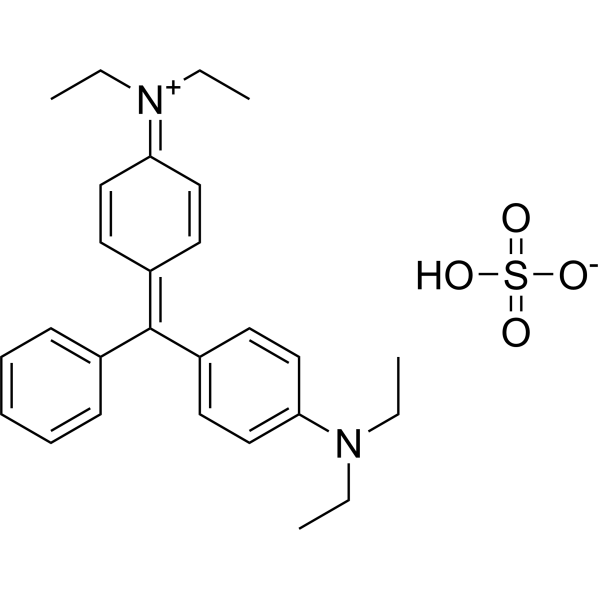
Brilliant green is a diaminotriphenylmethane compound and cationic dye that serves as a biological stain. Brilliant green exhibits strong antibacterial activity, with significant inhibitory effects on Gram-positive bacteria. The detection wavelength of Brilliant green is λmax = 625 nm .
loading...
    loading...
Cat. No.: HY-D1422
CAS No.: 1445108-32-6
Synonyms: BDNCA-346
Target:  

Fluorescent Dye

Research Areas:  

Others

ER Tracker Yellow (BDNCA-346) is a Fluorescent probe for targeted visualization of temperature at the endoplasmic reticulum. Its detection mechanism depends on temperature, with fluorescence intensity decreasing at higher temperatures due to preferential non-radiative processes; this intensity reversibly returns to baseline when cooled, provided the probe does not precipitate or degrade. It localizes specifically to the endoplasmic reticulum, where it may covalently attach to biomacromolecules via a thiol-reactive moiety, and its fluorescence remains stable after cell fixation; its fluorescence intensity is unaffected by physiological pH ranges of 5.0–8.0 and free Ca²⁺ concentrations of 0–800 μM. Its excitation/emission wavelength is Ex/Em = 559/581 nm[1].
loading...
    loading...
Cat. No.: HY-D3283
CAS No.: 2158197-66-9
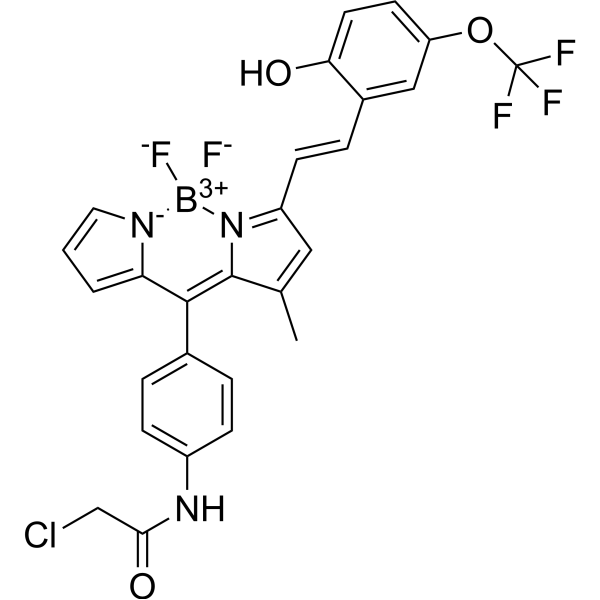
Ctrl-CCF1 is a control probe for CCF1. Ctrl-CCF1 can be used to distinguish copper-dependent responses from potential dye-dependent variations, such as cellular uptake, retention, subcellular accumulation, and changes in pH, redox or hydrophobic/hydrophilic environments .
loading...
    loading...
Cat. No.: HY-D3382
Target:  

Fluorescent Dye

Research Areas:  

Others

SGC3 is a fluorescent dye with lipophilic properties. SGC3 can be used to study synaptic vesicle recycling and "kiss-and-run" exocytosis by monitoring dye efflux through nanoscale fusion pores, and its detection mechanism relies on its own lipophilic properties. SGC3 generates fluorescence when bound to lipid membranes, and a decrease in fluorescence intensity can be detected when SGC3 leaves vesicles and exists in a free state in solution .
loading...
    loading...
Cat. No.: HY-E71350
κ-Carrageenase from Zobellia galactanivorans (EC 3.2.1.83) is an enzyme systematically named κ-carrageenan 4-β-D-glycanohydrolase (configuration-retaining). κ-Carrageenase from Zobellia galactanivorans hydrolyzes κ-carrageenan in an endolytic manner, primarily producing κ-neocarratetraose (DP4) and κ-neocarrahexaose (DP6). κ-Carrageenase, Zobellia galactanivorans generates κ-carrageenan oligosaccharides (κ-COS) that exhibit antioxidant, immunomodulatory, antitumor, anticoagulant, and antiviral activities via Nrf2/NF-κB/AMPK and other pathways; the enzyme itself possesses only catalytic activity and no direct pharmacological effects .
loading...
    loading...
Cat. No.: HY-138660
CAS No.: 2376841-30-2
Synonyms: HM-JF526 NHS
Target:  

Fluorescent Dye

Research Areas:  

Others

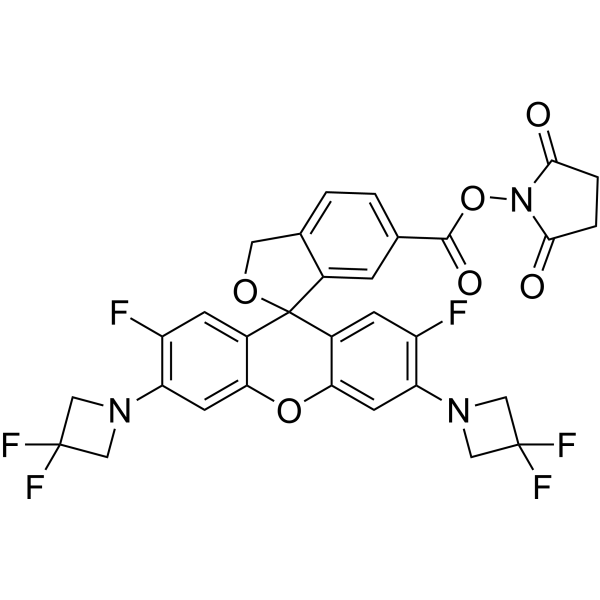
HM Janelia Fluor 526, SE (HM-JF526 NHS) is a derivative of hydroxymethyl JF526 (HM-JF526). SMLM (single-molecule localization microscopy) imaging in standard phosphate-buffered saline (pH 7.4) revealed that the HM-JF526 label showed spontaneous blinking behavior throughout the imaging session and did not require short-wavelength activation light . Janelia Fluor fluorescent dyes can be chemically conjugated to the specific HaloTag substrate (a chloroalkane ligand) to form a fluorescent ligand, rather than binding directly to the HaloTag protein itself. Janelia Fluor products are licensed under U.S. Pat. Nos. 9,933,417, 10,018,624 and 10,161,932 and other patents from Howard Hughes Medical Institute.
loading...
    loading...
Cat. No.: HY-183740
CAS No.: 3020685-33-7
Synonyms: N-Acryloylindole-alkyne
Research Areas:  

Others

NAIA (N-Acryloylindole-alkyne) is a cysteine-reactive probe. NAIA can be used as an imaging agent, proteome profiling agent, and covalent ligand screening tool .
loading...
    loading...
Cat. No.: HY-D3074
Research Areas:  

Others

TCM-4COOH is an AIE-active fluorescent probe for calcium ions. TCM-4COOH relies on aggregation-induced emission activity, and its carboxyl chelating group can bind to Ca 2+ and Mg 2+ to form insoluble aggregates, triggering fluorescence enhancement via restricting intramolecular motion (Ex/Em = 477/603 nm). TCM-4COOH shows pH independence in physiological environments (pH 4-9), can be strongly activated at Ca 2+ concentrations ranging from low nM to mM, and has a stronger binding ability to Ca 2+ than to Mg 2+. TCM-4COOH, as its acetoxymethyl ester derivative TCM-AM, can penetrate cell membranes for intracellular detection. TCM-4COOH can be used for imaging of cellular calcium overload, detection of bone microcracks, and studies related to calcium-rich biological environments .
loading...
    loading...
Cat. No.: HY-D3127
CAS No.: 455251-97-5
Target:  

Fluorescent Dye

Research Areas:  

Others

DCA-Mln is a Fluorescent probe for ferric iron (Fe³⁺) detection. The probe works via an internal charge transfer (ICT) process from its diethylamino group to its dicyano group, which produces bright pink fluorescence in its unbound state; when Fe³⁺ is present, two molecules of DCA-Mln chelate with one Fe³⁺ ion, with one cyano group of each DCA-Mln participating in the complexation, and this binding triggers a photoinduced electron transfer (PET) process that provides a nonradiative deactivation pathway, resulting in fluorescence quenching; additionally, the probe exhibits a visible color change from purple to peach pink upon Fe³⁺ binding, enabling dual-channel detection. The probe has an excitation wavelength of 570 nm and an emission wavelength of 670 nm, and it shows a rapid response, with fluorescence stabilizing within 15 seconds of Fe³⁺ addition. DCA-Mln is cell-membrane-permeable, nontoxic at the imaging concentration of 10 μM, and can be used for Fe³⁺ detection in actual water samples, Fe³⁺ imaging in living cells, and as an anti-counterfeiting ink[1].
loading...
    loading...
Cat. No.: HY-W075620
CAS No.: 1341134-09-5
Target:  

MOFs

Research Areas:  

Others

NH2-MIL-88B (Fe) is a metal-organic framework (MOF) with coordinatively unsaturated iron sites and carbon monoxide-releasing activity. NH2-MIL-88B (Fe) binds with carbon monoxide to form Fe 2+-CO and Fe 3+-CO adducts, and releases the bound carbon monoxide under physiological conditions, serving as a carrier and delivery vehicle for gaseous transmitters .
loading...
    loading...
Cat. No.: HY-182962
CAS No.: 852155-68-1
Synonyms: 7-Me-3'-OMe-GDP imidazole
Research Areas:  

Others

7-Methylguanosine 5-disphosphoimidazolide disodium (7-Me-3'-OMe-GDP imidazole) is a guanosine diphosphate imidazolide and starting material for synthesis of alkyne-containing C-phosphonate and phosphoester clickable mononucleotide building blocks for triazole-modified mRNA cap analogues .
loading...
    loading...
Cat. No.: HY-183982
CAS No.: 2173066-81-2
Target:  

Drug Derivative

Research Areas:  

Cardiovascular Disease

PAR4 antagonist 9-phosphoric acid is a phosphate prodrug of the PAR4 antagonist 9 (HY-183983). PAR4 antagonist 9-phosphoric acid is applicable to research related to arterial thrombosis .
loading...
    loading...
Cat. No.: HY-D3233
Ctrl-BDPS1 is a BODIPY-based control probe that shows no response to copper ions (exhibiting two emission peaks at 575 nm and 708 nm; the maximum excitation wavelength is at 627 nm). Ctrl-BDPS1 has no fluorescent response to Cu + .
loading...
    loading...
Cat. No.: HY-D2984
CAS No.: 1308789-62-9
Synonyms: SNAP-PEG-NH2
Target:  

Fluorescent Dye

Research Areas:  

Others

BG-PEG-NH2 (SNAP-PEG-NH2) is an amino-terminal fluorescent probe building block and a precursor for site-specific labeling of SNAP-tag fusion proteins. BG-PEG-NH2 undergoes one-step coupling with activated carboxyl esters to form customized SNAP-tag substrates, which covalently bind to SNAP tags via a thioether bond formed at the Cys145 site. After coupling with a caged carboxyfluorescein, BG-PEG-NH2 forms a probe with Ex/Em = 500/524 nm following ultraviolet uncaging. Coupling of BG-PEG-NH2 with SeTau-647-NHS enables visualization of GPCR signal transduction. BG-PEG-NH2 is suitable for coupling reactions in aqueous phases or buffers, conjugation of labels, and labeling of intracellular or cell-surface proteins .
loading...
    loading...
Cat. No.: HY-D3090
CAS No.: 2757682-04-3
Target:  

Fluorescent Dye

Research Areas:  

Others

NRLD is a lipid droplet-targeting solvatochromic fluorescent probe developed based on Nile Red (HY-D0718), which can target lipid droplets and sense the non-polar lipid microenvironment inside lipid droplets. NRLD exhibits superior lipid droplet-targeting selectivity compared to the parent Nile Red dye in HeLa cell imaging. NRLD achieves detection relying on the solvatochromic effect generated by excited-state charge transfer, and its emission wavelength shifts according to the local polarity changes of the microenvironment it locates in: the more compact and ordered the lipid packing and the lower the environmental polarity, the more blue-shifted the emission; the looser the lipid packing or the stronger the hydration and the higher the environmental polarity, the more red-shifted the emission. NRLD shows blue shift in the non-polar oil core of lipid droplets and red shift in high-polarity environments such as phosphate buffer .
loading...
    loading...
Cat. No.: HY-158741
CAS No.: 1369302-24-8
Synonyms: APG-2 Acetoxymethyl ester
IPG-2 AM (APG-2 Acetoxymethyl ester) is a membrane-permeant acetoxymethyl ester derivative and selective fluorescent potassium ion indicator. IPG-2 AM exhibits fluorescence increases proportional to extracellular potassium ion concentrations. IPG-2 AM enables real-time monitoring of cytosolic free potassium ion fluxes in human platelets and macrophages. IPG-2 AM can be used for the research of intracellular potassium concentration dynamics .
loading...
    loading...
Cat. No.: HY-D3160
Target:  

Fluorescent Dye

Research Areas:  

Others

Golgi-hNR is a cell membrane-permeable Golgi-targeted fluorescent probe containing a sulfonamide group. Golgi-hNR selectively accumulates in the Golgi apparatus of living cells, enabling real-time tracking and homeostasis assessment of reversible pH changes in the Golgi apparatus. Golgi-hNR exhibits a pH-dependent "off-on" fluorescence response mechanism within the pH 7.4-3.0 range, and its red fluorescence intensity decreases with increasing pH. The Ex/Em of Golgi-hNR is 560/664 nm and 580/664 nm, with the maximum emission peak located at 615 nm .
loading...
    loading...

