56 Results for "

P2Y2

" in MedChemExpress (MCE) Product Catalog:
Products (56)

56 Results for "P2Y2" in MCE Product Catalog:

Cat. No.: HY-137608A
Synonyms: UDP-β-S trisodium
Uridine 5'-O-thiodiphosphate trisodium (UDP-β-S trisodium) is a P2Y6 receptor agonist with an EC50 of 25 nM. Uridine 5'-O-thiodiphosphate trisodium resists degradation by extracellular nucleotidases and stimulates the accumulation of inositol phosphates. Uridine 5'-O-thiodiphosphate trisodium stimulates contractile responses in endothelium-denuded rat mesenteric arteries. As a mitogen, Uridine 5'-O-thiodiphosphate trisodium stimulates DNA synthesis, [ 3H] thymidine incorporation, protein synthesis, [ 3H]leucine incorporation, and increases the number of vascular smooth muscle cells. Uridine 5'-O-thiodiphosphate trisodium can be used in the research of cardiovascular diseases such as atherosclerosis .
loading...
    loading...
Cat. No.: HY-137603
CAS No.: 79049-97-1
Synonyms: UTPγS
Target:  

P2Y Receptor

Research Areas:  

Metabolic Disease

Uridine-5'-O-(3-thiotriphosphate) (UTPγS), a stable analogue of Uridine triphosphate (UTP) (HY-107372), is a potent agonist of the P2Y2 and P2Y4 receptors with increased metabolic stability. Uridine-5'-O-(3-thiotriphosphate) stimulates inositol phosphate formation in human 1321N1 astrocytoma cells stably expressing the phospholipase C-coupled human P2U-purinoceptor (EC50 = 240 nM) .
loading...
    loading...
Cat. No.: HY-108649
CAS No.: 1047980-83-5
MRS2768 is a potent, selective, and metabolically stable P2Y2 receptor agonist with an EC50 of 1.89 μM for the human P2Y2 receptor. MRS2768 activates Gq/PLC/PKC signaling, leading to downstream phosphorylation of Akt, eNOS, and ERK, with effects varying by cell type. MRS2768 inhibits ENaC via Gq/PKC/Src/Akt to promote natriuresis and lower blood pressure in the kidney. MRS2768 activates eNOS to increase NO secretion in endothelial cells. MRS2768 drives proliferation via PI3K/Akt in fibroblasts and cancer cells. MRS2768 exerts anti-apoptotic effects through PKC/Src/Akt in cardiomyocytes. MRS2768 can be applied to investigate P2Y2-dependent pathological processes, including acute kidney injury, chronic kidney disease and renal fibrosis, DOCA-salt induced hypertension, myocardial infarction, pulmonary arterial hypertension, pancreatic cancer, cardiac fibrosis, dry eye disease, as well as shear stress-mediated vascular remodeling and atherosclerosis .
loading...
    loading...
Cat. No.: HY-179448
CAS No.: 3120348-70-8
Target:  

P2Y Receptor

Research Areas:  

Cancer

P2Y2R antagonist 1 is a selective P2Y2R antagonist (pIC50 = 7.78). P2Y2R antagonist 1 can be used for the study of Glioma .
loading...
    loading...
Cat. No.: HY-RS09930
Research Areas:  

Others

P2ry2 Rat Pre-designed siRNA Set A contains three designed siRNAs for P2ry2 gene (Rat), as well as a negative control, a positive control, and a FAM-labeled negative control.

loading...
    loading...
Cat. No.: HY-RS09929
Research Areas:  

Others

P2ry2 Mouse Pre-designed siRNA Set A contains three designed siRNAs for P2ry2 gene (Mouse), as well as a negative control, a positive control, and a FAM-labeled negative control.

loading...
    loading...
Cat. No.: HY-137612A
Synonyms: Uridine 5'-O-1-thiotriphosphate tetrasodium
Target:  

P2Y Receptor

Research Areas:  

Cancer

Sp-UTP-α-S (Uridine 5-0-1-thiotrirhosphate) tetrasodium is a P2Y2 and P2Y4 receptor activator. Sp-UTP-α-S tetrasodium can be used in cancer research .
loading...
    loading...
Cat. No.: HY-RS09928
Research Areas:  

Others

P2RY2 Human Pre-designed siRNA Set A contains three designed siRNAs for P2RY2 gene (Human), as well as a negative control, a positive control, and a FAM-labeled negative control.

loading...
    loading...
Cat. No.: HY-113273B
CAS No.: 102783-61-9
Purity:  ≥96.0%
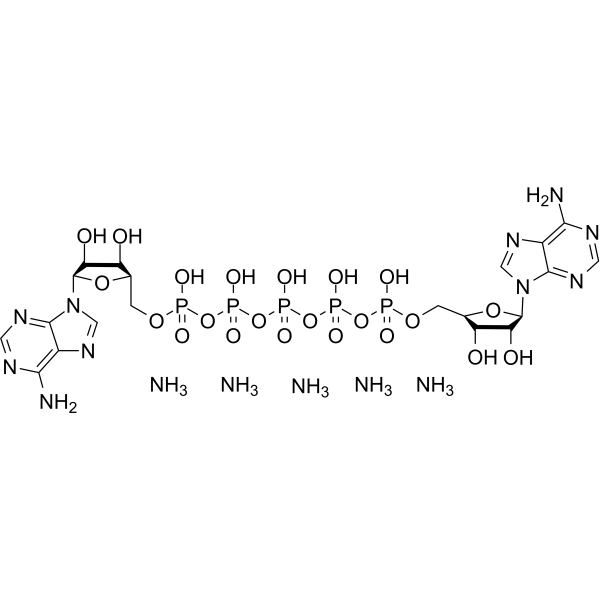
Synonyms: Ap5A pentaammonium; P1,P5-Di(adenosine-5'-)pentaphosphate pentaammonium
Target:  

Endogenous Metabolite

Diadenosine pentaphosphate (Ap5A; P1,P5-Di(adenosine-5'-)pentaphosphate) pentaammonium is an endogenous generated diadenosine polyphosphate, possessing the dual identities of intracellular alarm signal and extracellular signaling molecule. Diadenosine pentaphosphate regulates calcium signaling in the nervous, cardiac and peripheral sensory systems by activating P2X1/P2X3/P2Y receptor and RyR2 channels (EC50 = 140 μM). Diadenosine pentaphosphate can be used in studies related to intracellular calcium release channels, cardiovascular diseases and nociception (pain) .
loading...
    loading...
Cat. No.: HY-113273C
CAS No.: 94108-02-8
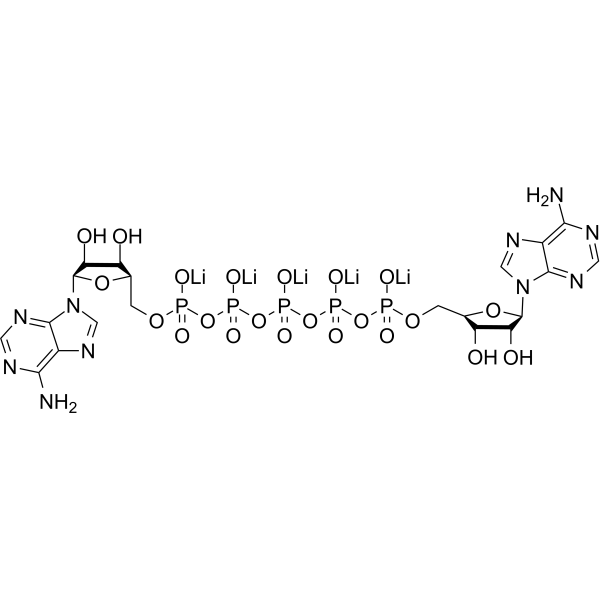
Synonyms: Ap5A pentalithium; P1,P5-Di(adenosine-5'-)pentaphosphate pentalithium
Target:  

Endogenous Metabolite

Diadenosine pentaphosphate (Ap5A; P1,P5-Di(adenosine-5'-)pentaphosphate) pentalithium is an endogenous generated diadenosine polyphosphate, possessing the dual identities of intracellular alarm signal and extracellular signaling molecule. Diadenosine pentaphosphate regulates calcium signaling in the nervous, cardiac and peripheral sensory systems by activating P2X1/P2X3/P2Y receptor and RyR2 channels (EC50 = 140 μM). Diadenosine pentaphosphate can be used in studies related to intracellular calcium release channels, cardiovascular diseases and nociception (pain) .
loading...
    loading...
Cat. No.: HY-108654
CAS No.: 917567-60-3
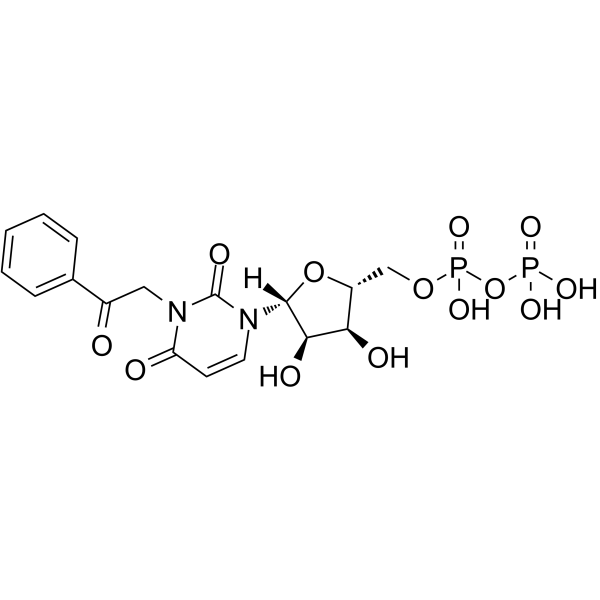
PSB 0474 (3-phenacyl-UDP) is a UDP (HY-113359) analog and selective P2Y6 receptor agonist, with an EC50 value of 70 nM for the hP2Y6 receptor. PSB 0474 activates Phospholipase C-coupled receptors to increase intracellular inositol phosphate levels. PSB 0474 enhances NO release by upregulating inducible iNOS and induces Apoptosis. PSB 0474 increases micturition frequency in urine of anesthetized rats, without altering bladder contraction amplitude/duration or causing urothelial damage. PSB 0474 can be used in studies related to chronic brain inflammation .
loading...
    loading...
Cat. No.: HY-110322AR
CAS No.: 1160271-30-6
Research Areas:  

Inflammation/Immunology

PPTN (Standard) is the analytical standard of PPTN (HY-110322A). This product is intended for research and analytical applications. PPTN, a chemical probe, is a potent, high-affinity, competitive and highly selective P2Y14 receptor antagonist with a KB value of 434 pM. PPTN exhibits no agonist or antagonist effect at the P2Y1, P2Y2, P2Y4, P2Y6, P2Y11, P2Y12, or P2Y13 receptors. Anti-inflammatory and immune activity .
loading...
    loading...
Cat. No.: HY-137603A
Synonyms: UTPγS tetrasodium
Target:  

P2Y Receptor

Uridine-5'-O-(3-thiotriphosphate) (UTPγS) tetrasodium, a stable analogue of Uridine triphosphate (UTP) (HY-107372), is a potent agonist of the P2Y2 and P2Y4 receptors with increased metabolic stability. Uridine-5'-O-(3-thiotriphosphate) tetrasodium stimulates inositol phosphate formation in human 1321N1 astrocytoma cells stably expressing the phospholipase C-coupled human P2U-purinoceptor (EC50 = 240 nM) .
loading...
    loading...
Cat. No.: HY-184044
CAS No.: 13112-05-5
Target:  

P2X Receptor

Research Areas:  

Neurological Disease

P2X2R antagonist-1 (compound 66) is a P2X2 receptor antagonist derived from Reactive Blue 4 (HY-125815). P2X2R antagonist-1 shows high selectivity for P2X4, P2X7, P2Y2, P2Y4, P2Y6 and P2Y12 receptors, moderate selectivity for P2X1 and P2X3 receptors, and exhibits higher potency toward homomeric P2X2 receptors than heteromeric P2X2/3 receptors. P2X2R antagonist-1 competitively inhibits ATP-mediated currents. P2X2R antagonist-1 can be used in research related to pain and urinary incontinence .
loading...
    loading...
Cat. No.: HY-P87437A
Synonyms: P2RU1, P2RY2, P2Y purinoceptor 2, P2Y2, ATP receptor, P2U purinoceptor 1, P2U receptor 1, Purinergic receptor, P2U1

Host:  

Mouse

Application:  

FC, ELISA

Reactivity:  

Human

loading...
    loading...
Cat. No.: HY-189107
CAS No.: 787548-03-2
Synonyms: INS50589 free acid
Target:  

P2Y Receptor

Research Areas:  

Cardiovascular Disease

Regrelor (INS50589 (free acid)) is a selective, reversible, and competitive P2Y12 receptor antagonist and an adenosine 5′-monophosphate derivative. Regrelor inhibits ADP (HY-W010918)-induced aggregation of human washed platelets with an IC50 of 0.016 μM. Intravenous infusion of Regrelor rapidly and dose-dependently inhibits ADP-induced platelet function, and platelet function gradually recovers after cessation of infusion. Regrelor can be used for research on P2Y12-mediated platelet function and cardiovascular regulation .
loading...
    loading...

