71 Results for "

background

" in MedChemExpress (MCE) Product Catalog:
Products (71)

71 Results for "background" in MCE Product Catalog:

Cat. No.: HY-10996
CAS No.: 1262770-73-9
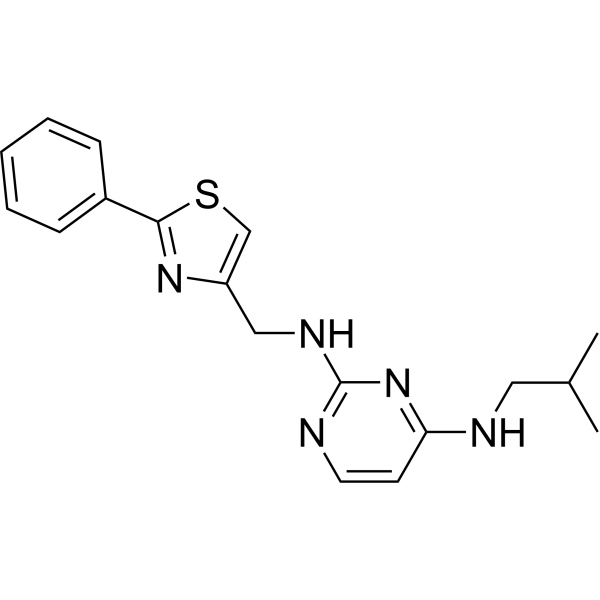
KHS101 is a blood-brain barrier-penetrant anticancer agent that primarily functions by inhibiting HSPD1 (IC50 = 14.4 μM) and TACC3 across different cellular backgrounds. KHS101 promotes the aggregation of HSPD1 with client proteins, destabilizes TACC3, and reduces the levels of TACC3, Aurora A and PLK1. KHS101 induces autophagy, apoptosis, cell cycle exit and neuronal differentiation; it suppresses cancer cell growth, motility, EMT and stemness; it also impairs mitochondrial bioenergetics and glycolysis in glioblastoma cells. KHS101 can be used in research related to glioblastoma multiforme and breast cancer .
loading...
    loading...
Cat. No.: HY-164867
CAS No.: 3023933-33-4
Research Areas:  

Others

Fmoc-L-Dap(NBSD)-OH is a benzodiazole amino acid that can be used as a building block for constructing background-free peptide probes for fluorescence imaging .
loading...
    loading...
Cat. No.: HY-P10036
CAS No.: 910804-03-4
Target:  

PKG

Research Areas:  

Others

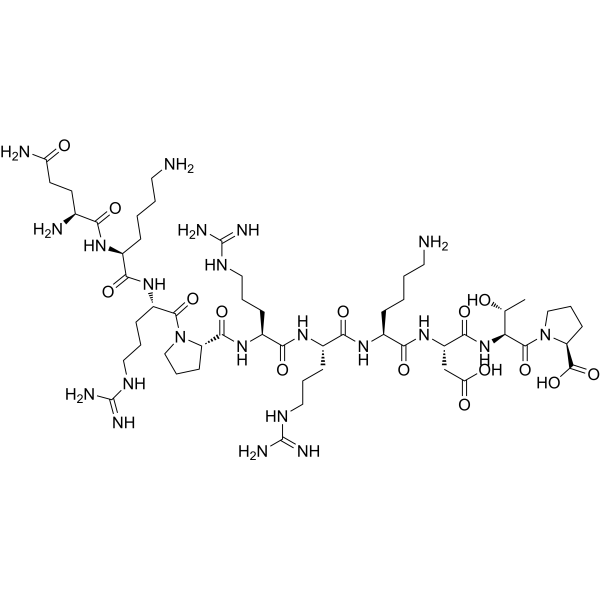
G-Subtide is a G-substrate peptide localized in Purkinje cells of the cerebellum. G-Subtide has little activity distinct from background and is a preferentially phosphorylated peptide substrate of recombinant PfPKG2 protein .
loading...
    loading...
Cat. No.: HY-164869
CAS No.: 2863607-71-8
Research Areas:  

Others

1-Hex-GlcNAlk is a metabolic chemical reporter (MCR) utilized in glycosylation research. 1-Hex-GlcNAlk exhibits robust labeling over background with negligible amounts of nonspecific chemical labeling in cell lysates .
loading...
    loading...
Cat. No.: HY-D1426
CAS No.: 217176-86-8
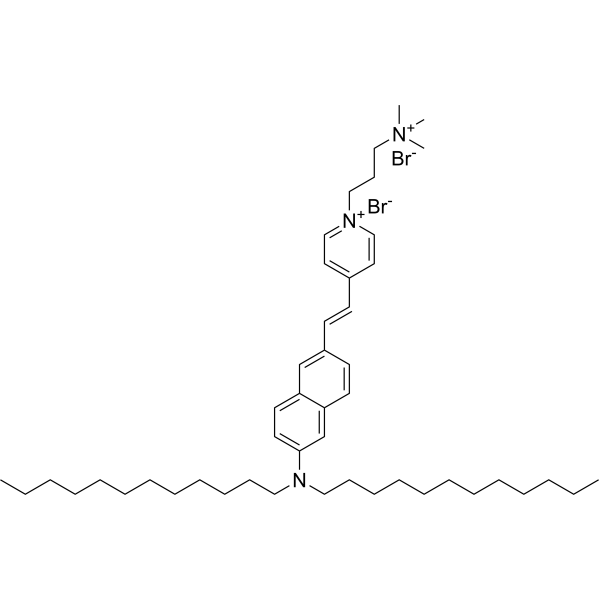
Di-12-ANEPPQ is a fast-responding membrane potential dye. Di-12-ANEPPQ, the lipophilic dye, shows cell-specific loading and Golgi-like staining patterns with minimal background fluorescence in the slices of neocortex and hippocampus .
loading...
    loading...
Cat. No.: HY-D3005
NpCy-4 is a reliable reporter for monitoring lysosomal pH and viscosity changes in real time during Autophagy (λex = 650 nm; λem = 660-740 nm). NpCy-4 demonstrates a superior signal-to-background ratio (SBR) for cellular imaging. NpCy-4 facilitates real-time, noninvasive diagnostic imaging of acute gastritis model with high contrast .
loading...
    loading...
Cat. No.: HY-156124
CAS No.: 2860554-32-9
Target:  

Sigma Receptor

Research Areas:  

Cancer

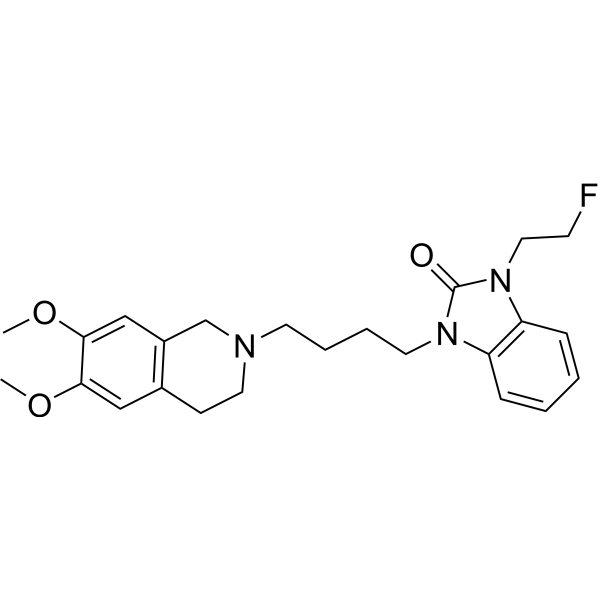
Sigma-2 Radioligand 1 (compound 1) is a Sigma-2 selective ligand. Sigma-2 Radioligand 1 has good biodistribution in mice and good in vivo activity in rats. [18F] Modified Sigma-2 Radioligand 1 for visualization of tumors in micro-PET/CT imaging, exhibiting high tumor uptake and tumor-to-background ratio. Experiments show that Sigma-2 Radioligand 1 binds highly specifically in U87MG glioma xenografts .
loading...
    loading...
Cat. No.: HY-111382R
CAS No.: 344940-63-2
Synonyms: DTZ (Standard)
Research Areas:  

Cancer

Diphenylterazine (Standard) is the analytical standard of Diphenylterazine (HY-111382). This product is intended for research and analytical applications. Diphenylterazine (DTZ) is a bioluminescence agent. Diphenylterazine alone yielded very little background, leading to excellent signal-to-background ratios .
loading...
    loading...
Cat. No.: HY-DY2047
Research Areas:  

Infection

Phosphotungstic Acid Negative Staining Solution (3%, pH 7.0) is an electron microscopy negative stain. Phosphotungstic Acid Negative Staining Solution (3%, pH 7.0) forms an electron-dense background around samples, enabling the imaging of viruses, bacterial, macromolecules and organelles .
loading...
    loading...
Cat. No.: HY-D3206
CAS No.: 1860808-05-4
CuFS is a reaction-based fluorescent sensor for detecting Cu 2+ with zero background fluorescence. CuFS acts as a fluorescence quencher in the absence of Cu 2+ and as a fluorescence enhancer in the presence of Cu 2+. CuFS can be fabricated into test strips and applied to the detection of Cu 2+ in human cancer cells .
loading...
    loading...
Cat. No.: HY-D3522
pH630 Deep Red maleimide, Thiol Reactive is a fluorescent labeling reagent combining pH responsiveness and thiol targeting capabilities. It combines pH sensitivity and thiol-specific labeling, primarily used for highly specific, low-background fluorescent labeling and imaging of thiol-containing biomolecules in acidic environments (Ex/Em = 630/650 nm).
loading...
    loading...
Cat. No.: HY-D3523
pH630 Deep Red TFP Ester, Amine reactive is a fluorescent labeling reagent combining pH responsiveness and amine-targeting capabilities. It combines pH sensitivity and amine-specific labeling, primarily used for highly specific, low-background fluorescent labeling and imaging of primary amine-containing biomolecules in acidic environments (Ex/Em = 630/650 nm).
loading...
    loading...
Cat. No.: HY-D1346A
Target:  

Fluorescent Dye

Research Areas:  

Others

610CP TFA is a new type of actin labeling dye. It dissolves in organic solvents. In DMSO the 610CP TFA excitation/emission wavelength is between 609 and 634 nm. 610CP TFA is a fluorescent dye that penetrates living cells. Upon cell entry, 610CP TFA binds to Bromo-des-methyl-Jasplakinolide Therefore, 610CP TFA dye can be used to stain actin fluorescence images with low background and high resolution.
loading...
    loading...
Cat. No.: HY-P11859
Research Areas:  

Cancer

NP1 is a NOTA-chelated linear precursor based on the ROR1-targeting peptide. After labeling with [ 18F]AlF, NP1 yields [ 18F]AlF-NP1, a PET imaging probe with excellent ROR1 specificity (KD = 141.7 nM), rapid tumor uptake and high target-to-background ratio, which is suitable for non-invasive visualization of various ROR1-overexpressing tumors .
loading...
    loading...
Cat. No.: HY-D2925
Synonyms: dTCO-SNAP
dTCOBG (dTCO-SNAP) is a SNAP-tag reactive benzylguanine (BG) analogue specifically designed for the specific labeling of immune cells. dTCOBG forms a stable thioether bond through the cysteine at the active site of SNAP-tag and O6-benzylguanine, resulting in a covalent linkage. dTCOBG demonstrates unique advantages in the labeling of macrophages derived from ER-HoxB8: it only labels SNAP-tag + macrophages, with no background signal in the control group. dTCOBG can be used for click chemistry labeling .
loading...
    loading...
Cat. No.: HY-D3174
CAS No.: 2688758-23-6
PiF is a fluorescent probe with high specificity for pancreatic β-cells (Ex/Em = 535 nm/565 nm), and its fluorescence signal increases significantly with elevated insulin concentrations in in vitro experiments. PiF enables visualization of rat and human islets transplanted via the portal vein in mouse livers with low liver background signals. The fluorine atom of PiF can be replaced by radioactive 18F to prepare a PET tracer. PiF can be used for research on type 1 diabetes .
loading...
    loading...
Cat. No.: HY-D3603
CAS No.: 928817-42-9
Research Areas:  

Others

Benzylguanine-CY5 is a quenched fluorescent dye conjugate based on benzylguanine (BG). Benzylguanine-CY5 possesses the activity of specifically covalently labeling SNAP-tag fusion proteins. Benzylguanine-CY5 exhibits intramolecular fluorescence quenching in the unbound state; upon binding to SNAP-tag, the quenching guanine moiety is cleaved, and its fluorescence intensity increases. Benzylguanine-CY5 can be used for background-free specific fluorescent labeling and imaging studies of SNAP-tag fusion proteins in living cells .
loading...
    loading...
Cat. No.: HY-110251R
CAS No.: 1539318-36-9
Research Areas:  

Others

DFHBI-1T (Standard) is the analytical standard of DFHBI-1T (HY-110251). This product is intended for research and analytical applications. DFHBI-1T is a membrane-permeable RNA aptamers-activated fluorescence probe (ex/em=472 nm/507 nm). DFHBI-1T binds to RNA aptamers (Spinach, Spinach2, iSpinach, and Broccoli) and causes specific fluorescence and lower background fluorescence. DFHBI-1T is used to image RNA in live cells .
loading...
    loading...
Cat. No.: HY-D3007
LD-CK is a fluorescent probe based on a coumarin-chromone structure, specifically designed to visualize lipid droplet polarity changes and endowed with multimodal imaging capability. LD-CK contains a high-performance lipophilic coumarin moiety, which enables it to specifically target lipid droplets upon cellular entry while minimizing background fluorescence to the greatest extent. LD-CK has an excitation wavelength (Ex) of 488 nm and an emission wavelength (Em) of 540 nm (in low-polarity environments such as toluene) or 640 nm (in high-polarity environments such as glycerol), with its emission peak undergoing a redshift as solvent polarity increases .
loading...
    loading...
Cat. No.: HY-P11737
IPM-N001 is a carbonic anhydrase IX (CAIX) ligand with a Kd value of <0.0337 nM for hCAIX. When radio-conjugated with 68Ga, IPM-N001 serves as a CAIX-targeted radionuclide tracer. [ 68Ga]Ga-IPM-N001 exhibits excellent tumor uptake and significantly improves the tumor-to-background ratio in PET/CT imaging studies using OS-RC-2 tumor-bearing mice. IPM-N001 can be used for the research of clear cell renal cell carcinoma .
loading...
    loading...

