745 Results for "

Mutations

" in MedChemExpress (MCE) Product Catalog:
Products (745)

745 Results for "Mutations" in MCE Product Catalog:

製品番号: HY-167690
CAS 番号: 1034474-19-5
Target:  

Endogenous Metabolite

研究分野:  

Infection

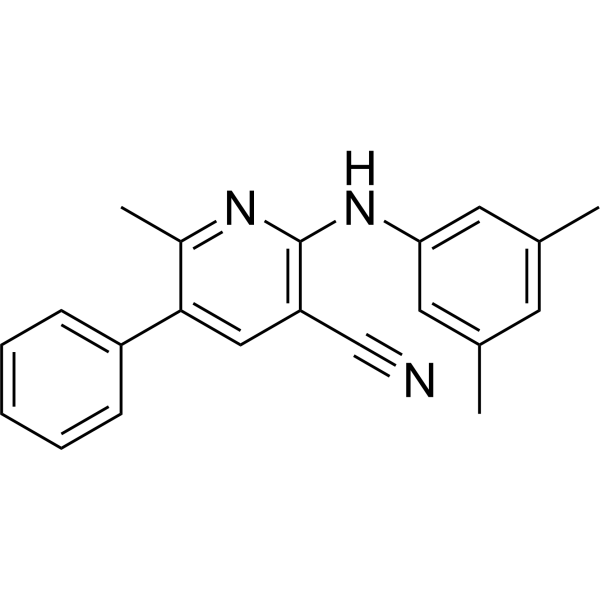
MK-6186 is a novel non-nucleoside reverse transcriptase inhibitor with sub-nanomolar activity against wild-type viruses and the two most common NNRTI-resistant RT mutants (K103N and Y181C). MK-6186 exhibits excellent antiviral activity against K103N and Y181C mutant viruses. When MK-6186 targets 12 common NNRTI-associated mutant viruses, only two relatively rare mutants (Y188L and V106I/Y188L) show high resistance, with FC values exceeding 100, while the FC values of the remaining viruses are all below 10. In addition, when MK-6186 faces 96 clinical virus isolates carrying NNRTI-resistant mutations, most (70%) viruses show more than 10-fold resistance to efavirenz (EFV), while only 29% of mutant viruses show more than 10-fold resistance to MK-6186 .
loading...
    loading...
製品番号: HY-L915
422 compounds

Lysine is the second most common target residue used in the design of TCIs and related covalent ligands. Its appeal lies in its abundance in human proteins, which is approximately three times higher than that of cysteine (5.8% vs. 1.9%). This significantly increases the number of proteins suitable for covalent targeting, especially given that many human proteins lack ligandable cysteine residues. Moreover, it has been suggested that functional lysines have a lower probability of being replaced by mutation, as they often play a crucial role in catalysis by acting as bases or nucleophiles. Additionally, lysines are essential for maintaining the structural integrity of proteins and for regulating post-translational modifications (PTMs). Consequently, targeting lysine has garnered significant interest in recent years.

Through careful selection, we constructed a structural filter containing over 110 electrophilic groups. By analyzing the electrophilic fragments selected by the structural filter, we removed any molecules with trivial or undesirable structural features. Ultimately, we obtained 445 fragment molecules which can target lysine residue and can be used for fragment-based covalent drug discovery.

製品番号: HY-L101
3,003 compounds

Liver cancer is one of the leading malignancies which occupies the second position in cancer deaths worldwide, becoming serious threat to human health. Hepatocellular carcinoma (HCC), also known as hepatoma is the most common type accounting for approximately 90% of all liver cancers.

Current evidence indicates that during hepatocarcinogenesis, two main pathogenic mechanisms prevail: (1) cirrhosis associated with hepatic regeneration after tissue damage caused by hepatitis infection, toxins or metabolic influences, and (2) mutations occurring in single or multiple oncogenes or tumor suppressor genes. Both mechanisms have been linked with alterations in several important cellular signaling pathways. These include the RAF/MEK/ERK pathway, PI3K/AKT/mTOR pathway, WNT/b-catenin pathway, insulin-like growth factor pathway, c-MET/HGFR pathway , etc.

MCE offers a unique collection of 3,003 compounds with identified and potential anti-liver cancer activity. MCE anti-liver cancer compound library is a useful tool for anti-liver cancer drugs screening and other related research.

製品番号: HY-L260
82 compounds

KRAS (Kirsten Rat Sarcoma Viral Oncogene Homolog) is one of the most important oncogenic driver genes in oncology, with high mutation frequencies in pancreatic cancer, non‑small cell lung cancer, and colorectal cancer. For a long time, KRAS was considered "undruggable" due to the lack of suitable small‑molecule binding pockets on its protein surface. In recent years, with the discovery of the switch‑II pocket and the successful approval of KRAS G12C inhibitors, KRAS‑targeted research has achieved groundbreaking progress, which has also spurred a wave of development targeting non‑G12C mutants such as G12D and G12V, as well as upstream and downstream regulatory factors including SOS1 and SHP2.

MCE KRAS Targeted Compound Library contains 82 small‑molecule compounds targeting the KRAS, serving as high‑quality research tools for mechanistic studies of KRAS‑mutant tumors, combination therapy development, resistance mechanism exploration, and high‑throughput drug screening, thereby providing robust support for KRAS‑targeted drug discovery.

製品番号: HY-153873
CAS 番号: 1629160-83-3
純度:  99.52%
研究分野:  

Cancer

MSU38225 is a selective Nrf2 inhibitor. MSU38225 increases ROS levels by inhibiting antioxidant production. MSU38225 arrests cells at the G2/M phase, enhances cellular sensitivity to chemotherapeutic agents, and exerts synergistic effects with Carboplatin (HY-17393) and 5-fluorouracil (HY-90006). MSU38225 exhibits anticancer activity against lung cancer. MSU38225 can be used in research related to non-small cell lung cancer .
loading...
    loading...
製品番号: HY-112817A
別名: 8-Oxo-Deoxyguanosine triphosphate trisodium
Target:  

Apoptosis

研究分野:  

Others

8-Oxo-dGTP (8-Oxo-Deoxyguanosine triphosphate) trisodium solution (100mM) is an oxidized guanine nucleotide formed by ROS-mediated oxidative modification of dGTP, and it also serves as a key substrate for 8-oxo-dGTP pyrophosphohydrolases (such as hMTH1 and E. coli MutT). 8-Oxo-dGTP trisodium solution (100mM) acts as a DNA mutagen, inserts into nascent DNA and pairs with adenine and cytosine, inducing A:T to C:G transversion mutations. Furthermore, 8-Oxo-dGTP trisodium solution (100mM) causes oxidative DNA base modification, strand breakage and S-phase arrest, and ultimately triggers AIF-mediated apoptosis and promotes spontaneous carcinogenesis in mth1-deficient mice. Accumulation of 8-Oxo-dGTP trisodium solution (100mM) in cells induces genomic instability, but it exhibits a tumor-suppressive effect that reduces tumor incidence in mouse models instead. 8-Oxo-dGTP trisodium solution (100mM) is widely used in studies related to spontaneous carcinogenesis, Parkinson's disease, Alzheimer's disease, heart failure and tumor mechanisms .
loading...
    loading...
製品番号: HY-179560
研究分野:  

Cancer

PMV6-PEG4-BI2536 is an RIPTAC-like bifunctional molecule that promotes the formation of the p53 Y220C-PLK1 ternary complex (EC50 = 1.4 μM). PMV6-PEG4-BI2536 causes PLK1 mislocalization and inhibits PLK1 activity, inducing G2/M phase arrest and apoptosis in p53 Y220C-mutant cells, while sparing cells with wild-type TP53. PMV6-PEG4-BI2536 can be used in research on uterine, gastric, pancreatic, prostate, and breast cancers harboring the p53 Y220C mutation. PMV6-PEG4-BI2536 is composed of PMV6 (a p53 Y220C mutant-binding ligand), PEG4 (a linker), and BI2536 (HY-159493) (a PLK inhibitor) .
loading...
    loading...
製品番号: HY-P990290
Anti-Mouse CD16/CD32 (LALA-PG) Antibody (2.4G2) is a mouse-derived IgG2a κ type antibody inhibitor, targeting to mouse CD16/CD32. Anti-Mouse CD16/CD32 (LALA-PG) Antibody (2.4G2) is a chimeric antibody of the original 2.4G2 antibody (HY-P99125). Anti-Mouse CD16/CD32 (LALA-PG) Antibody (2.4G2) contains the LALA-PG mutation region. Anti-Mouse CD16/CD32 (LALA-PG) Antibody (2.4G2) can block the combination of CD16 and FcγRs. Anti-Mouse CD16/CD32 (LALA-PG) Antibody (2.4G2) can be used for the researches of immunology and cardiovascular disease.
loading...
    loading...
製品番号: HY-L083
3,806 compounds

Mutations in oncogenes and tumor suppressor genes can modify multiple signaling pathways and in turn cell metabolism, which facilitates tumorigenesis. The paramount hallmark of tumor metabolism is “aerobic glycolysis” or the Warburg effect, coined by Otto Warburg in 1926, in which cancer cells produce most of energy from glycolysis pathway regardless of whether in aerobic or anaerobic condition. Usually, cancer cells are highly glycolytic (glucose addiction) and take up more glucose than do normal cells from outside. The increased uptake of glucose is facilitated by the overexpression of several isoforms of membrane glucose transporters (GLUTs). Likewise, the metabolic pathways of glutamine, amino acid and fat metabolism are also altered. Recent trends in anti-cancer drug discovery suggests that targeting the altered metabolic pathways of cancer cells result in energy crisis inside the cancer cells and can selectively inhibit cancer cell proliferation by delaying or suppressing tumor growth.

MCE provides a unique collection of 3,806 compounds which cover various tumor metabolism-related signaling pathways. These compounds can be used for anti-cancer metabolism targets identification, validation as well anti-cancer drug discovery.

製品番号: HY-171884
CAS 番号: 2769714-36-3
Target:  

EGFR

研究分野:  

Cancer

BI-8128 is a potent EGFR inhibitor, with IC50 values of 12, 6.7, 22, 10, and 3 nM against wild-type, T790M, C797S, T790M/C797S, and L858R/T790M/C797S mutant EGFR, respectively. BI-8128 significantly inhibits the proliferation of Ba/F3 and PC-9 drug-resistant mutant cells. BI-8128 is applicable for the research of non-small cell lung cancer .
loading...
    loading...
製品番号: HY-187334
CAS 番号: 1923767-20-7
Target:  

EGFR Bcr-Abl Apoptosis

研究分野:  

Cancer

EGFR-IN-216 is an epidermal growth factor receptor (EGFR) tyrosine kinase (TK) inhibitor. EGFR-IN-216 inhibits EGFR tyrosine kinase phosphorylation, blocks downstream signaling pathway activation, suppresses cancer cell proliferation and promotes tumor cell apoptosis (apoptosis). EGFR-IN-216 can be used for the research of non-small cell lung cancer .
loading...
    loading...
製品番号: HY-184318
CAS 番号: 915407-80-6
Target:  

HIV Integrase HIV

研究分野:  

Infection

GS-9160 is a HIV-1 integrase strand transfer inhibitor with an IC50 of 28 nM. GS-9160 elevates the level of HIV-1 double long terminal repeat circles and reduces integration junctions. GS-9160 exhibits selective antiviral activity against HIV-1 in cells. GS-9160 can select for integrase mutants E92V and L74M, and shows synergistic activity with other HIV-1 inhibitors. GS-9160 can be used in studies related to HIV-1 infection .
loading...
    loading...
製品番号: HY-182316
CAS 番号: 449806-40-0
Target:  

HIV Protease HIV

研究分野:  

Infection

P-1946 is a HIV protease inhibitor with a human HIV-1 protease Ki of 2.600 nM. P-1946 has potent and selective in vitro antiviral activity and retains full antiviral activity against HIV isolates resistant to commercially available protease inhibitors. P-1946 can be used for the research of human immunodeficiency virus type 1 (HIV-1) infection .
loading...
    loading...
製品番号: HY-170524
CAS 番号: 3052313-73-9
TDI-015051 is a highly selective, orally active antiviral agent that targets the coronavirus NSP14 guanine-N7 methyltransferase. TDI-015051 binds to substrates in a non-competitive manner and forms a stable ternary complex, precisely blocking the capping and methylation processes of viral mRNA. TDI-015051 potently inhibits a variety of coronaviruses (including SARS-CoV-2 and MERS). By impairing viral replication and translation and inducing a moderate type I interferon-mediated immune response, it significantly reduces pulmonary viral load and exhibits a synergistic effect with Nirmatrelvir (HY-138687). In addition, TDI-015051 does not inhibit non-coronavirus methyltransferases, and the drug-resistant mutations it induces impair viral fitness, demonstrating excellent antiviral properties and safety. TDI-015051 can be used for research on COVID-19 and the replication mechanism of coronaviruses .The IC50 values of TDI-015051 against SARS-CoV-2, α-hCoV-NL63, α-hCoV-229E, β-hCoV-MERS are 0.15 nM, 1.7 nM, 2.6 nM and 3.6 nM, respectively, and the Ka value against SARS-CoV-2 is 0.061 nM .
loading...
    loading...
製品番号: HY-P990269

Target:  

TNF Receptor

研究分野:  

Inflammation/Immunology Cancer

Anti-Mouse CD40L/CD154 (LALA-PG) Antibody (MR-1) is a mouse-derived IgG2a κ type antibody inhibitor, targeting to mouse CD40L/CD154. Anti-Mouse CD40L/CD154 (LALA-PG) Antibody (MR-1) is a chimeric version of the original MR-1 antibody (HY-P990134). The variable domain sequences are identical to the original MR-1 but the constant region sequences have been switched from Armenian hamster IgG to mouse IgG2a. Anti-Mouse CD40L/CD154 (LALA-PG) Antibody (MR-1) contains a LALA-PG mutation in the Fc fragment rendering it unable to bind to endogenous Fcγ receptors. Anti-Mouse CD40L/CD154 (LALA-PG) Antibody (MR-1) blocks CD40/CD40L signaling. Anti-Mouse CD40L/CD154 (LALA-PG) Antibody (MR-1) can be used for researches of cancer, inflammation and immunology.
loading...
    loading...
製品番号: HY-P990270

Target:  

TNF Receptor

研究分野:  

Inflammation/Immunology Cancer

Anti-Mouse CD40L/CD154 (D265A) Antibody (MR-1) is a mouse-derived IgG1 κ type antibody inhibitor, targeting to mouse CD40L/CD154. Anti-Mouse CD40L/CD154 (D265A) Antibody (MR-1) is a chimeric version of the original MR-1 antibody (HY-P990134). The variable domain sequences are identical to the original MR-1 but the constant region sequences have been switched from Armenian hamster IgG to mouse IgG1. Anti-Mouse CD40L/CD154 (D265A) Antibody (MR-1) contains a D265A mutation in the Fc fragment rendering it unable to bind to endogenous Fcγ receptors. Anti-Mouse CD40L/CD154 (D265A) Antibody (MR-1) blocks CD40/CD40L signaling. Anti-Mouse CD40L/CD154 (D265A) Antibody (MR-1) can be used for researches of cancer, inflammation and immunology.
loading...
    loading...
製品番号: HY-P990304B

Target:  

TNF Receptor

Anti-Mouse 4-1BBL/CD137L (D265A) Antibody (TKS-1) is a mouse-derived IgG1 κ antibody inhibitor that targets mouse 4-1BBL/CD137L. Anti-Mouse 4-1BBL/CD137L (D265A) Antibody (TKS-1) is a chimeric version of the original TKS-1 antibody (HY-P990304). The variable domain sequences are identical to the original TKS-1 but the constant region sequences have been switched from rat IgG2a to mouse IgG1. Anti-Mouse 4-1BBL/CD137L (D265A) Antibody (TKS-1) contains a D265A mutation in the Fc fragment rendering it unable to bind to endogenous Fcγ receptors. Anti-Mouse 4-1BBL/CD137L (D265A) Antibody (TKS-1) reacts with mouse 4-1BB ligand (4-1BBL). Anti-Mouse 4-1BBL/CD137L (D265A) Antibody (TKS-1) can be used for the researches of cancer, infection, inflammation and immunology.
loading...
    loading...
製品番号: HY-P990304C
Anti-Mouse 4-1BBL/CD137L (LALA-PG) Antibody (TKS-1) is a mouse-derived IgG2a κ antibody inhibitor that targets mouse 4-1BBL/CD137L.Anti-Mouse 4-1BBL/CD137L (LALA-PG) Antibody (TKS-1) is a chimeric version of the original TKS-1 antibody (HY-P990304). The variable domain sequences are identical to the original TKS-1 but the constant region sequences have been switched from rat IgG2a to mouse IgG2a. Anti-Mouse 4-1BBL/CD137L (LALA-PG) Antibody (TKS-1) contains a LALA-PG mutation in the Fc fragment rendering it unable to bind to endogenous Fcγ receptors. Anti-Mouse 4-1BBL/CD137L (LALA-PG) Antibody (TKS-1) reacts with mouse 4-1BB ligand (4-1BBL). Anti-Mouse 4-1BBL/CD137L (LALA-PG) Antibody (TKS-1) can be used for the researches of cancer, infection, inflammation and immunology.
loading...
    loading...
製品番号: HY-L075
3,061 compounds

Lung cancer is a major global health problem, as it is the leading cause of cancer-related deaths worldwide. Lung cancer is divided into two categories: small cell lung cancer and non-small cell lung cancer (NSCLC). Non-small cell lung cancer accounts for about 85 percent of lung cancers.

As with all cancers, lung cancer may be treated with surgery, chemotherapy, radiation therapy, targeted therapy, immunotherapy or a combination thereof. Targeted therapy is one of the most exciting developments in lung cancer medicine, especially for NSCLC. Extensive genomic characterization of NSCLC has led to the identification of molecular subtypes of NSCLC that are oncogene addicted and exquisitely sensitive to targeted therapies. These include activating mutations in epidermal growth factor receptor (EGFR) and BRAF or echinoderm microtubule-associated protein-like 4 (EML4)-anaplastic lymphoma kinase (ALK) fusions and ROS1 receptor tyrosine kinase fusions. These are important targets for target therapy.

MCE offers a unique collection of 3,061 compounds with identified and potential anti-lung cancer activity. These compounds target lung cancer’s major targets and signaling pathways. MCE anti-lung cancer compound library is a useful tool for anti-lung cancer drugs screening and other related research.

製品番号: HY-L013
3,961 compounds

Neuronal Signaling is involved in the regulation of the mechanisms of the central nervous system (CNS) such as its structure, function, genetics and physiology as well as how this can be applied to understand diseases of the nervous system. Every information processing system in the CNS is composed of neurons and glia, neurons have evolved unique capabilities for intracellular signaling (communication within the cell) and intercellular signaling (communication between cells). G protein-coupled receptors (GPCRs), including 5-HT receptor, histamine receptor, opioid receptor, etc. are the largest class of sensory proteins and are important therapeutic targets in Neuronal Signaling. Besides, Notch signaling, such as β- and γ-secretase, also plays multiple roles in the development of the CNS including regulating neural stem cell (NSC) proliferation, survival, self-renewal and differentiation. GPCR dysfunction caused by receptor mutations and environmental challenges contributes to many neurological diseases. Notch signaling in neurons, glia, and NSCs is also involved in pathological changes that occur in disorders such as stroke, Alzheimer's disease and CNS tumors. Thus, targeting Neuronal Signaling, such as notch signaling and GPCRs, can be used as therapeutic interventions for several different CNS disorders.

MCE designs a unique collection of 3,961 Neuronal Signaling-related compounds that act as a useful tool for the research of neuronal regulation and neuronal diseases.

